Showing posts with label Volcanic Eruption. Show all posts

Saturday, April 11, 2015

Summer into Winter

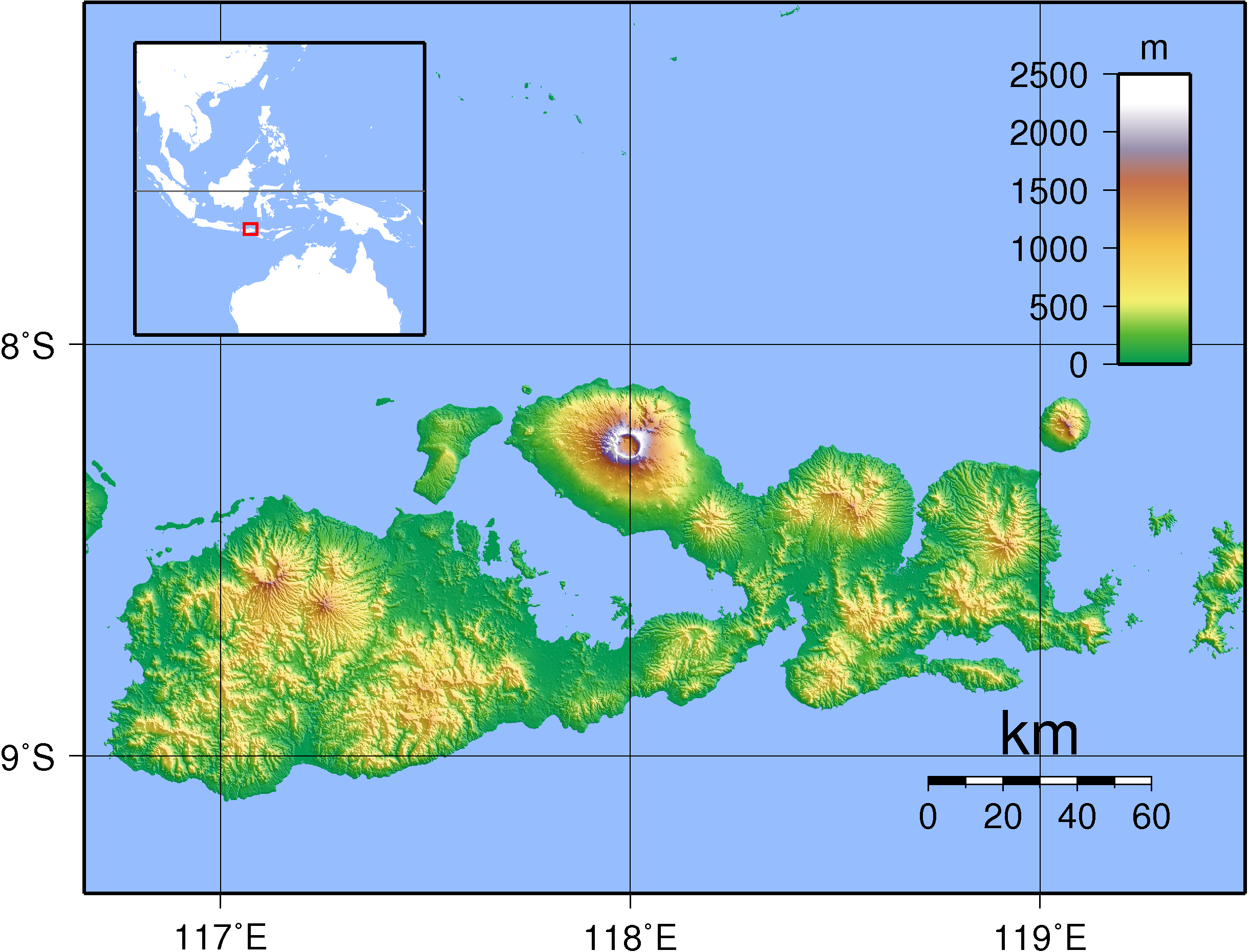
Mount Tambora
Two hundred years ago Mount Tambora erupted. The event occurred over a two-day period, April 10-11, in 1815.
It is considered the world's largest ash eruption since the last ice age.
Sulfate aerosols generated from the volcanic gases blocked sunlight turning the approaching summer into winter over much of the Northern Hemisphere.

The Tambora caldera is about 6 km or 3.7 miles wide by 7 km or 4.3 miles long and more than a kilometer or .6 miles in depth.
"Because Tambora ejected sulfurous gas that generated sulfate aerosols in the atmosphere, which block sunlight, the eruption created a ‘year without a summer,’ leading to food shortages — people were eating cats and rats — and very general hardship throughout Europe and eastern North America"
— Stephen Self
That summer, mean temperatures dropped by 0.7–1.3 °F (0.4–0.7 °C) around the world causing food shortages across the Northern Hemisphere.

Intense atmospheric haze led to unusually spectacular sunsets like those painted by the Romanticist landscape painter J. M. W. Turner (1775-1851).

J. M. W. Turner Sunsets


REFERENCES

Saturday, January 24, 2015

Volcano of Fire

Volcán de Colima is a stratovolcano known as the Volcano of Fire. The Colima volcano has erupted several times this month.

Web cam animation of Volcán de Colima eruption
21 January 2015, 9:13AM

Volcán de Colima is in the Trans-Mexican Volcanic Belt which is a series of volcanic mountains that rise from the high plateaus of central-southern Mexico.
Our earth is very old, an old warrior that has lived through many battles. Nevertheless, the face of it is still changing, and science sees no certain limit of time for its stately evolution. Our solid earth, apparently so stable, inert, and finished, is changing, mobile, and still evolving.
— Reginald Aldworth Daly, Our Mobile Earth (1926), 320.

Crater atop Volcán de Colima
Source: Google Maps

Stratovolcanoes like Volcán de Colima are steep conical mountains characterized by periodic explosive eruptions. Stratovolcanoes have conduits that link them to magma reservoirs deep in the Earth's crust.

Strata is from the Latin stratum meaning laid down. Strato-volcanoes are built from alternating layers of hardened lava, tephra, pumice, and ash.

I am here tracing the History of the Earth itself, from its own Monuments.
— Jean André Deluc, Geological Letters Addressed to Professor Blumenbach, 1794


REFERENCES

Saturday, January 17, 2015

Island Creation in Tonga

Tonga
Tonga is an island nation of some 176 islands distributed over 270,000 square miles in the southern Pacific Ocean.

A volcano that started spewing rocks and ash last December is creating a new island.

Tonga's official island tally might soon be incremented by one.

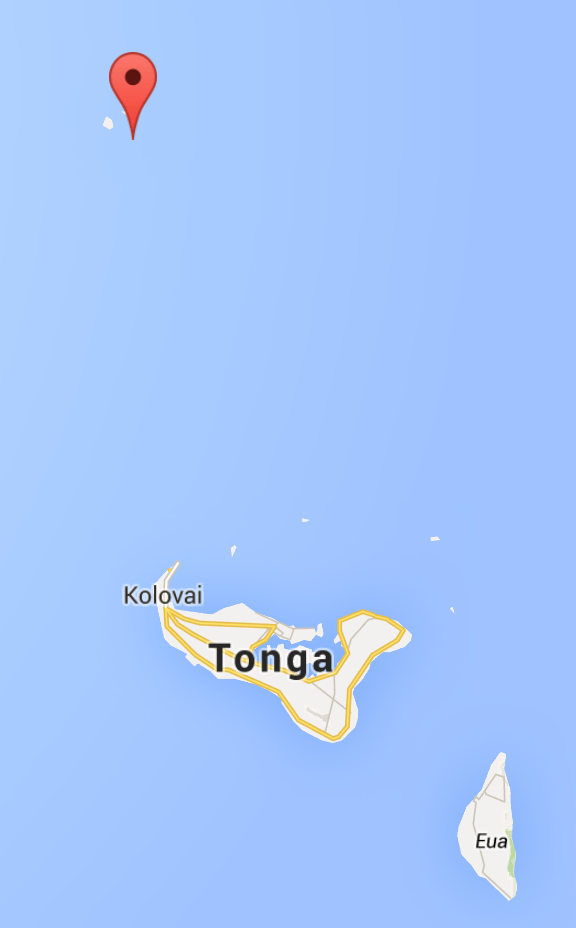
HungaHa'apai
Geologists from the Tongan Ministry of Lands traveled by boat to study the volcano. They confirmed that a huge amount of volcanic material continues to transform the landscape.

Tongan geologists indicated the volcano is erupting from two vents. One vent is located on the uninhabited Hunga Ha'apai (red marker, right). The other is about 100 yards offshore from Hunga Ha'apai.
"The new island is more than one kilometer wide, two kilometers long and about 100 meters high"
— Ministry of Lands
Prior to the month-long eruption, the surface area of the Tongan islands was about 290 square miles. The surface area continues to expand.
"During our observations the volcano was erupting about every five minutes to a height of about 400 meters, accompanied by some large rocks... as the ash is very wet, most is being deposited close to the vent, building up the new island."
— Ministry of Lands
Rock and ash exploding from the Hunga Ha'apai volcano.
photo: AFP/MFAT

The Tongan islands lie on a global hotspot called the Ring of Fire. 75% of the world's active and dormant volcanoes lie on the Ring of Fire where continental plates collide causing seismic rumbles and volcanic eruptions. It's here that the Pacific Plate slides under the Indo-Australian Plate.
"The real difficulty about vulcanism is not to see how it can start, but how it can stop."
— Sir Harold Jeffreys, 1891–1989

REFERENCES

Saturday, May 26, 2012

Valley of Ten Thousand Smokes

No one alive remembers an eruption as massive as the Novarupta-Katmai Eruption of 1912. The Novarupta-Katmai eruption was the largest volcanic eruption of the Twentieth Century. This massive volcanic event occurred in Alaska in an area that was later named Valley of Ten Thousand Smokes. 
No one living today can recall a volcanic eruption of such magnitude, or of such potential disruption to human safety and systems, and yet we know that many volcanic complexes in the United States and around the globe are capable of someday erupting similar or larger volumes of molten rock and ash.
~Marcia McNutt, USGS Director
The site has been preserved since 1980 by the Katmai National Park and Preserve.

Katmai Calder - Mount Katmai, Alaska
In June of 1912, glowing hot pumice and ash spewed from the Novarupta-Katmai volcano. It flowed over terrain destroying life in its path. The ash, pumice, and gas ejected cast a haze-darkened sky over most of the Northern Hemisphere.

The Novarupta-Katmai eruption:
  • Was ten times more forceful than the 1980 eruption of Mount St. Helens. 
  • Buried more than 40 square miles in volcanic deposits as much as 700 feet deep. 
  • Spewed 7 cubic miles of ash as far as the Mediterranean Sea. 
  • Caused an acid rain that disintegrated clothes on clotheslines as far away as Vancouver, Canada.
  • Reduced visibility 100 miles away in Kodiak, Alaska where for two days a person could not see a lantern held at arm's length. 


The volume of ash ejected by Novarupta-Katmai, if concentrated in one place, would be enough to bury the city of Anchorage 3 miles deep.

Volcanology is the study of volcanoes, lava, magma, and related phenomena. The term volcanology comes from the Latin word vulcanus. 
In ancient Roman religion and myth, Vulcan is the god of beneficial and hindering fire, including the fire of volcanoes. 
At the time of the Novarupta-Katmai eruption in 1912, the study of volcanic eruptions was in its infancy. Researchers had few points of comparison. Field investigations of the Katmai site provided key insights that contributed to advances in volcanology. Novarupta-Katmai has been one of the most studied eruptions in the world.

I have seen so many eruptions in the last 20 years that I don't care if I die tomorrow.
~Maurice Krafft, Volcanologist, on the day before he was killed on Unzen Volcano, Japan 1991.


Resources

Alaska Volcano Observatory - Katmai Reported Activity.
Alaska Volcano Observatory - The Great Katmai Eruption of 1912: A Century of Research Tracks Progress in Volcano Science.
USGS - The Novarupta-Katmai Eruption of 1912—Largest Eruption of the Twentieth Century: Centennial Perspectives.
Wikipedia - Valley of Ten Thousand Smokes.
Wikipedia - Vulcan (mythology).
Wikipedia - Volcanology.

Popular