Showing posts with label Albert Einstein. Show all posts

Saturday, July 30, 2016

Grand Harmonies

Mathematician Henri Poincaré believed we study science and natural phenomena because we take pleasure in it. We take pleasure in natural phenomena because they're beautiful. On the motivation behind scientific inquiry Poincaré wrote:

"If nature were not beautiful it would not be worth knowing, and life would not be worth living."
― Henri Poincaré

Lavender and Green
Arthur Wesley Dow
1912

Poincaré delineated between the beauty of appearances and the beauty of intellectual abstractions like the mathematics undergirding science.
I am not speaking, of course, of the beauty which strikes the senses, of the beauty of qualities and appearances. I am far from despising this, but it has nothing to do with science. What I mean is that more intimate beauty which comes from the harmonious order of its parts, and which a pure intelligence can grasp.
― Henri Poincaré
Drawing these distinctions was Poincaré's preference. At some level, these distinctions becomes immaterial. Perception is subjective whether born from sensual input from natural phenomena or from the symbolic abstractions crafted to model the behavior of some natural phenomena. Sublimity is sublimity. Beauty is beauty.

Geologist and early expedition leader in the American west John Wesley Powell wrote of the harmony of form, color, and sound he experienced after he explored the Grand Canyon:
The glories and the beauties of form, color, and sound unite in the Grand Canyon - forms unrivaled even by the mountains, colors that vie with sunsets, and sounds that span the diapason from tempest to tinkling raindrop, from cataract to bubbling fountain.
— John Wesley Powell
The Destroyer
Arthur Wesley Dow
circa 1911-13
American artist Arthur Wesley Dow argued against the shallow pursuit of painting imitative likenesses of nature. Rather he advocated for composition: the harmonious use of line, color, and shading.
Composition, building up of harmony, is the fundamental process in all the fine arts. I hold that art should be approached through composition rather than through imitative drawing.
— Arthur Wesley Dow
The Destroyer, a curvilinear composition of the Grand Canyon is an exquisite example of Dow's use of line, color, and shading.

Dow's painting evokes a sensual experience of the Grand Canyon that arguably would've been absent in a representational painting.

Dow was influenced by Japanese art. He was taken by the compositional freedom that encouraged off-center subject matter. He was inspired by the use of flat areas of strong color, simplified shapes, and patterns of darks and lights — elements that also influenced the arts and crafts movement.

August Moon
Arthur Wesley Dow
circa 1905

Simplicity is revealed by complexity. Harmony emerges from discord. Both await our discovery.
Three Rules of Work:
Out of clutter find simplicity.
From discord find harmony.
In the middle of difficulty lies opportunity.
― Albert Einstein


REFERENCES

Saturday, February 13, 2016

Gravitational Waves

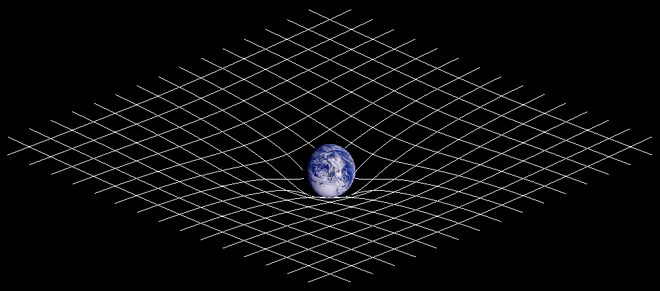
Idealized spacetime curvature
caused by Earth's mass
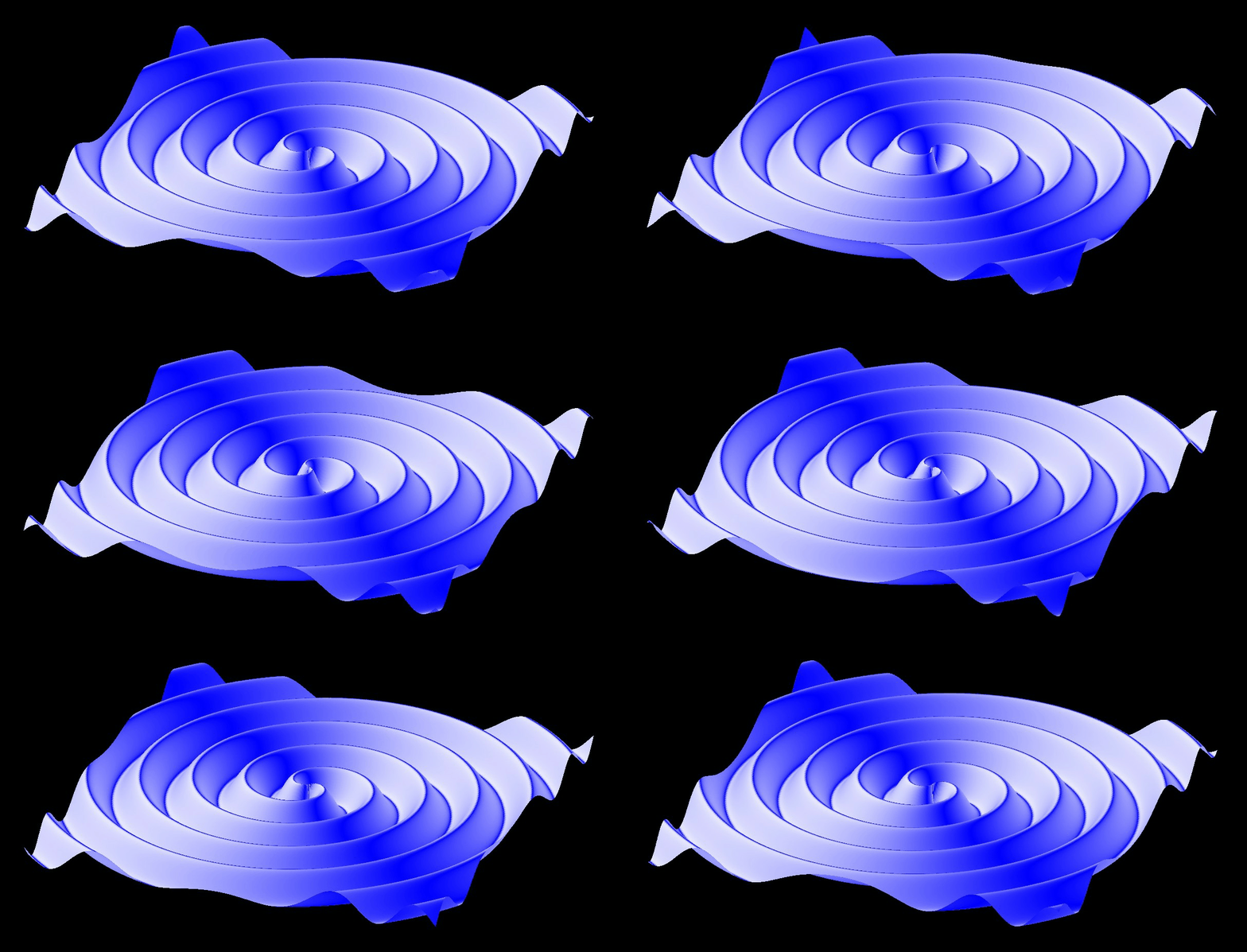
Gravitational waves are wave-like ripples in the curvature of spacetime.

One precept of Einstein's General Relativity is that spacetime is perturbed by the presence of matter.
Generally, the more mass that is contained within a given volume of space, the greater the curvature of spacetime will be at the boundary of this volume.
― Gravitational Waves, Wikipedia
More than a century following Einstein's proposition of gravitational waves, physicists at the Laser Interferometer Gravitational-Wave Observatory (LIGO) have detected the presences of gravitational waves. These waves are believed to be emanating from the collision of two massive black holes that merged some 1.3 billion years ago.
The Universe has spoken and we have understood.
― David Blair, LIGO collaboration member

Idealized depiction of gravitational waves
by Frank Glowna - Own work, CC BY-SA 3.0

LIGO's discovery appears to be empirical confirmation of the gravitational waves predicted by Einstein's 1918 paper Über Gravitationswellen where he calculated the effect of gravitational waves.

The LIGO system consists of identical detectors in Livingston, Louisiana and Hanford, Washington, that discern tiny vibrations from passing gravitational waves.
It will give us ears to the Universe where before we’ve only had eyes.
― Karsten Danzmann, LIGO collaboration member
Ironically Einstein considered gravitational waves a theoretical construct, perhaps too small to be detected.
Imagination is more important than knowledge. For knowledge is limited to all we now know and understand, while imagination embraces the entire world, and all there ever will be to know and understand.
― Albert Einstein

REFERENCES

Saturday, March 14, 2015

A Function of the Universe

Einstein noted the deceptive chicanery of human consciousness that makes us experience a separateness from the flow of the universe.
"A human being is a part of the whole called by us universe, a part limited in time and space. He experiences himself, his thoughts and feeling as something separated from the rest, a kind of optical delusion of his consciousness. "
— Albert Einstein
Einstein felt we must disabuse ourselves of this notion.
"Our task must be to free ourselves from this prison by widening our circle of compassion to embrace all living creatures and the whole of nature in its beauty."
— Albert Einstein

All indications are that humans are dynamic systems within a dynamic system. We are dynamic systems composed of an infinitesimally smaller series of dynamic systems within an infinitely larger series of dynamic systems.
image: Σ64

We find ourselves an integral part of the sum of all ecosystems existing for a limited time on a planetary life raft that surrounds our home planet.

Buckminster Fuller noted that we reside as passengers on a planetary spaceship. Our spaceship is composed of finite life-supporting resources. Our rotating spaceship is speeding around a traveling sun.
Earth is an automated Spaceship speeding rotatively at 66,000 miles per hour around the sun, which in turn, is on its own course at 6.0 kilometers per second within the Galactic Nebula.
― Buckminster Fuller
Fuller considered humans neither fixed, nor stationary. Rather he considered humans a process, rather than a thing.
I live on Earth at present, and I don't know what I am. I know that I am not a category. I am not a thing — a noun. I seem to be a verb, an evolutionary process — an integral function of the universe.
― Buckminster Fuller

REFERENCES

Saturday, October 18, 2014

Deep Time

Einstein mused about the illusive nature of distinguishing past, present, and future.
"People like us, who believe in physics, know that the distinction between past, present, and future is only a stubbornly persistent illusion."
― Albert Einstein
An eon in common parlance, is a very long period of time:
e·on/ˈēən,ˈēˌän/noun.an indefinite and very long period of time, often a period exaggerated for humorous or rhetorical effect.
usage: She reached the hilltop cairn eons before my arrival.
An eon acquires the specificity a billion years for geologists and astronomers. Radiometric dating indicates Earth is 4,540,000,000 years old. This translates to about four and one half eons.
“Four days will quickly steep themselves in nights;
Four nights will quickly dream away the time.”

― William Shakespeare, A Midsummer Night's Dream

Deep Time

Þingvellir
by Hansueli Krapf
Earth is roughly 57 million times older than the longest average human life expectancy. Perhaps the 56,750,000-fold difference explains why geologic time is baffling.

Geologic time is also referred to as deep time.

Comparing deep time to human time in Basin and Range, John McPhee borrows a metaphor cited from Stephen Jay Gould's Time's Arrow, Time's Cycle:

Consider the Earth's history as the old measure of the English yard, the distance from the King's nose to the tip of his outstretched hand. One stroke of a nail file on his middle finger erases human history.

Some geologic phenomena occur in real-time like the calving of a glacier, the flow of lava from a volcano, or the formation of a tropical cyclone.

Most geologic phenomena occur on a geologic time scale like continental drift — for example the pulling apart of the North American and Eurasian Plates at Þingvellir in southwestern Iceland.

Geologists have trained themselves to imagine events unfolding in units of time no smaller than a million years. The intersection of human time and geologic time excites our curiosity.
“If you free yourself from the conventional reaction to a quantity like a million years, you free yourself a bit from the boundaries of human time. And then in a way you do not live at all, but in another way you live forever.”
— John McPhee, Annals of the Former World

Image: Tobias Alt

"The mind seemed to grow giddy by looking so far into the abyss of time."
― John Playfair, remarking on the strata of the unconformity at Siccar Point

If one lives to be 100 years old, Earth will still be some 45 million years older.

REFERENCES

Saturday, September 7, 2013

Submarine Volcano Identified

Last Thursday the discovery that a submarine peak known as Tamu Massif is a single volcano was reported by geophysicists in the journal Nature Geoscience.

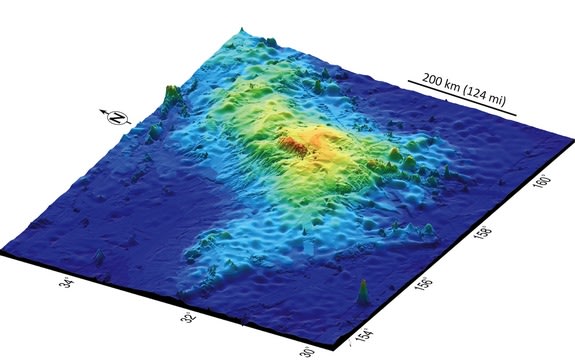
Tamu Massif is a Shield volcano about 900 miles off the coast of Japan. Shield volcanoes have a low vertical profile resembling that of a warrior's shield because of how they are formed.

Mauna Kea
13,803 ft above sea level
The genesis of a shield volcano involves fluid lava flows of low viscosity magma that travel farther horizontally than vertically explosive volcanoes.

Mauna Kea on the Big Island of Hawaii is an example of a shield volcano expressed above sea level.

Tamu Massif erupted for a few million years during the early Cretaceous period. It has been inactive since then.

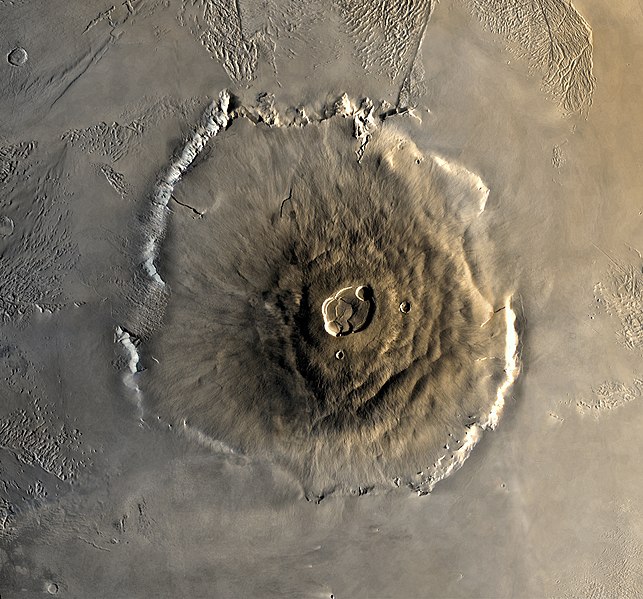
Tamu Massif is is 400 miles wide and 2.5 miles high and considered by some geoscientists to be the largest known volcano on Earth. By comparison, Tamu Massif is 25% smaller by volume than Mars' Olympus Mons volcano.
Olympus Mons, Mars
Tamu Massif , Earth
Olympus Mons is the largest volcano discovered in the solar system.

"A human being is a part of the whole called by us universe, a part limited in time and space. He experiences himself, his thoughts and feeling as something separated from the rest, a kind of optical delusion of his consciousness. This delusion is a kind of prison for us, restricting us to our personal desires and to affection for a few persons nearest to us. Our task must be to free ourselves from this prison by widening our circle of compassion to embrace all living creatures and the whole of nature in its beauty." ― Albert Einstein

REFERENCES

Saturday, January 26, 2013

Essential Grandeur

Einstein agreed to have his oft-quoted phrase "God is subtle, but he is not malicious" inscribed and hung in the Princeton mathematics building, but wrote to mathematician Oswald Veblen that he really meant to say,
"Nature conceals her mystery by means of her essential grandeur, not by her cunning."
If I was sitting with Einstein on his porch facing Mercer Street, I like to think I would have asked him,
Isn't nature's cunning the allure of her grandeur?
Nature appears to unfold with a certain randomness because we frequently fail to recognize or appreciate the profound beauty of its overarching patterns.

Ice break-up, Yellowstone Lake, May 2012.

Indeed we often ignore, or are ignorant of, the framework ― the physical and biological patterns ― in which these events occur.

I observe scant if any naivete in nature. The physical and biological patterns I observe then ruminate about suggest that
Nature appears feckless, but has a reliable record of intelligence.
What are examples of the physical and biological patterns that make up the framework?

The most dominant biological pattern is self-correcting survival. Species are programmed to proliferate with a simple rule:
Self-correct the template by mating with survivors.
Then there are the physical laws of the earth and of the universe. There are the sublimely evident and irrefutable earth-bound truths like
There are also the apparent laws of the universe like conservation of energy.
"Our life is a faint tracing on the surface of mystery, like the idle, curved tunnels of leaf minors on the face of a leaf."
― Annie Dillard
Within this framework nature abounds and proliferates. It is up to us to find the passion and self-discipline to observe, to understand, and to appreciate its grandeur.

The old philosophical saw "if a tree falls in the forest" strikes me as naively human-centric. As Annie Dillard writes in the opening chapter of Pilgrim at Tinker Creek,
"The answer must be, I think, that beauty and grace are performed whether or not we will or sense them. The least we can do is try to be there."

REFERENCES

Saturday, May 5, 2012

Waves in Nature

Surface Waves
Are you an observer of waves?

I was an observer of waves in water long before I knew waves were everywhere.

I observed waves long before I knew that light waves make things visible, or that sound waves make things audible, or even that solid things vibrate at a certain frequency.

In waves we observe how energy changes from one state to another and back again.
It would be possible to describe absolutely everything scientifically, but it would make no sense. It would be without meaning, as if you described a Beethoven symphony as a variation of wave pressure.
~ Albert Einstein
Dunes Oceano, Ansel Adams, 1963
Ansel Adams, Dunes Oceano, 1963
A wave travels through space-time and is accompanied by a transfer of energy, but there's something more poetic and indescribable about waves.

There are waves one creates and waves one experiences, waves one can see and waves one can feel.
Dunes Oceano, Edward Weston, 1936
Edward Weston, Dunes Oceano, 1936
The first wave says, "You don't understand! We're all going to crash!
All of us waves are going to be nothing! Isn't it terrible?"


The second wave says,
"No, you don't understand. You're not a wave, you're part of the ocean.

~ Morrie Schwartz,
   from Tuesdays with Morrie
When does a wave begin? When does it end? Are the terms beginning and end relevant in the context of waves?
I am you; you are me. You are the waves; I am the ocean. Know this and be free, be divine.
~ Sri Sathya Sai Baba

Popular