Showing posts with label John Wesley Powell. Show all posts

Saturday, August 6, 2016

Constraints & Consequences

John Wesley Powell, early expedition leader of the American West, wrote of the range of sounds he experienced exploring the Grand Canyon by boat:
"...sounds that span the diapason from tempest to tinkling raindrop, from cataract to bubbling fountain."— John Wesley Powell
In his poetic description of sounds, Powell used the word diapason, a musical term denoting the interval of an octave.

The Powell Geographic Expedition of 1869 chronicled the first recorded passage through the the Grand Canyon by men of European origin.
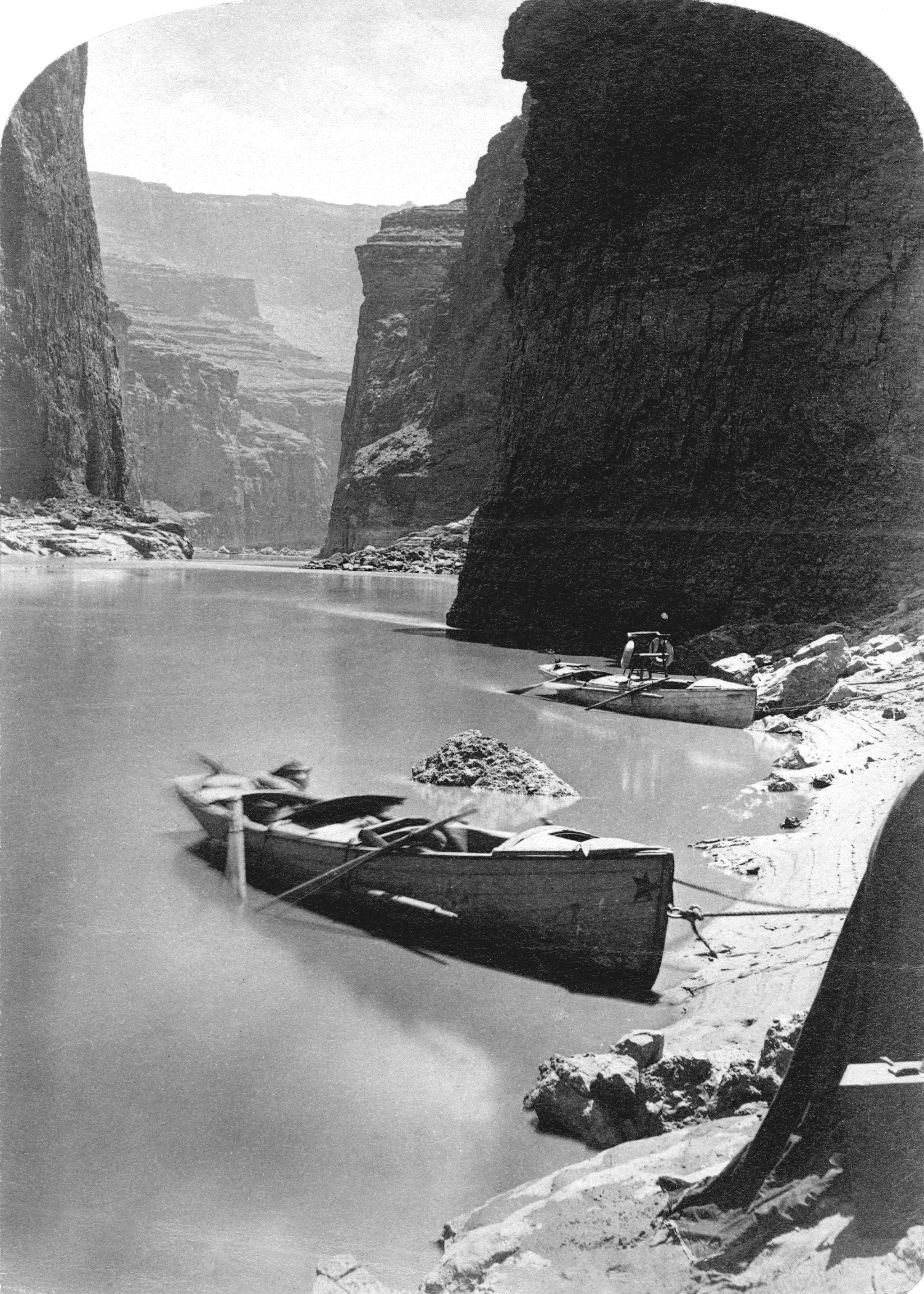
The Boats in Marble Canyon
John Wesley Powell's 2nd expedition, 1872

Diapason is a word also used in the metaphoric sense of a grand swelling of harmony.

Harmony with nature is a popular human construct. The General Assembly of the United Nations established International Mother Earth Day in 2009 to recognize "the Earth and its ecosystems are our home." The General Assembly resolved that "it is necessary to promote harmony with nature and the Earth."

Promoting harmony is a compelling, but idealized fiction. Organisms, and in particular humans, follow few if any altruistic rules. Organisms exist within dynamic constraints like predation pressure and food supply.

The biosphere is made up of dynamic and inter-dependent constraints. Constraints in the biosphere are more complex but not unlike the consumer economics concept of supply and demand. As early as the first agricultural revolution, humans have sought to defy constraints from an unpredictable food supply to the force of gravity.

Since the transition from mobile scavenging communities of hunter gatherers to the more predictable and geographically stationary communities of crop cultivation around 10,000 BC, humans have been shedding constraints and burning up resources with little recognition of the consequences.

To humans, the available resources to exploit seemed limited by ingenuity, rather than by the recognition of finite supply. Animals often act against their interests when constraints diminish. When predation pressure from foxes diminishes, herbivores like rabbits might spike in population, then overgraze a finite range of plants.

Dispassionate examination of ecological dynamics is more instructive and essential to our viability than the romantic allure of proposing to live in harmony with nature. Our existential plight depends on our recognition of the consequences of pursuing our desires with few constraints beyond the degradation of the biosphere and the hard stop of finite resources.

The Derelict (The Lost Boat)
by Arthur Wesley Dow

The challenge of our time is recognizing the grand swelling of harmony in each moment with the full range of our senses, while simultaneously recognizing the compass of consequences of self-serving behavior.


REFERENCES

Saturday, July 30, 2016

Grand Harmonies

Mathematician Henri Poincaré believed we study science and natural phenomena because we take pleasure in it. We take pleasure in natural phenomena because they're beautiful. On the motivation behind scientific inquiry Poincaré wrote:

"If nature were not beautiful it would not be worth knowing, and life would not be worth living."
― Henri Poincaré

Lavender and Green
Arthur Wesley Dow
1912

Poincaré delineated between the beauty of appearances and the beauty of intellectual abstractions like the mathematics undergirding science.
I am not speaking, of course, of the beauty which strikes the senses, of the beauty of qualities and appearances. I am far from despising this, but it has nothing to do with science. What I mean is that more intimate beauty which comes from the harmonious order of its parts, and which a pure intelligence can grasp.
― Henri Poincaré
Drawing these distinctions was Poincaré's preference. At some level, these distinctions becomes immaterial. Perception is subjective whether born from sensual input from natural phenomena or from the symbolic abstractions crafted to model the behavior of some natural phenomena. Sublimity is sublimity. Beauty is beauty.

Geologist and early expedition leader in the American west John Wesley Powell wrote of the harmony of form, color, and sound he experienced after he explored the Grand Canyon:
The glories and the beauties of form, color, and sound unite in the Grand Canyon - forms unrivaled even by the mountains, colors that vie with sunsets, and sounds that span the diapason from tempest to tinkling raindrop, from cataract to bubbling fountain.
— John Wesley Powell
The Destroyer
Arthur Wesley Dow
circa 1911-13
American artist Arthur Wesley Dow argued against the shallow pursuit of painting imitative likenesses of nature. Rather he advocated for composition: the harmonious use of line, color, and shading.
Composition, building up of harmony, is the fundamental process in all the fine arts. I hold that art should be approached through composition rather than through imitative drawing.
— Arthur Wesley Dow
The Destroyer, a curvilinear composition of the Grand Canyon is an exquisite example of Dow's use of line, color, and shading.

Dow's painting evokes a sensual experience of the Grand Canyon that arguably would've been absent in a representational painting.

Dow was influenced by Japanese art. He was taken by the compositional freedom that encouraged off-center subject matter. He was inspired by the use of flat areas of strong color, simplified shapes, and patterns of darks and lights — elements that also influenced the arts and crafts movement.

August Moon
Arthur Wesley Dow
circa 1905

Simplicity is revealed by complexity. Harmony emerges from discord. Both await our discovery.
Three Rules of Work:
Out of clutter find simplicity.
From discord find harmony.
In the middle of difficulty lies opportunity.
― Albert Einstein


REFERENCES

Popular