Showing posts with label Universe. Show all posts

Saturday, December 5, 2015

Light and Dark

Light is life. The Sun is one star among a continuous and distinctive band of stars called the main sequence. Carl Sagan reminds us that when we look up at the night sky, each shinning star light is generated by nuclear fusion.

Fusion powers the stars.


Regions of star formation. Carina Nebula, the Eagle Nebula, and IC 2944.
source: ESO

The Sun like other stars, generates energy in its core by fusing hydrogen atoms into helium. The dense core of the Sun fuses 620 million metric tons of hydrogen per second.

The Sun gives us light. As it happens, light is a precious commodity.
...astronomers have been forced to confront the possibility that most of the universe is invisible, and that all the glittering chains of galaxies are no more substantial, no more reliable guides to physical reality, than greasepaint on the face of a clown.
― Dennis Overbye
Atoms are the stuff of stars and of starlight. Yet as chance would have it, atoms constitute a mere 5% of the universe by weight. Some 20% of the universe is made up of mysterious invisible particles called dark matter. An unknown form of energy called dark energy constitutes the remaining 70% of the universe.

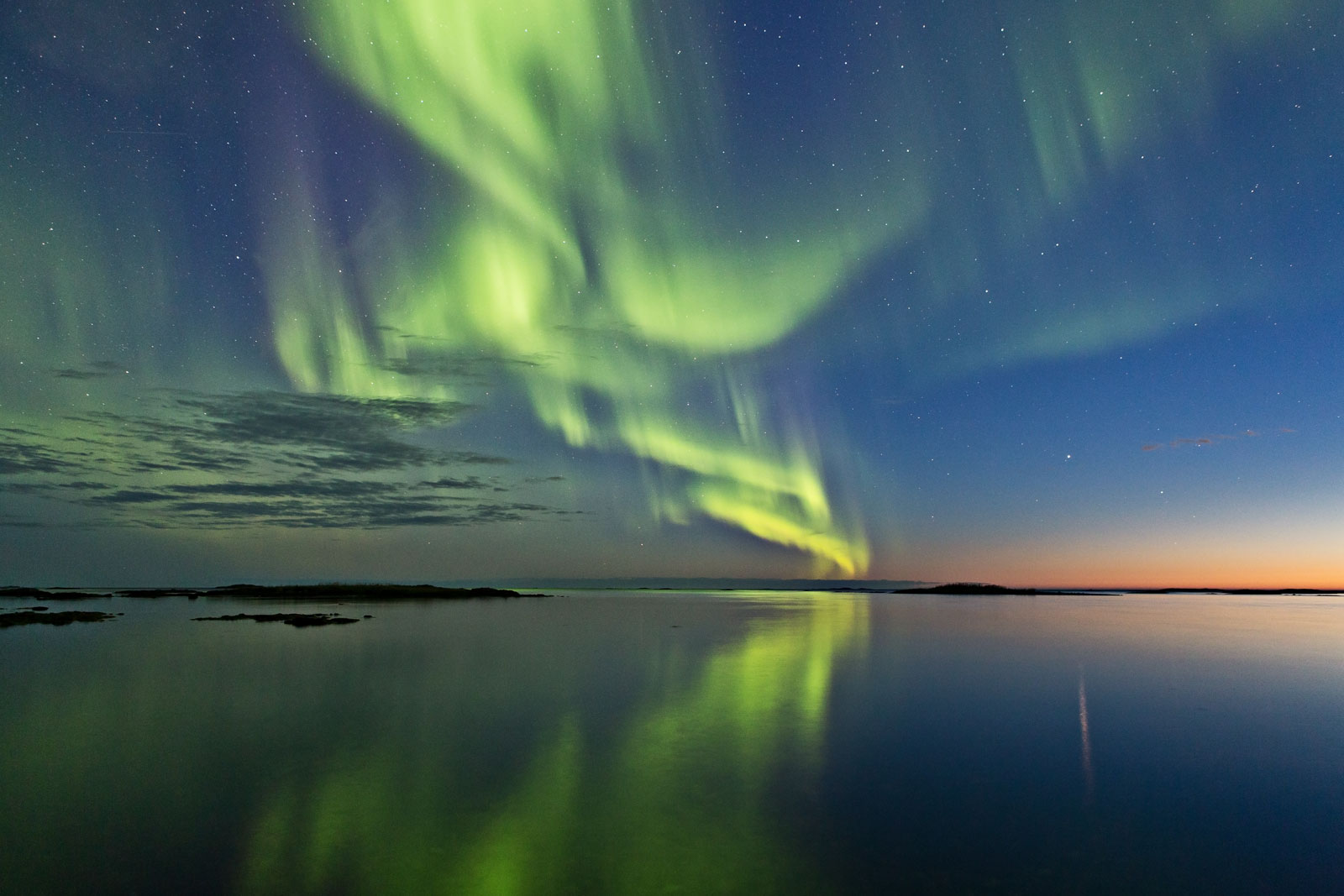
Arctic light
Frank Olsen

“let me die
from having been drunk on
indigo skies, my liver...
overflowing with stars.”

― Sanober Khan

REFERENCES

Saturday, May 24, 2014

It Goes On

Model of L-serine molecule
Moments after the Big Bang, the universe contained hydrogen, helium, and trace amounts of lithium. Once stars coalesced, carbon and oxygen were produced.

Carbon and oxygen are synthesized when helium burns inside red giant stars.
Carbon in the universe is traceable to stars

Carbon-based Life

Carbon is the essential ingredient of life-sustaining organic molecules: carbohydrates; proteins; nucleic acids; and lipids.

Carbon allows for bonds that form three-dimensional molecular structures likened to, and modeled by, rings and chains. Such complex molecular structures provide the building blocks of life.
“In three words I can sum up everything I've learned about life: it goes on.”
― Robert Frost

Earth's Carbon

Earth is largely comprised of oxygen and silicon with comparatively little carbon.

Earth exhibits an observable and measurable carbon cycle analogous to a bookkeeper's columnar ledger of debits and credits. Carbon is exchanged between these reservoirs:
  • Biosphere - sum of all ecosystems, or life zone;
  • Pedosphere - outermost layer of Earth comprised of soil and soil formation;
  • Geosphere - solid parts of Earth including, but not limited to, the lithosphere;
  • Hydrosphere - combined mass of water on and under the surface of Earth; and
  • Atmosphere - layer of gases surrounding Earth retained by Earth's gravity.
Earth's carbon cycle is a model for the ongoing flows between each of the reservoirs. Some carbon flows are slow (e.g., on the order of hundreds of millions of years), while others are fast:
  • Slow Carbon Cycle - Over the span of geologic time (100 - 200 million years), chemical reactions, tectonic events, and volcanic events occur that transfers carbon between rocks, soil, ocean, and atmosphere.
  • Fast Carbon Cycle - Plants, and phytoplankton in the ocean, absorb carbon dioxide (CO2) from the atmosphere into their cells via photosynthesis, then return CO2 via cellular respiration and microbial decomposition.

Fast carbon cycle depicting exchange of carbon between reservoirs

“Originally, the atoms of carbon from which we’re made were floating in the air, part of a carbon dioxide molecule. The only way to recruit these carbon atoms for the molecules necessary to support life—the carbohydrates, amino acids, proteins, and lipids—is by means of photosynthesis. Using sunlight as a catalyst the green cells of plants combine carbon atoms taken from the air with water and elements drawn from the soil to form the simple organic compounds that stand at the base of every food chain. It is more than a figure of speech to say that plants create life out of thin air.”
― Michael Pollan, The Omnivore's Dilemma: A Natural History of Four Meals

Monitoring Earth's Carbon

NASA will launch the Orbiting Carbon Observatory-2 satellite in July 2014. It will record atmospheric CO2 from space. The data will be used to map CO2 sources and sinks and to provide insight into its variability over seasonal cycles.

You will die but the carbon will not; its career does not end with you. It will return to the soil, and there a plant may take it up again in time, sending it once more on a cycle of plant and animal life.
― Jacob Bronowski

REFERENCES

Saturday, August 10, 2013

Views Toward Home

Views of the Earth recorded from interplanetary spacecraft are relatively rare.

Images made from space looking back towards Earth give us a culturally unprecedented perspective on the vast space and flash of time in which we exist.
"Look again at that dot. That's here. That's home. That's us."
— Carl Sagan
Earthrise, 1968
from Apollo 8
Earthrise

Earthrise is the name of an iconic photograph of the Earth taken during the Apollo 8 moon mission in December 1968. This photograph was made by astronaut William Anders seven months before the first lunar landing.
"The most influential environmental photograph ever taken."
- Galen Rowell, wilderness photographer
This image, recorded at a distance of 240,000 miles, is the first view of earth from an interplanetary spacecraft.

Pale Blue Dot

Pale Blue Dot, 1990
from Voyager 1
Pale Blue Dot is the name of a photograph of Earth taken from a record distance of 3.7 billion miles from our planet by the Voyager 1 spacecraft in 1990.

The primary mission of Voyager 1 was to leave the solar system, but the unmanned spacecraft was commanded by NASA to turn its camera back to photograph the Earth at the request of cosmologist Carl Sagan.

This photograph shows earth as a barely perceptible dot travelling in the dark expanse of space.

Some Perspective

At some distance, the Earth becomes barely perceptible. Humans, along with all other living organisms, are temporary voyagers in a vast, expansive system.

From cosmologist Carl Sagan:
"Look again at that dot. That's here. That's home. That's us. On it everyone you love, everyone you know, everyone you ever heard of, every human being who ever was, lived out their lives. The aggregate of our joy and suffering, thousands of confident religions, ideologies, and economic doctrines, every hunter and forager, every hero and coward, every creator and destroyer of civilization, every king and peasant, every young couple in love, every mother and father, hopeful child, inventor and explorer, every teacher of morals, every corrupt politician, every "superstar," every "supreme leader," every saint and sinner in the history of our species lived there-on a mote of dust suspended in a sunbeam.

The Earth is a very small stage in a vast cosmic arena. Think of the endless cruelties visited by the inhabitants of one corner of this pixel on the scarcely distinguishable inhabitants of some other corner, how frequent their misunderstandings, how eager they are to kill one another, how fervent their hatreds. Think of the rivers of blood spilled by all those generals and emperors so that, in glory and triumph, they could become the momentary masters of a fraction of a dot.

Our posturings, our imagined self-importance, the delusion that we have some privileged position in the Universe, are challenged by this point of pale light. Our planet is a lonely speck in the great enveloping cosmic dark. In our obscurity, in all this vastness, there is no hint that help will come from elsewhere to save us from ourselves.

The Earth is the only world known so far to harbor life. There is nowhere else, at least in the near future, to which our species could migrate. Visit, yes. Settle, not yet. Like it or not, for the moment the Earth is where we make our stand.

It has been said that astronomy is a humbling and character-building experience. There is perhaps no better demonstration of the folly of human conceits than this distant image of our tiny world. To me, it underscores our responsibility to deal more kindly with one another, and to preserve and cherish the pale blue dot, the only home we've ever known."

REFERENCES

Popular