Showing posts with label Margaret Atwood. Show all posts

Saturday, December 13, 2014

Original Water

More than two thirds of Earth's surface is covered by water.


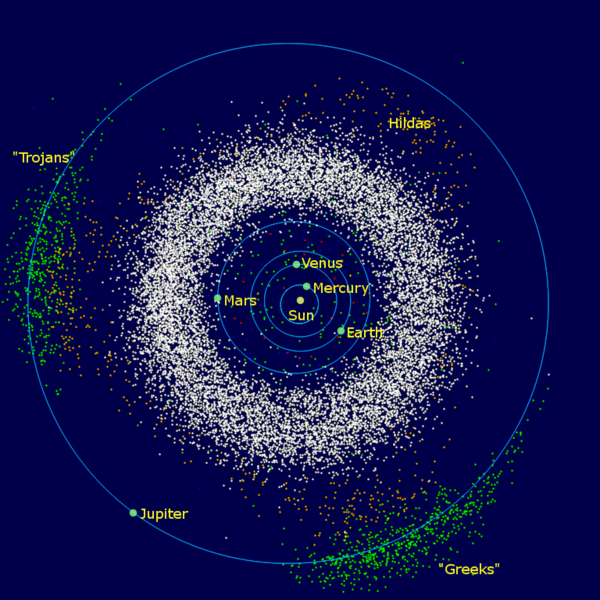
The Asteroid Belt
If Earth's primordial water was boiled off from the intense heat during planetary cooling, where did Earth's abundant water originate?

The origin of Earth’s water remains a mystery.

A prevailing hypothesis is that Earth's water came later from collisions with water-bearing comets or proto-planets from the outer reaches of the Asteroid Belt

Recent analysis of the composition of water sampled on comet 67P suggest Earth's water might not have come from cometary collisions (Life from Comet Collisions).

Scientists suggest that one key to solving the mystery of Earth's abundant water is found in the D/H ratio or the flavor of water. The D/H ratio is the proportion of Deuterium (symbol D) to Hydrogen (symbol H). The ratio of these two hydrogen isotopes might provide clues to the origin of Earth's water.

Deuterium is a form of hydrogen (i.e., hydrogen isotope) that has an additional neutron not present in common hydrogen. There are about 6,420 hydrogen atoms for every deuterium atom found in the world's oceans.

Deuterium can replace hydrogen in water molecules. The properties of D2O differ from H2O (common water). D2O is called heavy water because it's 10.6% denser than H2O. D2O is also more viscous than H2O.
The current opinion that science and poetry are opposed is a delusion. On the contrary science opens up realms of poetry where to the unscientific all is a blank. Those engaged in scientific researches constantly show us that they realize not less vividly, but more vividly, than others, the poetry of their subjects.
― Herbert Spencer, Education, Intellectual, Moral, and Physical (1861)
Analysis of the composition of water sampled on comet 67P, along with previous D/H analysis of other comets show a range of ratios generally containing higher amounts of deuterium than Earth.

Deuterium to Hydrogen Ratio in the Solar System
Source: ESA

Of the deuterium to hydrogen ratios detected in the solar system, the European Space Agency reports:
Of the 11 comets for which measurements have been made, it is only the Jupiter-family Comet 103P/Hartley 2 that was found to match the composition of Earth’s water.
The D/H ratio of water sampled on comet 67P is three times greater than that of Earth's oceans.

Scientists are are turning their attention to asteroids. Meteorites from asteroids in the Asteroid Belt have a closer match to the D/H ratio of water on Earth. Meteorites have a much lower water content than comets. However multiple serious of meteorite bombardments could have produced Earth's oceans.

Water does not resist. Water flows. When you plunge your hand into it, all you feel is a caress. Water is not a solid wall, it will not stop you. But water always goes where it wants to go, and nothing in the end can stand against it. Water is patient. Dripping water wears away a stone.
― Margaret Atwood, The Penelopiad

REFERENCES

Saturday, June 21, 2014

As The Day is Long

It's summer solstice in the Northern Hemisphere.

Summer Solstice Sunrise at Stonehenge

Summer solstice marks the longest period of daylight in the year. The sun is at its farthest point north of the Equator.
This is the solstice, the still point
of the sun, its cusp and midnight,
the year’s threshold
and unlocking, where the past
lets go of and becomes the future;
the place of caught breath…
― Margaret Atwood, Eating Fire: Selected Poetry 1965-1995
The word solstice comes from the Latin from sol meaning sun, and stare, or sistere, meaning to stand or stop.

Yin & Yang

The solstice is an astronomical occasion, but also has historical, mythological, and cultural significance.

From Chinese legend today is a celebration of yin, earth, and femininity. Today is winter solstice in the Southern Hemisphere. Winter solstice corresponds to a winter celebration of yang.

Happiness & Daylight

Psychologists have found a correlation between daylight and a measure of happiness.
We identified individual-level diurnal and seasonal mood rhythms in cultures across the globe, using data from millions of public Twitter messages. We found that individuals awaken in a good mood that deteriorates as the day progresses—which is consistent with the effects of sleep and circadian rhythm—and that seasonal change in baseline positive affect varies with change in daylength.
― Golder & Macy, Science
Summer solstice in an opportunity to experience the fullness of the day.
“We all shine on...like the moon and the stars and the sun.”
― John Lennon

REFERENCES

Saturday, May 3, 2014

Twilight

Following dawn and dusk, an earthly envelope of twilight fills us with emotions like hope and melancholy. Phases of sunlight move our circadian clock forward on the arrow of time.

When dawn surrenders to sunrise we are bathed in twilight.
“What breaks in daybreak? Is it the night? Is it the sun, cracked in two by the horizon like an egg, spilling out light?”
― Margaret Atwood
That same twilight covers us from dusk until sunset. Twilight is refracted sunlight that reaches us after the sun slips below Earth's horizon.

Sunrise over the South Pacific Ocean
International Space Station, 5 May 2013

Categories of Twilight
Humans revel and take comfort in naming what we observe.

Naming lets us categorize and individuate experience. Thus we call out categories of twilight.
“Twilight drops her curtain down, and pins it with a star.”
― Lucy Maud Montgomery
Objectifying observations is the silhouette of reverence.


REFERENCES

Saturday, February 16, 2013

Nature Writing

Mystic Lake, 1872
by William Henry Jackson
Nature writing reaches a crest when it is poetic and mysterious, yet grounded in the observational discipline of scientific inquiry.

Most often written in the first-person, readers are treated to the author's reflections and existential musing. The earthly mechanics of nature provide a wealth of metaphors.
"The grand show is eternal. It is always sunrise somewhere; the dew is never dried all at once; a shower is forever falling; vapor is ever rising. Eternal sunrise, eternal dawn and gloaming, on sea and continents and islands, each in its turn, as the round earth rolls."
― John Muir
Nature writing engages our senses, coaxing from us heightened sensory awareness. At its best, nature writing reminds us training our senses enables us to see beyond mere highlight, shadow, and color.
"It's all a matter of keeping your eyes open...If I can't see these minutiae, I still try to keep my eyes open. I'm always on the lookout for antlion traps in sandy soil, monarch pupae near milkweed, skipper larvae in locust leaves. These things are utterly common, and I've not seen one."
― Annie Dillard, Pilgrim at Tinker Creek
Words and phrases engage our auditory sense:
"Every hidden cell is throbbing with music and life, every fiber thrilling like harp strings."
― John Muir, The Wilderness World of John Muir
Words and phrases engage our olfactory sense:
"In the spring, at the end of the day, you should smell like dirt."
― Margaret Atwood, Bluebeard's Egg
Words and phrases appeal to our sense of taste:
"One swallow does not make a summer, but one skein of geese, cleaving the murk of a March thaw, is the spring."
― Aldo Leopold
Words and phrases appeal to our primal instinct to connect:
"One touch of nature makes the whole world kin."
― John Muir, Our National Parks
Nature writing is often deliciously multi-sensory:
"Once there were brook trout in the streams in the mountains. You could see them standing in the amber current where the white edges of their fins wimpled softly in the flow. They smelled of moss in your hand. Polished and muscular and torsional. On their backs were vermiculate patterns that were maps of the world in its becoming. Maps and mazes. Of a thing which could not be put back. Not be made right again. In the deep glens where they lived all things were older than man and they hummed of mystery."
― Cormac McCarthy, The Road
From acute sensory experience, the best nature writers deftly transition to existential ruminations and philosophy. Compelling nature writing frames the alluring sensory experience with the limit of our senses, our morality:
"Autumn teaches us that fruition is also death; that ripeness is a form of decay. The willows, having stood for so long near water, begin to rust. Leaves are verbs that conjugate the seasons."
― Gretel Ehrlich, The Solace of Open Spaces
"All through autumn we hear a double voice: one says everything is ripe; the other says everything is dying. The paradox is exquisite. We feel what the Japanese call "aware"--an almost untranslatable word meaning something like "beauty tinged with sadness."
― Gretel Ehrlich, The Solace of Open Spaces
Nature writers invite us to find comfort and solace:

"Those who contemplate the beauty of the earth find reserves of strength that will endure as long as life lasts. There is something infinitely healing in the repeated refrains of nature -- the assurance that dawn comes after night, and spring after winter."
― Rachel Carson, Silent Spring
From comfort and solace, we are gently coerced to the short leap into meditation and philosophy:
Being the Stream

Meditation is not just a rest or retreat from the turmoil of the stream or the impurity of the world. It is a way of being the stream, so that one can be at home in both the white water and the eddies. Meditation may take one out of the world, but it also puts one totally into it."

― Gary Snyder

REFERENCES

Popular