Showing posts with label Mythology. Show all posts

Saturday, August 20, 2016

The Glory of Shiva

Arthur Wesley Dow was influenced by the shapes, flatness, and stark lights and darks of the Japanese woodblock prints he saw at the Museum of Fine Arts in Boston in 1891.

Thirty-six Views of Mount Fuji, no. 32.
Katsushika Hokusai, circa 1830

Dow applied and refined these principles to New England landscapes for two decades, developing his work into a uniquely sensual, non-representational style, before traveling west to to paint the Grand Canyon in 1911 and 1912.

Dow painted a view of Shiva Temple. Shiva Temple is an isolated limestone cliff that rises 1,200 feet above the floor of the Grand Canyon.

The Glory of Shiva
Shiva Temple, Grand Canyon
Arthur Wesley Dow, 1912

Dow baths the shadowed canyon in purple hues that are surmounted by crimson sunlight striking the cliff.

Geologist Clarence Dutton named this formation after the Hindu god. Dutton drew from literary and mythological references to name geologic features. Surveying for the USGS in 1881, Dutton drew from his interest in eastern religions to name the Hindu, Vishnu and Shiva Temple sites in the Grand Canyon.
Fire is His head, the sun and moon His eyes, space His ears, the Vedas His speech, the wind His breath, the universe His heart. From His feet the Earth has originated. Verily, He is the inner self of all beings.
― Anonymous, The Upanishads
The Glory of Shiva sold to a private collector in 2012 for $120,000.
"Dow took on a fugitive effect of sunlight viewed at the cusp of the day, knowing that within moments the light would alter irrevocably." ― Gene Shannon, Auctioneer
Twenty million years ago a river began carving the Grand Canyon. Rising to lofty heights above the canyon floor, these cliffs now assume the almost mythological character conveyed in Dow's paintings.
"The little space within the heart is as great as the vast universe. The heavens and the earth are there, and the sun and the moon and the stars. Fire and lightening and winds are there, and all that now is and all that is not."
― Swami Prabhavananda, The Upanishads

REFERENCES

Saturday, April 16, 2016

Geoglyphs of the Mind

Mining mythologies is one means to unearth imagination.

Understanding human civilizations is enriched by analyzing and interpreting artifacts, yet aspects of the human narrative are best expressed by less literal communication channels like art, or poetry.

In the closing stanza of Forgotten Home, Dejan Stojanović writes:
There is another alphabet
Whispering from every leaf,
Singing from every river,
Shimmering from every sky.
Stojanović' reminds me there'll always be something overlooked or left unimagined.

Few phenomena excite the imagination like geoglyphs — large-scale, ancient or contemporary impressions made on the landscape by rearranging found materials. The Atacama Giant is one of many examples of ancient geoglyphs.

The Atacama Giant
by Emilio Erazo-Fisher

The Atacama Giant likely represents a deity created by Atacama Desert inhabitants. Some time from AD 1000 to 1400, people intentionally and methodically arranged desert materials in contrasting lines that, from a distance, formed the impression of an anthropomorphic figure.

One can only imagine what our desert forebears were thinking.
It's enough for me to be sure that you and I exist at this moment.
― Gabriel Garcí­a Márquez

REFERENCES

Saturday, October 19, 2013

Potential & Discharge

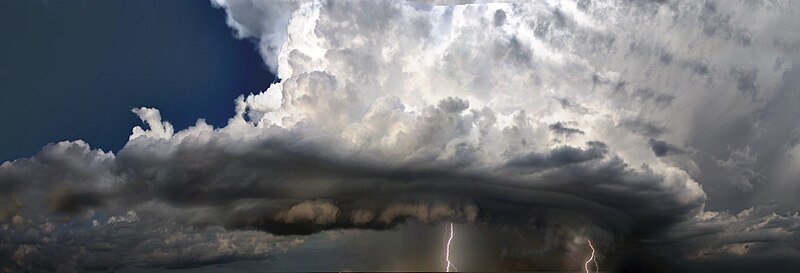
The flashing tentacles of light in lightning are a visual manifestation of an electrostatic discharge between two electrically charged regions in storm clouds, or between storm clouds and the Earth's surface.

Storm clouds are like giant electrical capacitors in the atmosphere. The upper region is positively charged. The lower region is negatively charged. The cause of these electric potential differences is inconclusive in the scientific community.

The flash of light we see occurs at the moment oppositely charged regions equalize. Lightning can occur from a cloud to itself; from cloud to cloud; or between a cloud and the ground.

Mythology

The awe-inspiring power, and the fear-inducing and potentially destructive nature of lightning, beget deeply held cultural mythologies throughout the ages.

In ancient and modern cultures, a lightning bolt is often considered a weapon of a sky god to be deployed as an act of retribution.

Prominent cultural mythologies:
Zeus' head and thunderbolt
coin from Epirus, 234 BC
  • The thunderbolt was a weapon given to Zeus in Greek mythology by the Cyclops (and Jupiter in Roman mythology). Lightning appeared on Greek and Roman coins;
  • In the Hebrew Bible, arrows are represented as lightning in Habakuk 3:11 and as divine punishment in Deuteronomy 32:42, Psalms 64:7, and Job 6:4;
  • In Hittite mythology, a triple thunderbolt was one symbol of Teshub;
  • In Vedic religion, and later Hindu mythology, Indra is the god of lightning armed with a thunderbolt;
  • In Celtic mythology, Taranis is the god of thunder;
  • Thor is the god of thunder in Germanic mythology;
  • Bai-Ülgen creates the thuderbolts in Turkish mythology;
  • In Maya mythology, Huracan is sometimes represented as three thunderbolts;
  • The Ani Hyuntikwalaski, or thunder beings, are beings that cause lightning fire in a hollow sycamore tree in Cherokee mythology;
  • The Thunderbirds, Nimkiig or Binesiiwag in Ojibway mythology, create thunder and lightning that's both benevolent and malevolent to people;
  • In Igbo mythology, the thunderbolt is the weapon of Amadioha; and
  • In the Yorùbá religion, the thunderbolt is the weapon of Shango.


"Why the Egyptian, Arabic, Abyssinian, Choctaw? Well, what tongue does the wind talk? What nationality is a storm? What country do rains come from? What color is lightning? Where does thunder go when it dies?"
― Ray Bradbury, Something Wicked This Way Comes

Temperature, Frequency, Sound and Light

The maximum temperature in lightening (52,540 °F) is about five times hotter than the surface of the sun (10,340 °F).

There are about 1.4 billion lightning flashes per year in the Earth's atmosphere occurring approximately 40–50 times a second.

Thunder is the sound of the shock waves emanating from the intense electrical discharge.

Lightning emits white light, but appears as different colors depending on local atmospheric conditions.

"It is in the darkness of their eyes that men get lost"
― Black Elk(1863 – 1950), from Black Elk Speaks

REFERENCES

Saturday, March 24, 2012

Northern Lights Mythology & Science

The Northern Lights are a spectacle. Knowing the mythology and science of auroras enhances the poetic quality of nature's light show. Understanding something so grand does little to diminish one's awe.
Earth and sky, woods and fields, lakes and rivers, the mountain and the sea, are excellent schoolmasters, and teach some of us more than we can ever learn from books.
~ John Lubbock
Mythology
  • The Algonquins of North America believed Nanabozho, after creating earth, went to the far north to build great fires reflecting southward as an expression of lasting love.
  • The Finnish word for the northern lights translates to Fox Fires originating from a Finnish fable. In the fable, the lights were caused by a fox sweeping his tail across the snow spraying it into the sky.
  • The Saami, indigenous arctic people, believed the lights to be blazing fires from the souls of the departed and to disrespect the fires would lead to bad fortune.
Geophysics

There wasn't a scientific rationalization of the Northern Lights until French geophysicist Jean-Jacques d'Ortous de Mairan linked auroras to solar activity in 1774.

An aurora is a display of light in the sky prevalent in the high latitudes. The light emanates from the collision of energetic charged particles with atoms in the high altitude atmosphere. The charged particles originate in the magnetosphere and from solar wind. The Earth's magnetic field draws the particles into the atmosphere. During a geomagnetic storm, the visible auroral zone expands into lower latitudes.

NASA Crew Earth Observations uploaded the following video sequence of an aurora over the Great Lakes and Canada.
The video was made by the crew of Expedition 30 on board the International Space Station. The video sequence was made on January 25, 2012 from 09:27:08 to 09:32:16 GMT, as the Space Station passed from northwestern Wisconsin to southeastern Quebec, near the Gulf of St. Lawrence.

Popular