Showing posts with label William Shakespeare. Show all posts

Saturday, December 27, 2014

Geomagnetic Past

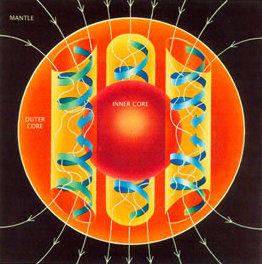
Convection currents of magma
in the outer core

With the paleomagnetic record as leading indicator, Earth's magnetic poles are poised to reverse within the next few thousand years.

Earth's Magnetic Field

A molten iron core generates Earth's magnetic field. Loosely analogous to an electrical generator, Earth's magnetic field is created by the convection of magma in its outer core.

The turbulent convection of molten iron is driven by radioactive heating. This movement produces electrical and magnetic energy. The currents cause the magnetic field surrounding the planet.

Geomagnetism is an ongoing and self-sustained process provided there is sufficient energy to convect flow in the outer core.

Geophysicists attribute shifting currents within the molten core as the cause for the drifting of the magnetic poles. Magnetic North drifts about 10 miles a year.

The positions of Magnetic North and Magnetic South appear destined to flip-flop as they have many times over the course of many millions of years.
What's past is prologue
— William Shakespeare, The Tempest.
Ancient Polarity

Geomagnetic reversals have occurred frequently over the past 169 million years. Paleomagnetic evidence is found in rocks on the ocean floor and in some lava flows.
Geomagnetic polarity is shown (image right) as time descends back in time from present day (top) to the Jurassic period (bottom). Polarity has flipped between the normal configuration we observe today (black stripes) and the reverse configuration we observe in the paleomagnetic record (white stripes).

The Cenozoic era ranges from present day to 66 million years ago. The Mesozoic era ranges from the beginning of the Cenozoic era to 252 million years ago. The Cenozoic, known also as the Age of Mammals, is derived from a composite of the Greeks words for new and life.
Conscience is our magnetic compass; reason our chart.
— Joseph Cook

REFERENCES

Saturday, December 20, 2014

Earthly Naming

B-15
Massive icebergs are given names. Lesser icebergs remain nameless. B-15 is the largest recorded iceberg.

Naming is curious and profoundly human.

Icebergs are named when they exceed an arbitrary length threshold.

If an iceberg has one side at least 12 miles long, it is named and tracked by the U.S. National Ice Center.

The side-length naming threshold has the unintended consequence of leaving massive, roundish-shaped icebergs unnamed. An unnamed 64 square mile iceberg was spotted three weeks ago adrift in the South Atlantic Ocean.

Unnamed iceberg in the South Atlantic Ocean
NASA Operational Land Imager, 3 December 2014

This particular unnamed iceberg has the same surface area as an entity we've deemed name-worthy: Galveston Island.

Why does William Shakespeare's character Juliet ask Romeo what's in a name?
Juliet: What's in a name? That which we call a rose
By any other name would smell as sweet.
She asks what's in a name because the star-cross'd lovers are burdened with names from two warring families. Juliet laments a person's name is an artificial — and in their case, an irrelevant — convention.

Why do humans name things?

Naming is conventional and arbitrary. Naming objectifies. Naming gives us the illusion of control and the illusion of mastery over — or separateness from — the natural world.

Yet what would we do without naming? The negative aspects of objectifying things also grease the skids for interpersonal communication. Naming gives us a hand-hold on the abstract, the complex, and the poetic.

Naming gives us a handle to things. A personified handle is expressed in this passage from Anne of Green Gables:
Anne:What is the name of that geranium on the window-sill, please?
Marilla:That's the apple-scented geranium.
Anne:Oh, I don't mean that sort of a name. I mean just a name you gave it yourself. Didn't you give it a name? May I give it one then? May I call it—let me see—Bonny would do—may I call it Bonny while I'm here? Oh, do let me!
Marilla:Goodness, I don't care. But where on earth is the sense of naming a geranium?
Anne:Oh, I like things to have handles even if they are only geraniums. It makes them seem more like people.
— Excerpt from Anne of Green Gables
Names have a historical narrative rarely considered. Some names are compounded from others, like iceberg.


Names move in and out of favor. Iceberg floated into existence.


REFERENCES

Saturday, October 18, 2014

Deep Time

Einstein mused about the illusive nature of distinguishing past, present, and future.
"People like us, who believe in physics, know that the distinction between past, present, and future is only a stubbornly persistent illusion."
― Albert Einstein
An eon in common parlance, is a very long period of time:
e·on/ˈēən,ˈēˌän/noun.an indefinite and very long period of time, often a period exaggerated for humorous or rhetorical effect.
usage: She reached the hilltop cairn eons before my arrival.
An eon acquires the specificity a billion years for geologists and astronomers. Radiometric dating indicates Earth is 4,540,000,000 years old. This translates to about four and one half eons.
“Four days will quickly steep themselves in nights;
Four nights will quickly dream away the time.”

― William Shakespeare, A Midsummer Night's Dream

Deep Time

Þingvellir
by Hansueli Krapf
Earth is roughly 57 million times older than the longest average human life expectancy. Perhaps the 56,750,000-fold difference explains why geologic time is baffling.

Geologic time is also referred to as deep time.

Comparing deep time to human time in Basin and Range, John McPhee borrows a metaphor cited from Stephen Jay Gould's Time's Arrow, Time's Cycle:

Consider the Earth's history as the old measure of the English yard, the distance from the King's nose to the tip of his outstretched hand. One stroke of a nail file on his middle finger erases human history.

Some geologic phenomena occur in real-time like the calving of a glacier, the flow of lava from a volcano, or the formation of a tropical cyclone.

Most geologic phenomena occur on a geologic time scale like continental drift — for example the pulling apart of the North American and Eurasian Plates at Þingvellir in southwestern Iceland.

Geologists have trained themselves to imagine events unfolding in units of time no smaller than a million years. The intersection of human time and geologic time excites our curiosity.
“If you free yourself from the conventional reaction to a quantity like a million years, you free yourself a bit from the boundaries of human time. And then in a way you do not live at all, but in another way you live forever.”
— John McPhee, Annals of the Former World

Image: Tobias Alt

"The mind seemed to grow giddy by looking so far into the abyss of time."
― John Playfair, remarking on the strata of the unconformity at Siccar Point

If one lives to be 100 years old, Earth will still be some 45 million years older.

REFERENCES

Saturday, December 7, 2013

Sun Dog Prisms

Sun Dogs in Fargo, North Dakota.
February 18th, 2009.
The luminous patches that occasionally appear on each side of the sun during freezing atmospheric temperatures are called sun dogs.

According to folklore, sun dogs follow the sun like a dog follows its master.

Parhelia is the scientific term for sun dogs. Parhelion derives from the Greek parēlion which means beside the sun.

Sun dogs are an atmospheric optical phenomena. The luminous patch occurs when sunlight passes through and is refracted by hexagonal ice crystals.

The hexagonal ice crystals, falling with their long axis perpendicular to the earth, act as rotating prisms bending the sunlight. Because of the prism-like configuration of the falling crystals, sun dogs happen 22° to the left and 22° to the right of the sun viewed above the horizon.
Top View of Falling Crystal: Sunlight passing through two
surfaces of a rotating hexagonal ice crystal which is a 60° prism.

Sun dogs appear in art and literature. Shakespeare wrote about them in  King Henry VI:
EDWARD
Dazzle mine eyes, or do I see three suns?

King Henry VI, Part 3
RICHARD
Three glorious suns, each one a perfect sun;
Not separated with the racking clouds,
But sever'd in a pale clear-shining sky.
See, see! they join, embrace, and seem to kiss,
As if they vow'd some league inviolable:
Now are they but one lamp, one light, one sun.
In this the heaven figures some event.

EDWARD
'Tis wondrous strange, the like yet never heard of.
I think it cites us, brother, to the field,
That we, the sons of brave Plantagenet,
Each one already blazing by our meeds,
Should notwithstanding join our lights together
And over-shine the earth as this the world.
Whate'er it bodes, henceforward will I bear
Upon my target three fair-shining suns.

— King Henry VI, Part 3, Act II, Scene 1

Sunrise or sunset is the best time to observe sun dogs.

REFERENCES

Popular
