Showing posts with label Annie Dillard. Show all posts

Saturday, March 12, 2016

Photosynthetic Phytoplankton

Most atmospheric oxygen comes from plant-life converting the Sun's energy into chemical energy via photosynthesis.
I cannot cause light; the most I can do is try to put myself in the path of its beam.
― Annie Dillard
Photosynthesis in aquatic plants like phytoplankton contributes roughtly 45% of atmospheric oxygen.
Phyto-
a botanical prefix derived from the Greek phyton meaning plant, flora, or vegetation.
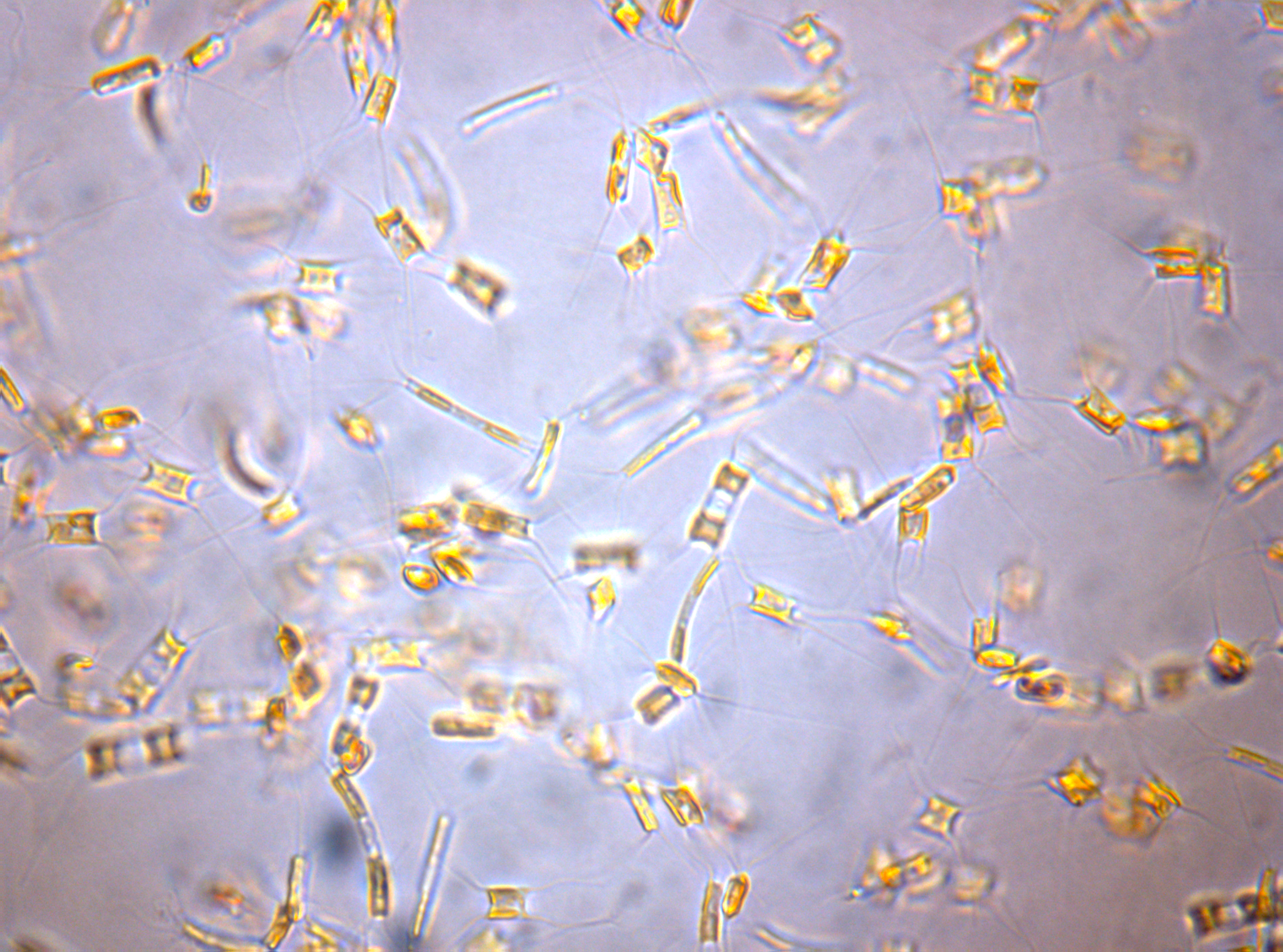
Phytoplankton are single-celled, aquatic plants adrift and aplenty in the oceans, seas, and freshwater ecosystems. Phytoplankton are microscopic organisms that sustain aquatic animals like whales, shrimp, snails, and jellyfish.

The diatom Attheya Longicornis at 400x magnification

The main classes of phytoplankton are diatoms and dinoflagellates. Diatoms often form ribbon-shaped colonies, but with no means of propulsion, are subject to the flow of currents.

Dinoflagellates are swimmers with whip-like flagella used to propel themselves.

Whip-like tail of a dinoflagellate

All phytoplankton convert the Sun's energy into sustenance via photosynthesis within the euphotic zone. The term euphotic comes from the Greek roots for well lit: εὖ "well" + φῶς "light".
Euphotic Zone
Sunlit water extending from the water's surface to a depth where the light intensity falls to 1% of that at the surface. 
Phytoplankton thrive where sunlight can penetrate and fuel their activity. About 90% of all marine life exists in the euphotic zone.
The oxygen in today's atmosphere is almost entirely the result of photosynthetic living, which had its start with the appearance of blue-green algae among the microorganisms.
— Lewis Thomas

REFERENCES

Saturday, February 28, 2015

Worldly Photographs

Some experience the world with enduring curiosity.
I had been chipping at the world idly, and had by accident uncovered vast and labyrinthine further worlds within it.
— Annie Dillard, An American Childhood
Some discover the poetic allure of worldly phenomena by accident, others discover with intent. Attentiveness to sensual phenomena requires discipline. Attentiveness must be practiced and exercised like one might practice running, yoga, meditation, or tai chi.
Push it. Examine all things intensely and relentlessly.
— Annie Dillard, Pilgrim at Tinker Creek
Originating with the fine art photography movement in the 1890s, photographers have used the mental and physical act of curating visual input to tune and exercise the brain to visual receptiveness.


For many photographers, photographing is a discipline of
Attentiveness with intent
Erosion Spider above is one of the 2014 European Geosciences Union photo contest winners. The image was made by John Clemens in the Grand Canyon.
Toward the bottom of the Grand Canyon in Arizona, USA, lies the Middle Cambrian Bright Angel Shale, a variably coloured sequence of relatively soft sedimentary rocks, here sculpted by erosion into a spider-like outcrop decorated with small green desert shrubs.
— John Clemens
The curated photographs of the annual European Geosciences Union photo contest are a feast for the senses. Photography is a visual medium curiously capable of transporting one to a place where the other senses come to life if only in one's imagination.
Art is always the replacement of indifference by attention.
— Guy Davenport

REFERENCES

Saturday, November 9, 2013

Solar Eclipse

When the moon passes between the Sun and the Earth, sunlight headed for the Earth is fully or partially blocked. This phenomenon is a Solar Eclipse.

The celestial configuration for a full or partial eclipse is described by the astronomy term syzygy. Syzygy is from the Ancient Greek suzugos meaning yoked together. To astronomers a syzygy is a straight-line alignment of three celestial bodies.


Sunrise Partial Eclipse by independent filmmaker Steve Ellington.

In a time-lapse sequence made by Steve Ellington of a November partial eclipse, the rising Sun is blocked by a rising Moon (video above).
“I cannot cause light; the most I can do is try to put myself in the path of its beam. It is possible, in deep space, to sail on solar wind. Light, be it particle or wave, has force: you can rig a giant sail and go. The secret of seeing is to sail on solar wind. Hone and spread your spirit till you yourself are a sail, whetted, translucent, broadside to the merest puff”
― Annie Dillard, Pilgrim at Tinker Creek
The same November eclipse shown above is shown in a NASA animation looking back at the earth (right).

The NASA Catalog of Solar Eclipses: 2001 to 2100 provides information on past and future eclipses.
“We are star stuff harvesting sunlight.”
― Carl Sagan
REFERENCES

Saturday, September 14, 2013

Playing to a Packed House

Kierkegaard advanced the idea that a person — not society, culture, or religion — is responsible for finding meaning in life and for living authentically, with passion and sincerity.
Life has its own hidden forces which you can only discover by living.
― Søren Kierkegaard 
Meaning begins and ends with consciousness. We sense and process while immersed in stimuli. We find our tribes and we make life-long connections.

We are here to notice each thing so each thing gets noticed. Together we notice not only each mountain shadow and each stone on the beach but, especially, we notice the beautiful faces and complex natures of each other. We are here to bring to consciousness the beauty and power that are around us and to praise the people who are here with us. We witness our generation and our times. We watch the weather. Otherwise, creation would be playing to an empty house.
― Annie Dillard
The summation of all consciousness is inestimable, if not infinite. If for nothing else but the will to live, the collective perceptions of all living organisms is a rapt audience. Nature, in the course of continuous unfolding, plays to a packed house.

Our home is the Earth. Our house is the universe.

According to the second law of thermodynamics, things fall apart. Structures disintegrate. Buckminster Fuller hinted at a reason we are here: By creating things, by thinking up new combinations, we counteract this flow of entropy. We make new structures, new wholeness, so the universe comes out even. A shepherd on a hilltop who looks at a mess of stars and thinks, ‘There’s a hunter, a plow, a fish,’ is making mental connections that have as much real force in the universe as the very fires in those stars themselves.
― Annie Dillard
Humans entertain the notion of counteracting the flow of entropy by creating things, by imposing temporary order, and by identifying and naming patterns in apparent replication and reoccurrence, but human purpose is disappointingly singular, like a mayfly hatch.

Consciousness is best not squandered. It ends in an instant.

REFERENCES

Saturday, February 16, 2013

Nature Writing

Mystic Lake, 1872
by William Henry Jackson
Nature writing reaches a crest when it is poetic and mysterious, yet grounded in the observational discipline of scientific inquiry.

Most often written in the first-person, readers are treated to the author's reflections and existential musing. The earthly mechanics of nature provide a wealth of metaphors.
"The grand show is eternal. It is always sunrise somewhere; the dew is never dried all at once; a shower is forever falling; vapor is ever rising. Eternal sunrise, eternal dawn and gloaming, on sea and continents and islands, each in its turn, as the round earth rolls."
― John Muir
Nature writing engages our senses, coaxing from us heightened sensory awareness. At its best, nature writing reminds us training our senses enables us to see beyond mere highlight, shadow, and color.
"It's all a matter of keeping your eyes open...If I can't see these minutiae, I still try to keep my eyes open. I'm always on the lookout for antlion traps in sandy soil, monarch pupae near milkweed, skipper larvae in locust leaves. These things are utterly common, and I've not seen one."
― Annie Dillard, Pilgrim at Tinker Creek
Words and phrases engage our auditory sense:
"Every hidden cell is throbbing with music and life, every fiber thrilling like harp strings."
― John Muir, The Wilderness World of John Muir
Words and phrases engage our olfactory sense:
"In the spring, at the end of the day, you should smell like dirt."
― Margaret Atwood, Bluebeard's Egg
Words and phrases appeal to our sense of taste:
"One swallow does not make a summer, but one skein of geese, cleaving the murk of a March thaw, is the spring."
― Aldo Leopold
Words and phrases appeal to our primal instinct to connect:
"One touch of nature makes the whole world kin."
― John Muir, Our National Parks
Nature writing is often deliciously multi-sensory:
"Once there were brook trout in the streams in the mountains. You could see them standing in the amber current where the white edges of their fins wimpled softly in the flow. They smelled of moss in your hand. Polished and muscular and torsional. On their backs were vermiculate patterns that were maps of the world in its becoming. Maps and mazes. Of a thing which could not be put back. Not be made right again. In the deep glens where they lived all things were older than man and they hummed of mystery."
― Cormac McCarthy, The Road
From acute sensory experience, the best nature writers deftly transition to existential ruminations and philosophy. Compelling nature writing frames the alluring sensory experience with the limit of our senses, our morality:
"Autumn teaches us that fruition is also death; that ripeness is a form of decay. The willows, having stood for so long near water, begin to rust. Leaves are verbs that conjugate the seasons."
― Gretel Ehrlich, The Solace of Open Spaces
"All through autumn we hear a double voice: one says everything is ripe; the other says everything is dying. The paradox is exquisite. We feel what the Japanese call "aware"--an almost untranslatable word meaning something like "beauty tinged with sadness."
― Gretel Ehrlich, The Solace of Open Spaces
Nature writers invite us to find comfort and solace:

"Those who contemplate the beauty of the earth find reserves of strength that will endure as long as life lasts. There is something infinitely healing in the repeated refrains of nature -- the assurance that dawn comes after night, and spring after winter."
― Rachel Carson, Silent Spring
From comfort and solace, we are gently coerced to the short leap into meditation and philosophy:
Being the Stream

Meditation is not just a rest or retreat from the turmoil of the stream or the impurity of the world. It is a way of being the stream, so that one can be at home in both the white water and the eddies. Meditation may take one out of the world, but it also puts one totally into it."

― Gary Snyder

REFERENCES

Saturday, February 2, 2013

Tuning Our Senses

Responding to the urge to immerse myself, I deliberately alert my mind to the prospect of incoming data. I have experienced the automaton-like phenomena of pinging my senses in a sort of mental roll-call:
What can I see? What can I smell? What can I hear?
Yet in what I imagine to be heightened awareness, I am often surprised ― not by what I see, hear, or smell, rather by the flicker of something I have just missed.

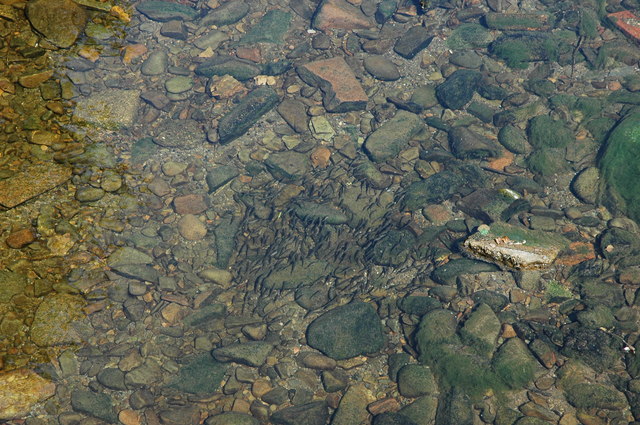
A School of Minnows
Sensual acuity is like a muscle needing the discipline of exercise and practice.

Annie Dillard devotes a chapter to Seeing in Pilgrim at Tinker Creek. She writes that the most obvious objects in nature are often the most difficult to see.
Nature is one of those line drawings of a tree that are puzzles for children.
― Annie Dillard
We are creatures deceived by expectation. Often we only see what we expect.
My eyes account for less than one percent of the weight of my head. I'm bony and dense; I see what I expect.― Annie Dillard
How do we tune our senses to the unexpected?
If you do not expect the unexpected you will not find it, for it is not to be reached by search or trail. ― Heraclitus

Saturday, January 26, 2013

Essential Grandeur

Einstein agreed to have his oft-quoted phrase "God is subtle, but he is not malicious" inscribed and hung in the Princeton mathematics building, but wrote to mathematician Oswald Veblen that he really meant to say,
"Nature conceals her mystery by means of her essential grandeur, not by her cunning."
If I was sitting with Einstein on his porch facing Mercer Street, I like to think I would have asked him,
Isn't nature's cunning the allure of her grandeur?
Nature appears to unfold with a certain randomness because we frequently fail to recognize or appreciate the profound beauty of its overarching patterns.

Ice break-up, Yellowstone Lake, May 2012.

Indeed we often ignore, or are ignorant of, the framework ― the physical and biological patterns ― in which these events occur.

I observe scant if any naivete in nature. The physical and biological patterns I observe then ruminate about suggest that
Nature appears feckless, but has a reliable record of intelligence.
What are examples of the physical and biological patterns that make up the framework?

The most dominant biological pattern is self-correcting survival. Species are programmed to proliferate with a simple rule:
Self-correct the template by mating with survivors.
Then there are the physical laws of the earth and of the universe. There are the sublimely evident and irrefutable earth-bound truths like
There are also the apparent laws of the universe like conservation of energy.
"Our life is a faint tracing on the surface of mystery, like the idle, curved tunnels of leaf minors on the face of a leaf."
― Annie Dillard
Within this framework nature abounds and proliferates. It is up to us to find the passion and self-discipline to observe, to understand, and to appreciate its grandeur.

The old philosophical saw "if a tree falls in the forest" strikes me as naively human-centric. As Annie Dillard writes in the opening chapter of Pilgrim at Tinker Creek,
"The answer must be, I think, that beauty and grace are performed whether or not we will or sense them. The least we can do is try to be there."

REFERENCES

Popular