Showing posts with label Eurasian Plate. Show all posts

Saturday, November 15, 2014

Motion Instruments

Earth's crust has seven or eight plates that drift on a softer mantle. The motions of the plates is described by the universally accepted theory of plate tectonics. Plate tectonics extends a preceding theory of continental drift popular in the early to mid 20th century.
It must have appeared almost as improbable to the earlier geologists, that the laws of earthquakes should one day throw light on the origin of mountains, as it must to the first astronomers, that the fall of an apple should assist in explaining the motions of the moon.
— Charles Lyell, Principles of Geology (1830-3), Vol. 3, 5.
Evidence of the motion of the plates comes from technologies like Interferometric Synthetic Aperture Radar (InSAR) and Global Positioning Systems (GPS).

InSAR

Interferometric synthetic aperture radar (InSAR) streams data to a satellite that records ground surface movements to within an inch. InSAR technology was first used to analyze the 1992 Landers earthquake.

InSAR has since provided data for variety of earthquakes including the M7.6 1999 Izmit earthquake that caused extensive damage and loss of life.

Surface motion caused by the Izmit earthquake is shown in the interferogram below which depicts surface changes. The interferogram used pairs of images from InSAR data recorded shortly before, and a month after, the earthquake event.

1999 Izmit, Turkey Earthquake Interferogram

Each color contour represents 1.1 inches (28 mm) of vertical displacement (toward the satellite), or 2.8 inches (70 mm) of horizontal movement. The thin, east-west red lines show the location of fault breaks. The thicker, east-west black lines show a fault rupture inferred from the data.

The Izmit earthquake occurred along the boundary of the Anatolian Plate and the Eurasian Plate (right).

The North Anatolian Fault broke during the Izmit earthquake event moving more than 8 feet to produce the pattern in the interferogram.

"Though the theories of plate tectonics now provide us with a modus operandi, they still seem to me to be a periodic phenomenon. Nothing is world-wide, but everything is episodic. In other words, the history of anyone part of the earth, like the life of a soldier, consists of long periods of boredom and short periods of terror."
— Derek Victor Ager, The Nature of the Stratigraphical Record, 3rd Ed. 1993, 141.

GPS

Another means to record earthquake-induced displacement is to use GPS. A marker bolt is drilled into the ground. The coordinates of the bolt are recorded using a GPS device. The coordinates of the bolt are recorded again at a later date to determine if movement has occurred. Consumer GPS devices are accurate to within several meters. Measuring earthquake movements requires a finer resolution GPS receiver that uses the phase of the signal to increase accuracy to within millimeters.
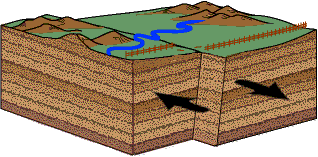
Visualization of a Strike-Slip Fault

"We are all glorified motion sensors.

Some things only become visible to us when they undergo change.

We take for granted all the constant, fixed things, and eventually stop paying any attention to them. At the same time we observe and obsess over small, fast-moving, ephemeral things of little value.

The trick to rediscovering constants is to stop and focus on the greater panorama around us. While everything else flits abut, the important things remain in place.

Their stillness appears as reverse motion to our perspective, as relativity resets our motion sensors. It reboots us, allowing us once again to perceive.

And now that we do see, suddenly we realize that those still things are not so motionless after all. They are simply gliding with slow individualistic grace against the backdrop of the immense universe.

And it takes a more sensitive motion instrument to track this."


― Vera Nazarian, The Perpetual Calendar of Inspiration

REFERENCES

Saturday, October 18, 2014

Deep Time

Einstein mused about the illusive nature of distinguishing past, present, and future.
"People like us, who believe in physics, know that the distinction between past, present, and future is only a stubbornly persistent illusion."
― Albert Einstein
An eon in common parlance, is a very long period of time:
e·on/ˈēən,ˈēˌän/noun.an indefinite and very long period of time, often a period exaggerated for humorous or rhetorical effect.
usage: She reached the hilltop cairn eons before my arrival.
An eon acquires the specificity a billion years for geologists and astronomers. Radiometric dating indicates Earth is 4,540,000,000 years old. This translates to about four and one half eons.
“Four days will quickly steep themselves in nights;
Four nights will quickly dream away the time.”

― William Shakespeare, A Midsummer Night's Dream

Deep Time

Þingvellir
by Hansueli Krapf
Earth is roughly 57 million times older than the longest average human life expectancy. Perhaps the 56,750,000-fold difference explains why geologic time is baffling.

Geologic time is also referred to as deep time.

Comparing deep time to human time in Basin and Range, John McPhee borrows a metaphor cited from Stephen Jay Gould's Time's Arrow, Time's Cycle:

Consider the Earth's history as the old measure of the English yard, the distance from the King's nose to the tip of his outstretched hand. One stroke of a nail file on his middle finger erases human history.

Some geologic phenomena occur in real-time like the calving of a glacier, the flow of lava from a volcano, or the formation of a tropical cyclone.

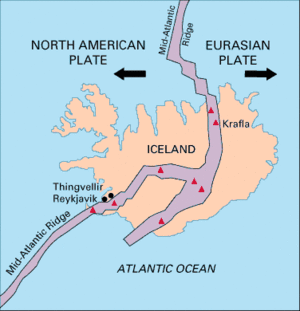
Most geologic phenomena occur on a geologic time scale like continental drift — for example the pulling apart of the North American and Eurasian Plates at Þingvellir in southwestern Iceland.

Geologists have trained themselves to imagine events unfolding in units of time no smaller than a million years. The intersection of human time and geologic time excites our curiosity.
“If you free yourself from the conventional reaction to a quantity like a million years, you free yourself a bit from the boundaries of human time. And then in a way you do not live at all, but in another way you live forever.”
— John McPhee, Annals of the Former World

Image: Tobias Alt

"The mind seemed to grow giddy by looking so far into the abyss of time."
― John Playfair, remarking on the strata of the unconformity at Siccar Point

If one lives to be 100 years old, Earth will still be some 45 million years older.

REFERENCES

Saturday, January 25, 2014

Plate Collision

Deformation, deflection, and detachment are observable when land masses collide. Via the immense pressure of colliding tectonic plates, horizontally deposited sedimentary rock, distinguished by distinctively colored, vertically-stratified slabs, can be:
  1. Squeezed into wavy layers forming synclines and anticlines (right); or
  2. Broken up so that the deeper layers (older) of rock pile on top of shallower (newer) layers. A phenomena called a thrust fault; or
  3. Forced to strike or slip along a plane creating a horizontally detached strike-slip fault.

Piqiang Fault, a strike-slip fault

Piqiang Fault is a dramatic example of a strike-slip fault in the Gobi desert. The sedimentary rock layers are offset by about 2 miles. Pressure from colliding tectonic plates, i.e., the northward moving Indian plate and the Eurasian plate, caused Piqiang Fault.

Civilization exists by geological consent, subject to change without notice.
― Will Durant

REFERENCES

Saturday, June 15, 2013

Forces Deep

Bridge over the Alfagja rift valley - the boundary
of the Eurasian and North American plates.
Forces deep within the earth separate continents.

Rift valleys occur from the separation of continental plates.

The pulling apart of plates creates a linear-shaped lowland that, on land, is gradually deepened by erosion.

When continental spreading forces are strong enough, a center block will drop relative to the flanking blocks leaving steep flank walls.

Mid-Atlantic Ridge


The most extensive rift valley is the result of sea floor spreading. It is found in the subsurface of the Atlantic Ocean along the crest of the Mid-Atlantic Ridge.

This massive rift valley is expressed on land as it transects the interior of Iceland.

“People usually consider walking on water or in thin air a miracle. But I think the real miracle is not to walk either on water or in thin air, but to walk on earth. Every day we are engaged in a miracle which we don't even recognize: a blue sky, white clouds, green leaves, the black, curious eyes of a child -- our own two eyes. All is a miracle.”
― Thich Nhat Hanh

REFERENCES

Popular