Showing posts with label Elon Musk. Show all posts

Saturday, December 12, 2015

Breathing Planet

Humans recognize the period from about 1760 to 1840 as the industrial revolution where we transformed from hand-made to machine production.

Since the beginning of the industrial age, the mean concentration of atmospheric carbon dioxide has increased from 280 parts per million to 400 parts per million.
"We're running the most dangerous experiment in history right now, which is to see how much carbon dioxide the atmosphere... can handle before there is an environmental catastrophe."
― Elon Musk
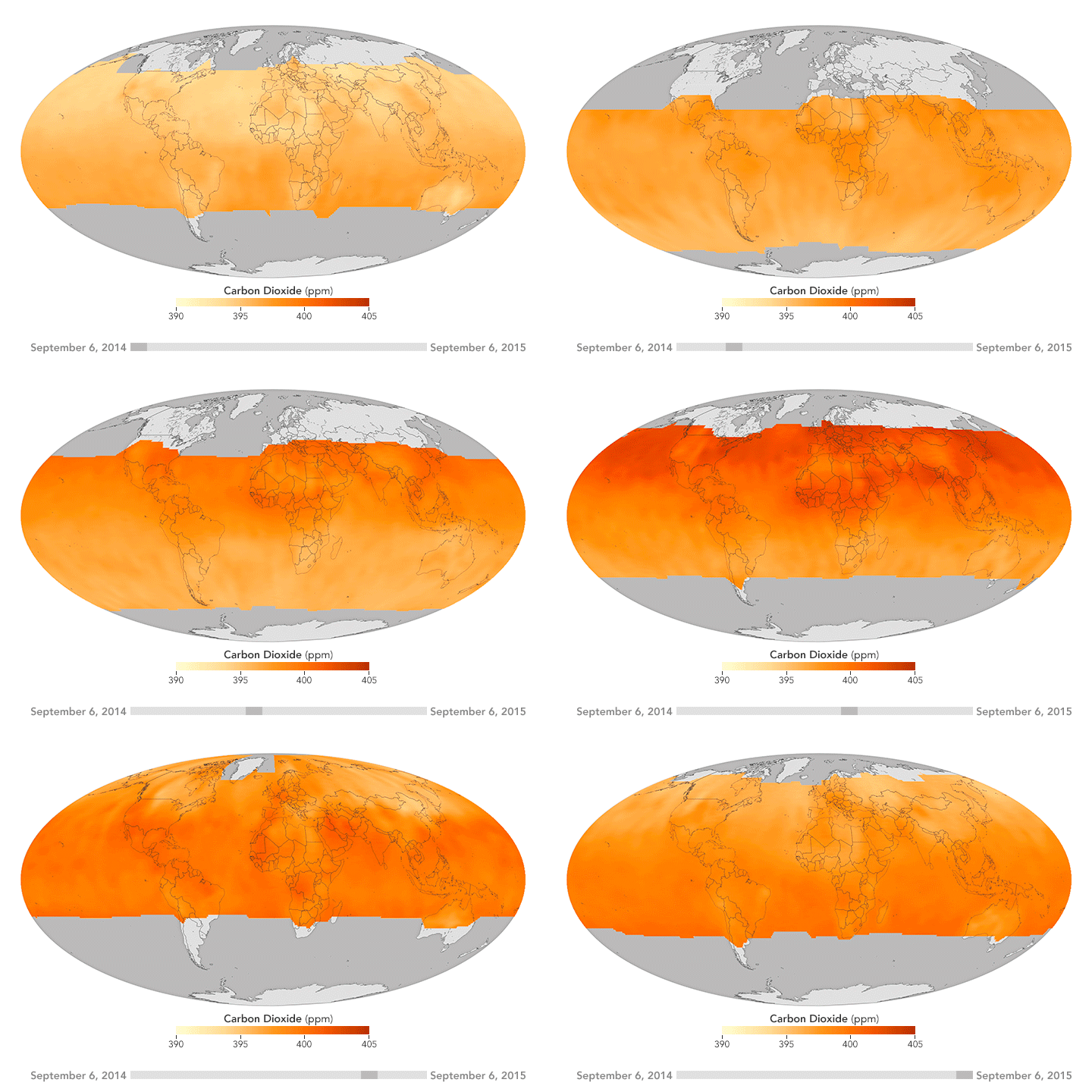
Over the past year, NASA's Orbiting Carbon Observatory-2 has been collecting global measurements of atmospheric carbon dioxide:

A Year in the Life of Carbon Dioxide
Atmospheric carbon dioxide concentration
NASA's Orbiting Carbon Observatory-2

Carbon dioxide concentrations were much higher a half a billion years ago because Earth was a rocky planet bereft of carbon sequestrating plant life. During the Devonian period 420 to 360 million years ago, Earth's atmosphere underwent a 15-fold decline in carbon dioxide.
"The decline is thought to be primarily attributable to carbon sequestration caused by the evolutionary emergence of large forest trees." ― The Forest Primeval
Atmospheric carbon dioxide concentrations have been rising steadily since the industrial age:

Actual and projected atmospheric carbon dioxide concentrations
source: Hannes Grobe

Much, if not most of life on Earth has an existential and symbiotic relationship with Earth's atmosphere. Animals must inhale and exhale to maintain life. Trees must sequester atmospheric carbon to grow a woody skeleton.

The word respire comes from the old French respirer or the Latin respirare meaning:
‘breathe out,’ from re- ‘again’ + spirare ‘breathe.’
Earth is planet of respiration. Earth is a breathing planet like no other planet we know.
What we call ’I’ is just a swinging door, which moves when we inhale and when we exhale.
― Shunryū Suzuki

REFERENCES

Saturday, June 20, 2015

Changing Atmosphere

Earth amassed its atmosphere from the gases of cooling rocks.
“The earth was initially very hot and without an atmosphere. In the course of time it cooled and acquired an atmosphere from the emission of gases from the rocks.”
― Stephen Hawking, A Brief History of Time
Today life persists in a thin band of Earth's atmosphere called the troposphere which has a mean height of 11 miles (~ 17 km) in the middle latitudes straddling the equator.

Layers of the atmosphere
source: NASA

While it's stands to reason that the atmosphere would continue to change over time, in recent decades the rate of change in the composition and characteristics of the atmosphere has become cause for concern, particularly when compared to the adaptive capacity of living organisms.

A range of public figures from naturalist David Attenborough, to science educator Bill Nye and entrepreneur Elon Musk have expressed concern over the impact of human activity on the composition and characteristics of the atmosphere.

On human population growth and industrialization:
"I would be absolutely astounded if population growth and industrialization and all the stuff we are pumping into the atmosphere hadn't changed the climatic balance. Of course it has. There is no valid argument for denial."
― David Attenborough
On burning carbon-based fuels creating gases that trap the sun's radiant energy:
"Burning carbon-based substances like oil, gas, and especially coal, produces billions of tons of extra carbon dioxide each year. Methane gas from cows and pigs and other animals on our large farms ends up in the atmosphere as well, trapping more of the sun's energy as heat." ― Bill Nye
On the rapidly accumulating carbon dioxide in the atmosphere:
"We're running the most dangerous experiment in history right now, which is to see how much carbon dioxide the atmosphere... can handle before there is an environmental catastrophe." ― Elon Musk

Earth's standard surface gravity of 9.8 m/s2 holds down the atmosphere, while atmospheric escape is the loss of atmospheric gases to outer space.
“The oldest, easiest to swallow idea was that the earth was man's personal property, a combination of garden, zoo, bank vault, and energy source, placed at our disposal to be consumed, ornamented, or pulled apart as we wished.”
― Lewis Thomas, The Lives of a Cell: Notes of a Biology Watcher

REFERENCES

Popular