Showing posts with label Human Activity. Show all posts

Saturday, July 23, 2016

Vagaries of Habitat

Egyptian peasant farmers
The transition from human subsistence on foraging and hunting to crop farming communities began around 10,000 B.C.

Humans have been moving, tilling, diverting, mining, burning, fabricating, fouling and laying waste unabated ever since.

The agricultural revolution was born from an aspiration to exercise sufficient control over our habitat to ensure a predictable supply of food.

Human impact on the biosphere is often ignored, downplayed, or denied, but that doesn't comport with the evidence. Humans have a knack for engineering and adapting the natural environment to changing needs and desires.

In Plans for Altering the River, poet Richard Hugo writes of the human propensity to engineer habitat. Hugo explores the vagaries and absurdities of altering a river.
Plans for Altering the River
by Richard Hugo

Those who favor our plans to alter the river
raise your hand. Thank you for your vote.
Last week, you'll recall, I spoke about how water
never complains. How it runs where you tell it,
seemingly at home, flooding grain or pinched
by geometric banks like those in this graphic
depiction of our plan. We ask for power:
a river boils or falls to turn our turbines.
The river approves our plans to alter the river.

Due to a shipwreck downstream, I'm sad to report
our project is not on schedule. The boat
was carrying cement for our concrete rip rap
balustrade that will force the river to run
east of the factory site through the state-owned
grove of cedar. Then, the uncooperative
carpenters union went on strike. When we get
that settled, and the concrete, given good weather
we can go ahead with our plan to alter the river.

We have the injunction. We silenced the opposition.
The workers are back. The materials arrived
and everything's humming. I thank you
for this award, this handsome plaque I'll keep
forever above my mantle, and I'll read
the inscription often aloud to remind me
how with your courageous backing I fought
our battle and won. I'll always remember
this banquet this day we started to alter the river.

Flowers on the bank? A park on Forgotten Island?
Return of cedar and salmon? Who are these men?
These Johnnys-come-lately with plans to alter the river?
What's this wild festival in May
celebrating the runoff, display floats on fire
at night and a forest dance under the stars?
Children sing through my locked door, 'Old stranger,
we're going to alter, to alter, alter the river.'
Just when the water was settled and at home.

Hugo personifies water, writing water never complains and it runs where you tell it. The natural world seems to comply to the whims of the plan.

Los Angeles Aqueduct
by Jet Lowe

Despite our inclination to control, our most careful plans are subject to the unforeseen like a shipwreck downstream or uncooperative carpenters. Eventually it seems we must alter what's already been altered, "Just when the water was settled and at home".


REFERENCES

Saturday, May 14, 2016

Bringing Heat

Greenhouse gases trap heat in the atmosphere by absorbing it. Without greenhouse gases, the mean temperature on Earth's surface would be 0°F rather than 59°F.

Over a century of mean temperature data plotted over time demonstrates the increasing rate of the rise.
The pace of change is immediately obvious, especially over the past few decades.
— Ed Hawkins
by Ed Hawkins, National Centre for Atmospheric Science

Humans have spiked a 40% increase in the atmospheric carbon dioxide concentration since 1750, the approximate outset of the industrial revolution.

Water vapor, carbon dioxide, methane, nitrous oxide, ozone, and chlorofluorocarbons are the greenhouse gases in order of abundance in the atmosphere. The anthropogenic spike in greenhouse gases comes primarily from human activities (power generation, transportation, and industrial agriculture).
“Thus human beings are now carrying out a large scale geophysical experiment of a kind that could not have happened in the past nor be reproduced in the future. Within a few centuries we are returning to the atmosphere and oceans the concentrated organic carbon stored in sedimentary rocks over hundreds of millions of years.”
― Bill McKibben

REFERENCES

Saturday, March 21, 2015

The Anthropocene

Anthropocene word origin
Anthropocene is a 21st century term popularized by atmospheric chemist and nobel laureate Paul Crutzen for what will perhaps be recognized as a new geologic epoch.

The roots of the word are anthropo- for man and cene for new.

No date is recognized as the start of the Anthropocene, but atmospheric data seems to point to the early 19th century industrialization that occurred during the time of the Industrial Revolution. Other scientists indicate it should start with the Atomic Age of the 1950s.

The Anthropocene was preceded by, or is encompassed by, the Holocene which, in turn, was preceded by the Pleistocene

The Holocene began about 11,700 years ago and includes the growth of the human species. The Pleistocene lasted from about 2,588,000 to the Holocene and spanned the most recent period of repeated glaciations.

Shanghai at sunset
The Anthropocene is marked by the characteristics of:
  • over-population (fourfold increase in the 20th century alone);
  • the greenhouse effect;
  • warming temperatures;
  • melting glaciers;
  • rising sea levels;
  • frequent weather extremes; and
  • overall climate disruption.
All of these characteristics are widely held to be linked to human activities.
"Two billion years ago, cyanobacteria oxygenated the atmosphere and powerfully disrupted life on earth. But they didn’t know it. We’re the first species that’s become a planet-scale influence and is aware of that reality. That’s what distinguishes us."
— Andrew Revkin

REFERENCES

Saturday, November 23, 2013

Blink of an Eye

The Earth continues to move, erupt, collide and change shape. Some of these changes are gradual and imperceptible, while others are sudden and catastrophic.

A new island appeared in the Pacific Ocean this week from an exploding underwater volcano. Will this island of ash and rock last long enough to be charted on a map? Will it be subdued and eroded by pounding waves? We don't know. But the story unfolds with or without us.

What once were warm clear oceans are now the world's tallest mountains:
"When the climbers in 1953 planted their flags on the highest mountain, they set them in snow over the skeletons of creatures that had lived in a warm clear ocean that India, moving north, blanked out. Possibly as much as 20,000 feet below the sea floor, the skeletal remains had turned into rock. This one fact is a treatise in itself on the movements of the surface of the earth."
― John McPhee, Annals of the Former World
1977 Soviet Military Map of Mount Everest Region [Scale 1:200,000]

Much of Earth's ongoing phenomena occur beyond the time scale of a human lifespan, but evidence of gradual and sudden changes abound.

The Earth is orders of magnitude older than any of the living creature that clings to it like a life raft. The Earth is much more resilient than living organisms.
"The planet has been through a lot worse than us. Been through earthquakes, volcanoes, plate tectonics, continental drift, solar flares, sun spots, magnetic storms, the magnetic reversal of the poles…hundreds of thousands of years of bombardment by comets and asteroids and meteors, worldwide floods, tidal waves, worldwide fires, erosion, cosmic rays, recurring ice ages…And we think some plastic bags and some aluminum cans are going to make a difference? The planet isn’t going anywhere. WE are!

We’re going away. Pack your shit, folks. We’re going away. And we won’t leave much of a trace, either. Maybe a little Styrofoam…The planet’ll be here and we’ll be long gone. Just another failed mutation. Just another closed-end biological mistake. An evolutionary cul-de-sac. The planet’ll shake us off like a bad case of fleas."


― George Carlin, comedian and social critic.

Human activity adversely impacts Earth's biosphere. The human species is a recent addition to the 3.5 billion year old biosphere, yet human activity, chiefly power generation and waste products, degrades the quality of water and air at an alarmingly accelerated rate. Whether human impacts can be stemmed or reversed remains a grave concern.

Life in the biosphere is fragile and short-lived. On a geologic time scale, species come into existence and vanish in the blink of an eye.
"If by some fiat, I had to restrict all this writing to one sentence; this is the one I would choose: The summit of Mt. Everest is marine limestone."
― John McPhee, Annals of the Former World

REFERENCES

Saturday, October 6, 2012

Polar Ice

Polar ice forms because as high latitude regions the poles receive less solar radiation than equatorial regions, resulting in lower temperatures.

Sea ice is frozen ocean water. Icebergs, glaciers, and ice shelves float in the ocean but originate on land. Sea ice cools the poles, but also moderates global climate.

Polar bears 280 miles from the North Pole
Polar bears 280 miles from the North Pole.
I seemed to vow to myself that some day I would go to the region of ice and snow and go on and on till I came to one of the poles of the earth, the end of the axis upon which this great round ball turns.
― Ernest Shackleton (1874 – 1922), Polar Explorer

Self-Perpetuating


Recently the Arctic has warmed twice as quickly as the rest of the northern hemisphere. Some aspects of changing climate is self-perpetuating.

Reflection / Absorption of Sea Ice
Sea Ice Reflection/Absorption in
Admiralty Bay, King George Island
Most sea ice is blanketed by reflective snow cover. About 80% of the sunlight striking snow-covered ice is reflected back into space.

Further, when soot from smokestacks in Europe and Asia migrate to the Arctic then settle onto the snow and ice, the darker particles absorb rather than reflect solar energy.

When sea ice melts, it exposes the darker, non-reflective ocean surface. Instead of reflecting solar energy, ocean water absorbs 90% of the incident solar radiation.

As ocean water warms, arctic temperatures rise.

Data

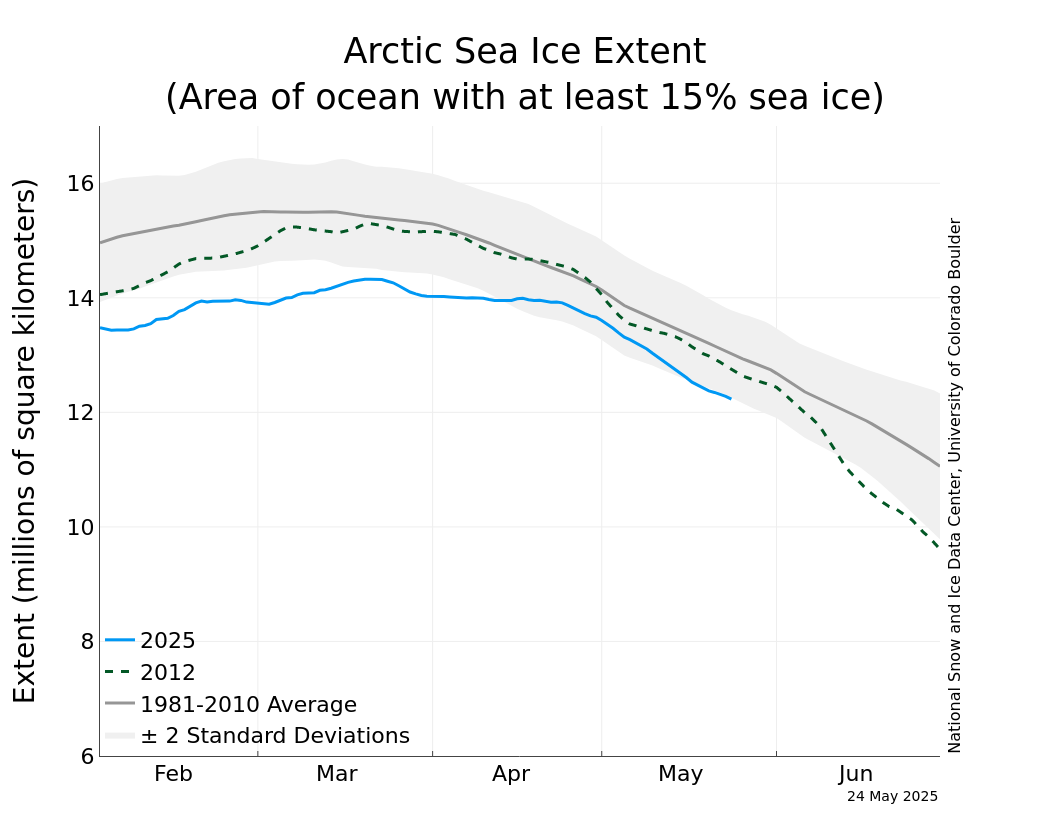
Sea ice data from the National Snow and Ice Data Center in Figure 1, indicate the mean monthly sea ice coverage has decreased between the years 1979 and 2012.

Figure 1.
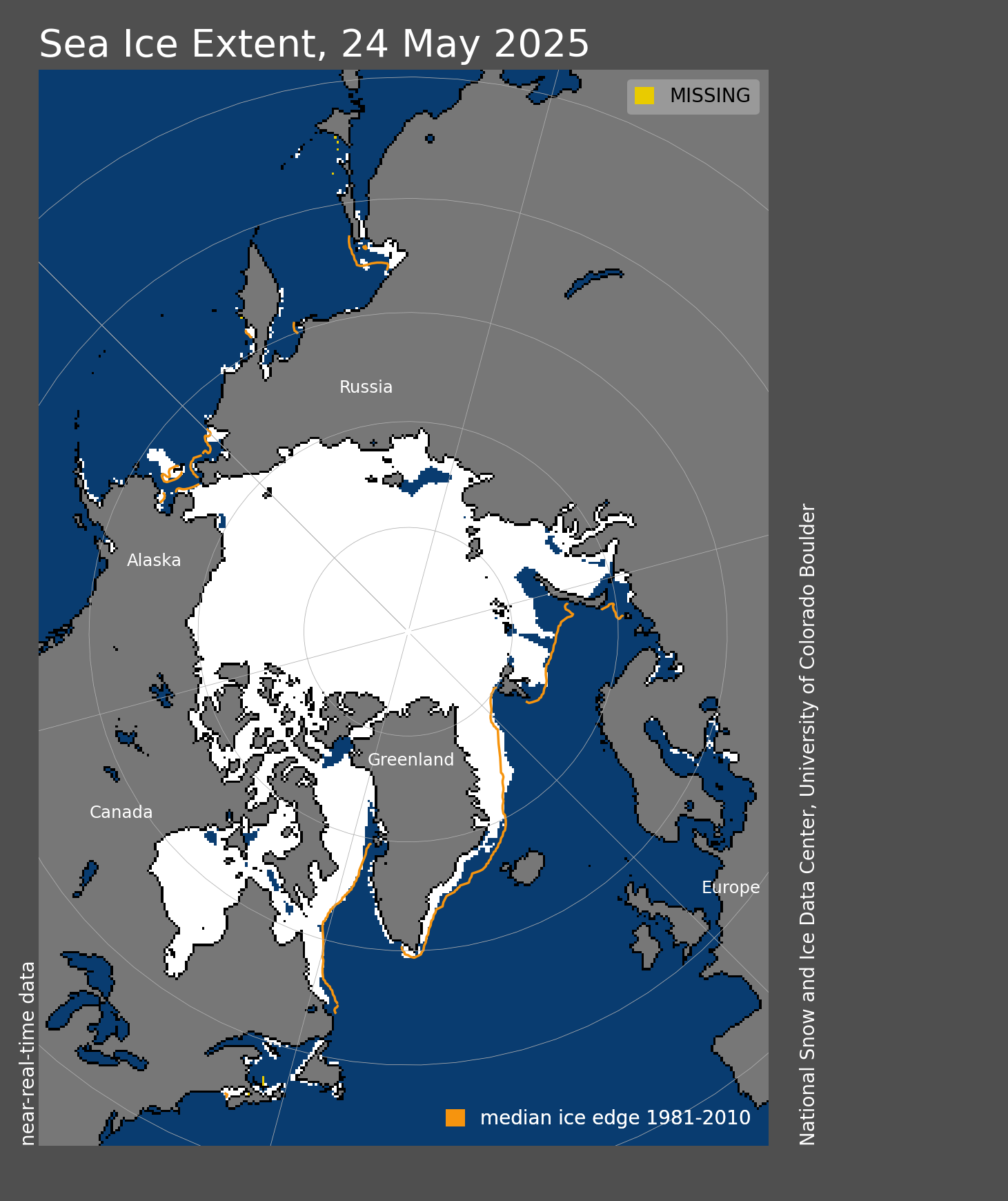
A plan view representation of sea ice extent is shown in Figure 2. The white region, representing the footprint of sea ice on October 2, 2012, is shown in comparison to the median footprint of sea ice during the period of 1979-2000 (orange outline).

Figure 2.
Science

Earth Scientists know from the geologic record that polar ice has changed over the last 12,000 years. Changes have occurred because of varied solar radiation and absorption. Further, on a geologic time scale, ice cover has grown or shrunk because of climate variation.

Sea ice is melting more dramatically each year. Scientists concur the melt is driven by climate change correlating to pollutants humans release into the atmosphere. A 2012 study of multi-decade sea ice variability concludes that 70 - 95% of the disappearance of Arctic ice since 1979 is due to human activity.

Within 10 years it will be impossible to travel to the North Pole by dog team. There will be too much open water.
― Will Steger

References

Popular