Showing posts with label Sierra Nevada. Show all posts

Saturday, October 24, 2015

One in the Sunbeam

From a creed steeped in sin and submission, grew an expansive creed of wonderment and awe. Naturalist and preservationist John Muir abandoned an evangelical upbringing to discover a god of nature.
That Muir was thus reborn, not from a life of sin to submission to the God of the Bible, but from a life of repression to revelation of the God of Nature, has left us the rich and inspiring legacy of his wilderness gospel.
― Mark R. Stoll
Inspired by the transcendence of the High Sierras, Muir wrote:

Mountains holy as Sinai. No mountains I know of are so alluring. None so hospitable, kindly, tenderly inspiring. It seems strange that everybody does not come at their call. They are given, like the Gospel, without money and without price. 'Tis heaven alone that is given away'.

Alpine meadow, boulders, and mountains in Humphries Basin
John Muir Wilderness, Sierra Nevada

For Muir the Sierras were a source of infinite well-being, awe, and wonderment. He described the deep calm and connection with a keen presence and awareness:

Here is calm so deep, grasses cease waving... Wonderful how completely everything in wild nature fits into us, as if truly part and parent of us. The sun shines not on us but in us. The rivers flow not past, but through us, thrilling, tingling, vibrating every fiber and cell of the substance of our bodies, making them glide and sing. The trees wave and the flowers bloom in our bodies as well as our souls, and every bird song, wind song, and; tremendous storm song of the rocks in the heart of the mountains is our song, our very own, and sings our love.

Folded rocks of Sevehah Cliff on the trail up Convict Canyon
John Muir Wilderness, Sierra Nevada

Of the resonance and oneness one experiences in the transcendence of nature, Muir wrote:

The Song of God, sounding on forever. So pure and sure and universal is the harmony, it matters not where we are, where we strike in on the wild lowland plains. We care not to go to the mountains, and on the mountains we care not to go to the plains. But as soon as we are absorbed in the harmony, plain, mountain, calm, storm, lilies and sequoias, forests and meads are only different strands of many-colored Light-are one in the sunbeam!


REFERENCES

Saturday, September 28, 2013

A Seat Among the Clouds

Mountains are the subject of legend and mythology. Some cultures revere mountains as sacred places. The rise, girth, steepness of mountain peaks piercing the clouds seem at times poetic and sacred, and awe inspiring.

Fittingly mountains are also the center of literary forms. In a poem by Gary Snyder, a Cold Mountain path becomes a metaphor for the trajectory of life where the trials of the trail lead to a seat among the clouds:
“Clambering up the Cold Mountain path,
The Cold Mountain trail goes on and on:
The long gorge choked with scree and boulders,
The wide creek, the mist-blurred grass.
The moss is slippery, though there's been no rain
The pine sings, but there's no wind.
Who can leap the world's ties
And sit with me among the white clouds?”
― Gary Snyder, Riprap and Cold Mountain Poems
A motion graphics video by Al Boardman illustrates the visual essence and characteristics of Earth's most extraordinary mountains from Everest to Monadnock:


For the Love of Mountains by Al Boardman on Vimeo.

EverestHighest Mountain in Altitude
K2Hardest Mountain to Climb
Annapurna IMost Dangerous Mountain
Gangkhar PuensumHighest Unclimbed Mountain
Ojos del SaladoHighest Active Volcano
KailashMost Sacred Mountain
LoganMountain with Largest Circumference
KilimanjaroHighest Free Standing Mountain
Mauna KeaTallest Mountain from Base to Summit
MonadnockMost Climbed Mountain

John Muir wrote,
"Climb the mountains and get their good tidings. Nature's peace will flow into you as sunshine flows into trees. The winds will blow their own freshness into you, and the storms their energy, while cares will drop away from you like the leaves of Autumn."
— John Muir, Our National Parks
Sacred places are physical and mental loci we return to for solace, well-being, peace and good tidings. On returning to climb in the Sierra Nevada after 31 years, Gary Snyder wrote,
“Range after range of mountains.
Year after year after year.
I am still in love.”
― Gary Snyder

REFERENCES

Saturday, November 3, 2012

Nature's Forces and Tools

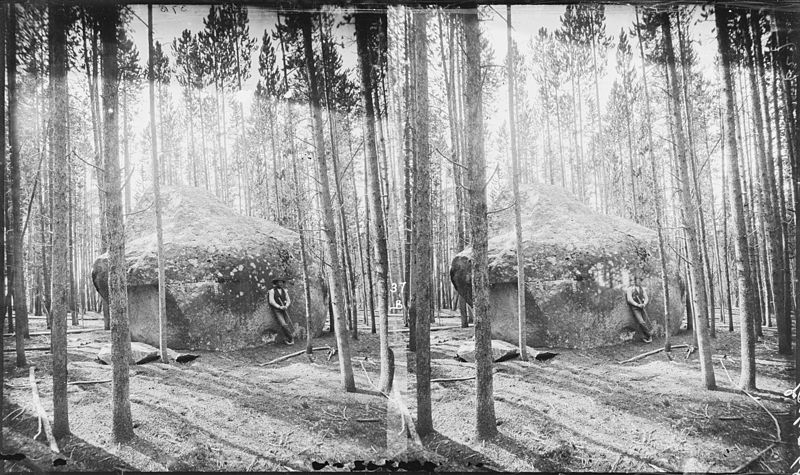
How a granite boulder, many times larger than man, finds it restful place amid a grove of lodgepole pines is a curiosity. The density of granite is about 2 tons per cubic yard.

What are the forces and what were the tools?

Granite boulder near Yellowstone Canyon.
Photograph by William Henry Jackson (1843–1942)
John Muir considered those questions in the summer of 1869 when he observed huge boulders in the high, cool pastures of the Sierra Nevada:
They look lonely here, strangers in a strange land, - huge blocks, angular mountain chips, the largest twenty or thirty feet in diameter, the chips that Nature has made in modeling her landscapes, fashioning the forms of her mountains and valleys. And with what tool were they quarried and carried?
― John Muir, My First Summer in the Sierra
Although controversial at the time, Muir believed receding glaciers, aided by water (solid and liquid) and by gravity, shaped the Sierra Nevada landscape by carving, fracturing, transporting, and depositing rock.

The Sierra Nevada was cold enough 2-3 million years ago to support ice fields and glaciers along the its crest. Ice fields sent out and sustained glaciers in many of the valleys. Muir recognized that:
Glacial ice quarried and transported huge volumes of rock debris.
Evidence suggests glacial ice scoured and modified the landscape. As the glaciers began melting away, much of the rock debris was deposited in situ, or flushed into valleys by swollen streams of melt-water.

Angular boulders on the summit of Mt. Whitney.
John Muir's observations and writings became a personal guide into nature for generations of people. American environmentalist Bill McKibben wrote:
"Muir invented a new grammar, a contagious vocabulary for communicating the splendor of the natural world."
Through rich prose, and via clear-thinking and insightful observation, Muir inspired and urged us into the modern paradigm of environmental consciousness -- the recognition that man is one of many creatures blessed by the vast wealth of nature and its phenomena.
"Climb the mountains and get their good tidings. Nature's peace will flow into you as sunshine flows into trees. The winds will blow their own freshness into you, and the storms their energy, while cares will drop away from you like the leaves of Autumn."
― John Muir
Muir's writing is both analytic and poetic.

To contemplate and consider the events and phenomena that surround us, these questions remain indispensable:
What are the forces and what were the tools?

REFERENCES

Popular