Showing posts with label Fossil. Show all posts

Saturday, January 23, 2016

Earth Tone Eyes

Imagining living organisms turned to stone is sensory and poetic in light of the asymmetric direction of time careening from the Devonian over 350 million years ago, into the epoch of industrialized humans called the Anthropocene.
"What we do see depends mainly on what we look for. ...In the same field the farmer will notice the crop, the geologists the fossils, botanists the flowers, artists the colouring, sportmen the cover for the game. Though we may all look at the same things, it does not all follow that we should see them."
― John Lubbock, The Beauties of Nature
Petoskey Stone
image: Michelle Pemberton
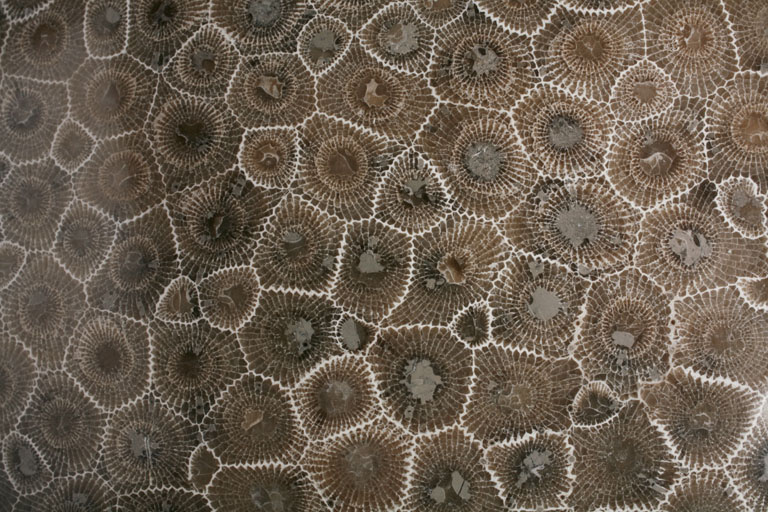
Considering a highly polished Petoskey stone, one imagines Earth tone eyes peering from hexagonal sockets.
"You can't depend on your eyes when your imagination is out of focus."
― Mark Twain
Petoskey stones are fossilized rugose coral. Rugosa are an extinct order of coral that thrived during the Devonian.

Fossilized coral is commonly found near the town of Petoskey in Michigan's Lower Peninsula.

The hexagonal sockets were once the coral's mouth, now frozen in time.

Close-up Petoskey Stone
image: Michelle Pemberton

"Time is the longest distance between two places."

― Tennessee Williams, The Glass Menagerie

REFERENCES

Saturday, November 21, 2015

The Forest Primeval

The first stanza of Longfellow's poem Evangeline sets the stage for a primal forest:
This is the forest primeval. The murmuring pines and the hemlocks,
Bearded with moss, and in garments green, indistinct in the twilight,
Stand like Druids of eld, with voices sad and prophetic,
Stand like harpers hoar, with beards that rest on their bosoms.
As ancient fossil forests are unearthed, scientists gather clues about nascent plant life and the prevailing climatic conditions of the time.

Fossilized forests discovered around the world, dated as far back as 380 million years ago, provide insights into Earth's ever-changing atmospheric composition and the corresponding climate changes on Earth.

During the Devonian some 420 to 360 million years ago, the atmosphere underwent a 15-fold decline in carbon dioxide. The decline is thought to be primarily attributable to carbon sequestration caused by the evolutionary emergence of large forest trees.

Carbon sequestration rates vary by forest age, composition, and location, but today we know that a single tree can absorb carbon dioxide at a rate of 48 lb. per year.

The decline in atmospheric carbon during the Devonian period is posited to have spawned large-scale global cooling that led to a period of glaciation.

Sketch of the forest floor in ancient fossil forest near Gilboa, New York
Frank Mannolini, New York State Museum

Fossil plant-life discovered in Schoharie County, New York in the 1850s, in 1920, and again in 2010, included the Gilboa stumps cited as Earth's oldest trees.
It was like discovering the botanical equivalent of dinosaur footprints. But the most exciting part was finding out just how many different types of footprints there were. The newly uncovered area was preserved in such a way that we were literally able to walk among the trees, noting what kind they were, where they had stood and how big they had grown."
― William Stein, Binghamton University, 2010
Researchers have unearthed another forest with fossilized tree stumps preserved in place in Svalbard, a Norwegian archipelago in the Arctic Ocean. 380 million years ago, Svalbard was located near the equator.

Reconstructed drawing
Fossil forest, Svalbard
Since the Devonian period, plate tectonics has transported Svalbard to its current location in the arctic ocean.
"These fossil forests shows us what the vegetation and landscape were like on the equator 380 million years ago, as the first trees were beginning to appear on the Earth."
― Chris Berry, Cardiff University
By the phenomena of carbon sequestration, trees absorb structure-forming carbon from atmospheric carbon dioxide through photosynthesis.
"The evolution of tree-sized vegetation is the most likely cause of this dramatic drop in carbon dioxide because the plants were absorbing carbon dioxide through photosynthesis to build their tissues, and also through the process of forming soils."
― Chris Berry
Svalbard is also in the forefront of preserving plant diversity. One of the northernmost inhabited villages on Earth, Svalbard is the site chosen by the Norwegian government in 2008 for the Global Seed Vault. Secured in the permafrost, the Svalbard seed vault is the largest seed storage in the World.
"In some mysterious way woods have never seemed to me to be static things. In physical terms, I move through them; yet in metaphysical ones, they seem to move through me."
― John Fowles

REFERENCES

Saturday, March 1, 2014

Cosmic Newcomers

Humans are cosmic newcomers.

It is commonly held that our home planet coalesced from cosmic dust and gas. Carbon-based life is a relatively recent event. Life is a viral outbreak that occurred billions of years ago on Earth.

The profundity of carbon-based life is that chemical organisms replicate and grow in complexity.

Life, and more specifically human life, is a latecomer to the existential table.

Humans are a puff, a wink, or a dream.
Men come and go, cities rise and fall, whole civilizations appear and disappear-the earth remains, slightly modified. The earth remains, and the heartbreaking beauty where there are no hearts to break....I sometimes choose to think, no doubt perversely, that man is a dream, thought an illusion, and only rock is real. Rock and sun.
― Edward Abbey, Desert Solitaire: A Season in the Wilderness
Many geologists think our atmosphere and oceans arrived on the Earth about 4 billion years ago either from a series of volcanic eruptions or from comets colliding with earth that released water and gases.

Evidence of Life

How long before life emerged from the chemical soup of oceans and atmosphere?

The first evidence of life, inferred from the chemical record (e.g., Carbon isotope C-12 to C-13 ratio), dates from 3.85 to 3.65 billion years ago. The first undisputed fossils appear in rocks about 3.2 billion years ago.

Human footprints appear 1,500,000 years ago. The first humans fossils known to us are from 195,000 years ago.
Artifact
Years Ago
Atmosphere and Ocean4,000,000,000
Life3,850,000,000
Fossil3,200,000,000
Human Footprint1,500,000
Human Fossil195,000

I stand for what I stand on.
― Edward Abbey

REFERENCES

Saturday, July 7, 2012

The Nature of Sea Levels

Sea Surface by Petr Kratochvil
Sea level is the average height of the ocean's surface. Sea levels have fluctuated over time.

Measurement

Mean Sea Level is a way to express the elevation of the sea with wave motion and tide changes averaged out.

Geologic observation and artifacts narrate the story of the oceans.

Constant Change


Bermuda
Sea level fluctuations are preserved in the geologic record.

Sedimentary and fossil records are often the key to estimating historic sea levels. Coral reefs are also accurate markers because they grow just below the prevailing sea level of the time.

There is sedimentary and fossil evidence that sea level was more than 21 meters (70 ft) higher 400,000 years ago than it is today:
...sedimentary and fossil evidence in the walls of a limestone quarry in Bermuda that documents a rise in sea level during an interglacial period of the Middle Pleistocene in excess of 21 meters above its current level. ~ Dramatic Rise In Sea Level And Its Broad Ramifications Uncovered


Ocean and Continents

Western Interior Seaway
The notion of the familiar borders between oceans and continents seems static within the time scale of a human lifetime. Over a geologic timescale, oceans and continents appear ever-changing.
Even Castles made of sand, fall into the sea, eventually.
~ Jimi Hendrix
The Western Interior Seaway was an inland sea that divided North American into two landmasses during the Mid-to-Late Cretaceous period. Vast carbonate deposits indicate the Seaway was warm and tropical.

The shallow Western Interior Seaway supported abundant marine life and early birds.

References

Popular