Showing posts with label Galileo Galilei. Show all posts

Saturday, April 23, 2016

Worldview

Galileo's Dialogue Concerning the Two Chief World Systems, published in 1632, compared the staunchly held Ptolemaic system with worldview changing Copernican theory.

Ptolemaic systemThe Universe orbits the Earth
Copernican systemThe Earth orbits the Sun

By 1633 Galileo's Dialogue Concerning the Two Chief World Systems had been put on the Index of Forbidden Books. Commissioned by Ferdinando II de' Medici, Galileo's book was banned because it was "vehemently suspect of heresy".

From the 21st century, this 17th century heresy is a mere historical footnote. Acceptance of the Copernican system marks a plot point in an evolving narrative forming a fundamental human-centric existential construct.
If you could see the earth illuminated when you were in a place as dark as night, it would look to you more splendid than the moon.
— Galileo Galilei

Earth viewed spacecraft circling the moon
source: NASA Lunar Reconnaissance Orbiter

Human space travel has caused new figurative and literal perspectives of Earth.
It's tiny out there… it's inconsequential. It's ironic that we had come to study the Moon and it was really discovering the Earth.
— William Anders, Apollo 8, When We Left Earth: The NASA Missions
One's worldview, the prevailing human-centric existential construct, is updated in fits and starts as we reconcile new information.


REFERENCES

Saturday, July 25, 2015

Looking Inward

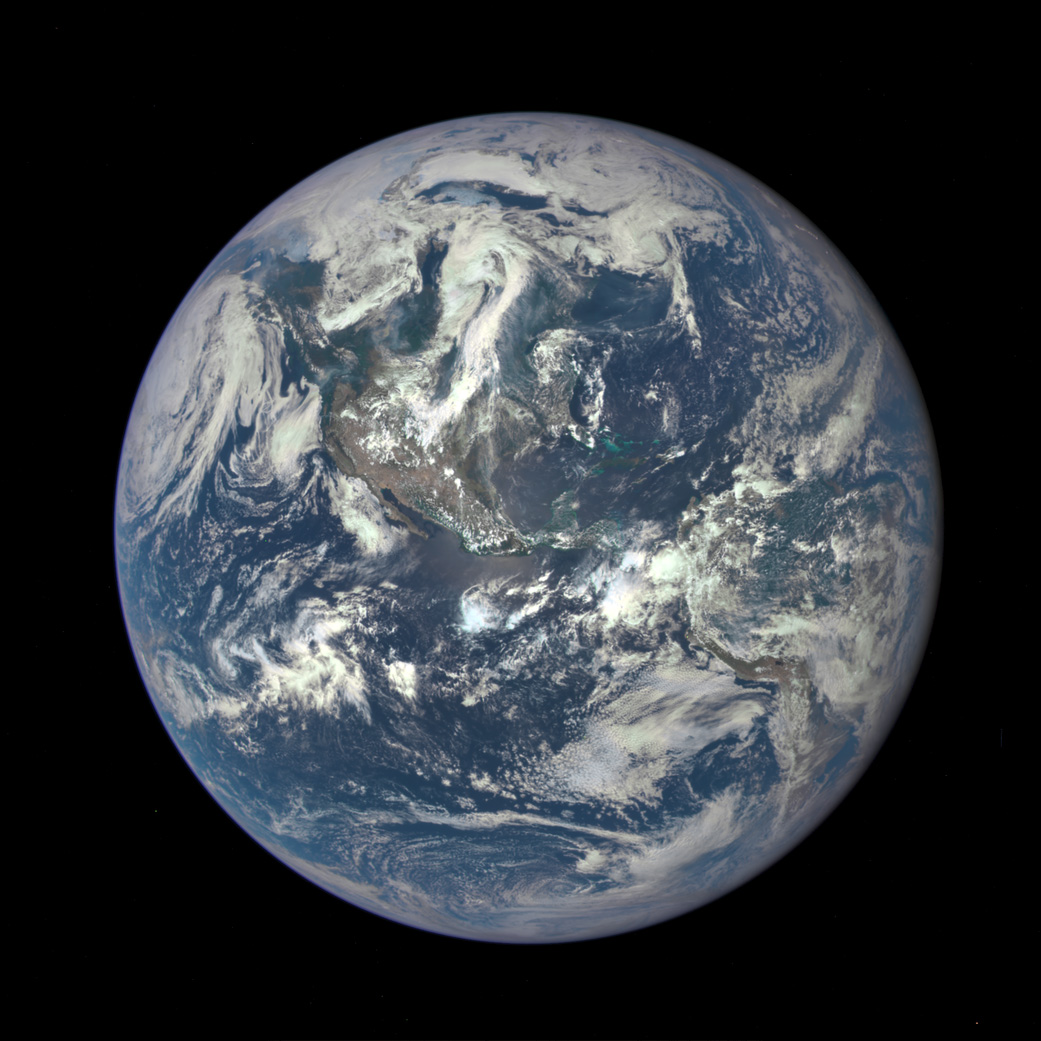
Early July, for the first time since December 1972 when Apollo 17 astronauts made the stunningly beautiful and transformational Blue Marble photographs, DSCOVR returned its first image of the sunlit face of Earth.

Following a million miles journey to the L1 Lagrange Point, the DSCOVR satellite positioned its gaze back toward Earth.
The medieval notion of the earth put man at the center of everything.
— Archibald MacLeish
Lagrange Points L1 - L5
Lagrange points are positions in an orbital configuration of two large bodies, like the Sun and Earth, where a small object like a satellite, pulled by the gravity of the large bodies, maintains a stable position.
Too close to the Sun, DSCOVR moves toward the Sun. Too close to Earth, DSCOVR moves Earthward.
Images from DSCOVR are made using NOAA's imaging instrument dubbed EPIC for Earth Polychromatic Imaging Camera.
If you could see the earth illuminated when you were in a place as dark as night, it would look to you more splendid than the moon.
— Galileo Galilei
Sunlit side of Earth
acquired July 6, 2015 by DSCOVR

To see the earth as it truly is, small and blue and beautiful in that eternal silence where it floats, is to see ourselves a riders on the earth together, brothers on that bright loveliness in the eternal cold—brothers who know now they are truly brothers.
— Archibald MacLeish

REFERENCES

Saturday, October 20, 2012

Golden Ratio in Nature

In words, the golden ratio is:
The ratio of the sum of two quantities over the larger quantity is equal to the ratio of the larger quantity over the smaller one.
The golden ratio expressed as an equation is:

(a + b) / a = 1.618 = a / b

From the golden ratio, we get a mathematical constant - a number. It is the number 1.6 which, by convention, is represented by the Greek letter φ (pronounced "fee").

The number φ is a mathematical curiosity. Like the mathematical constant π, φ appears everywhere.
Ginkgo Leaf
The good, of course, is always beautiful, and the beautiful never lacks proportion.
– Plato
The golden ratio is found in the proportions of leaves. I measured the golden ratio in the leaf of a ginkgo tree.

Using the typographical units of pica, I measured 28 pica from the notch to the base of the stem of a ginkgo leaf. I then measured 17 pica from the top of the stem to the base of the stem (length a).

The quotient of 28 pica over 17 pica yields the golden ratio 1.6.

Scientists have recently observed nanoscopic symmetry. The symmetry they observed had the attributes of the golden ratio, demonstrating this curious proportion at the quantum level.
The universe cannot be read until we have learnt the language and become familiar with the characters in which it is written. It is written in mathematical language, and the letters are triangles, circles and other geometrical figures, without which means it is humanly impossible to comprehend a single word.
– Galileo Galilei
References

Popular