Showing posts with label Alan Watts. Show all posts

Saturday, March 19, 2016

Spring Snow

The curiosity of life is seldom more poetic, rarely more tenuous, and scarcely more improbable than when a fledgling green shoot pokes through a covering of spring snow.
Life is a gamble, at terrible odds. If it were a bet you wouldn’t take it.
― Tom Stoppard
The animation prevails however temporarily, however incongruently, in an ever-flowing cycle ― like some sort of Möbius band driven by the energy of the Sun.


Spring snow
by Bob MacNeal
Spring Snow
by Richard Greene

Wet snow coats
twig, branch and bud.
Against the still black street
the waning season
limns its last words
in bold calligraphy.

Life flourishes despite a confluence of improbability of astonishing breadth ― from that which is too tiny to see, to that which is too large to imagine.

Spring snow shoots
by Bob MacNeal
In the upper latitudes of Earth's thin biosphere, a season seems like an exit through a door frame that, at its threshold, becomes an entrance to whatever follows.

Earth is our sacred shelter ― a temporary home for life, the animate, the inanimate, and events inevitable and unlikely.

Yukio Mishima wrote that everything has a quality of sacredness that can defiled by touch.
Once we are even marginally separated from what we can touch, the object is sanctified; it acquires the beauty of the unattainable, the quality of the miraculous. Everything, really, has this quality of sacredness, but we can desecrate it at a touch. How strange man is! His touch defiles and yet he contains the source of miracles.
― Yukio Mishima
Relative newcomers, homo sapiens thrive on sacred ground informed by physical and phenomenological evidence that our species is the most destructive life force in the annals of Earth.

Spring snow rock
by Bob MacNeal

It must be obvious... that there is a contradiction in wanting to be perfectly secure in a universe whose very nature is momentariness and fluidity.
― Alan Watts

REFERENCES

Saturday, May 18, 2013

Morning Rain

Thunder breaks my sleep. Night falls away to water dripping, clinging, and coursing. I don't know if my eyes are open.

Sounds, smells, and bright flashes carry me into the sharpness of my senses.
the moon is fleet
while branches clasp
to the rain
-Matsuo Bashō (1644-94)
Alan Watts wrote,
In Zen a man has no mind apart from what he knows and sees.
I notice my mind begins floating on the sounds of water. Water is not aware of the passing of the night, or of itself.
the long night;
the sound of water
says what I think
-Gochiku (1699-1781)
Water flows with purpose around obstacles. It has no commentary, no forethought, only purpose. Rain flows in a course like our deepest and most lasting knowledge is confined by experience.
spring day;
evening remains
in pools
-Kobayashi Issa (1763-1827)
We are often flooded by forethought or inundated by memories. Yet when an earthworm surfaces after a rain to move overland, it has no forethought of air travel. An earthworm never knows it will be plucked from the ground by a robin to be flown off to feed her hungry brood.


REFERENCES

Saturday, January 12, 2013

Water Revolutions

Temperature starts revolutions.

Probe any natural phenomena with the 5 Whys. Prepare yourself to leap from the concrete and observable to the speculative and spiritual by the third why.
I keep six honest serving-men
(They taught me all I knew);
Their names are What and Why and When
And How and Where and Who.

— Rudyard Kipling, excerpt from the tale of The Elephant's Child
If you examine any natural phenomena with the 5 Whys, one why is usually down to temperature. Temperature seems to be the engine of flow in much of nature.

Temperature drives change. It starts revolutions.

Fresh Water Lakes
"Who comes to a lake for water and sees the reflection of moon?"
― Rumi
Lake water undergoes a temperature-driven revolution during each seasonal cycle.

During the hottest and the coldest time of the year, lake water temperatures are sharply stratified from top to bottom. On the contrary, during the transitional periods from cold to warm, or from warm to cold, the water temperature in lakes overturns to become well-mixed (i.e., nearly homogeneous from top to bottom).

Seasonal Temperature Profile of a Lake in the Northern Hemisphere

Great Northern Loon
Temperature stratification is experienced by swimmers. During warm months, swimming near the surface, the water is pleasantly warm. Diving down to swim at depth, the water is refreshingly cool.
"When you swim you don't grab hold of the water, because if you do you will sink and drown. Instead you relax, and float."
― Alan Watts
The depth where the water temperature changes most rapidly, is the thermocline depth, or metalimnion.

During the coldest months, lakes might ice over. Ice and snow cover reflect incident solar radiation. A cold strata of denser water will overlie the less dense, warmer water below. Stratification foments ripeness for change.

Sunset over the ice of Lake Superior
Cause and effect of the seasonal overturn of lake water is orchestrated by the inter-related properties of water:
  1. Temperature changes density; and
  2. Density changes buoyancy.
The stratification that occurs during temperature extremes is inherently unstable, just as the well-mixed water of the transitional seasons is ripe for stratification.

The revolution is ongoing, repetitious, and sublimely beautiful in its simplicity.


REFERENCES

Saturday, October 13, 2012

Earth Rhythms

Autumn is a time for noticing changes and for witnessing life-cycles. It is also a time that lends itself to introspection. For many, Fall is the season when:
we look, rather than overlook.
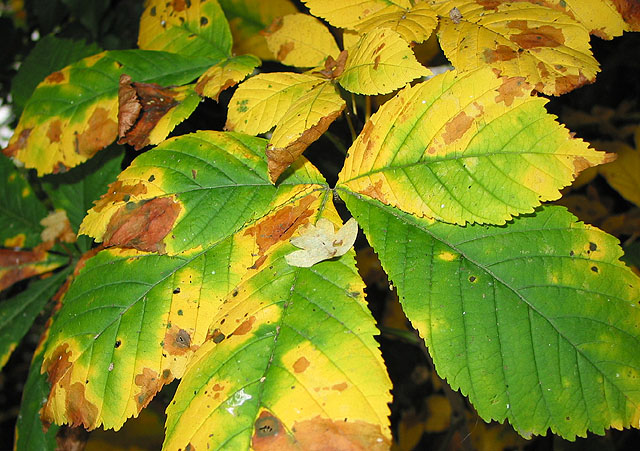
Horse Chestnut leaves on
the banks of the River Wye.
We are melancholic, but pleasantly befuddled by the essence of our mortality.

Autumn Leaves is a wistful tune sung by Nat King Cole and many talented singers.
Autumn Leaves
Johnny Mercer

The falling leaves drift by the window
The autumn leaves of red and gold
I see your lips, the summer kisses
The sun-burned hands I used to hold

Since you went away the days grow long
And soon I'll hear old winter's song
But I miss you most of all my darling
When autumn leaves start to fall

Translated to English from the 1945 French song Les Feuilles Mortes, i.e., "The Dead Leaves", the lyrics of Autumn Leaves expresses the longing we have for what we might have lost and for what we are about to lose.

Autumn is a rhythm of life. The earth's rhythms are plentiful and rewarding to those who observe them.

Earth's Rhythms

The word rhythm derives from the Greek ῥυθμός—rhythmos, meaning "any regular recurring motion, symmetry".

Rhythm describes a regular recurrence or pattern in time. Earth's rhythms appear in cyclical phenomena from microseconds to millions of years.

Time Scales

The rhythm of night and day is a Circadian Rhythm. The word circadian was coined by scientist Franz Halberg in 1959. It comes from the Latin words circa (i.e., around) and diem (singular of dies).

Halberg was a pioneer in Chronobiology (the study of biological rhythms, such as daily, tidal, weekly, seasonal, and annual rhythms). In the context of living organisms, circadian rhythms are both built-in and adjusted to environmental cues. Environment cues are called zeitgebers (i.e., a German word meaning synchronizers). One zeitgeber is daylight.

Relationship between ethological terms and parts of the day.
Circadian rhythms for living organisms are further described by the period within the cycle where they are most active, that is:
  • Diurnal (daytime);
  • Nocturnal (night time); and
  • Crepuscular (dawn and dusk hours).
The term Matutinal describes the pre-dawn or early morning hours. The morning glory is a matutinal flower that unravels into full bloom in the early morning. The flowers begin to fade a few hours before it closes its blooms later in the day. Vespertine describes dusk and evening hours where animals like deer are most active.

Other Rhythms

Echelon flock formation
of migratory birds
There are many temporal patterns other than circadian rhythm including the non-24-hour Infradian and Ultradian rhythms:

Infradian rhythms are cycles longer than a 24-hour day. For example,
  • the annual migration of birds;
  • the varied reproductive cycles of animals; and
  • the human menstrual cycle.
Ultradian rhythms are shorter than 24 hours. For example,
  • the 90-minute REM cycle;
  • the 4-hour nasal cycle of congestion/decongestion, and
  • the 3-hour cycle of growth hormone production.
Other notable rhythms include the cycle of ocean tides and gene oscillations in living organisms.
Tide pool in Portugal

Tidal rhythms are cycles that emerge from the roughly 12-hour transition from high to low tide and back.

Gene oscillations describe a phenomena where genes are more active during certain hours of the day (acrophase) and less active in the time (bathyphase).
I'm so glad I live in a world where there are Octobers.
― L.M. Montgomery, from Anne of Green Gables
Meditation

There is a measure of serenity in earth rhythms, the seemingly friction-less spin of the earth, and the earth's reliable orbit around the sun.
Nature's peace will flow into you as sunshine flows into trees. The winds will blow their own freshness into you, and the storms their energy, while cares will drop away from you like the leaves of Autumn.
― John Muir
All existence seems a pulsating rhythm. I wonder if my heart pulsates in harmony the changing color of leaves. At some level, I think it does.
...if you become aware of the fact that you are all of your own body, and that the beating of your heart is not just something that happens to you, but something you're doing, then you become aware also in the same moment and at the same time that you're not only beating your heart, but that you are shining the sun. Why? Because the process of your bodily existence and its rhythms is a process, an energy system which is continuous with the shining of the sun, just like the East River, here, is a continuous energy system, and all the waves in it are activities of the whole East River, and that's continuous with the Atlantic Ocean, and that's all one energy system and finally the Atlantic ocean gets around to being the Pacific Ocean and the Indian Ocean, etc., and so all the waters of the Earth are a continuous energy system. It isn't just that the East River is part of it. You can't draw any line and say 'Look, this is where the East River ends and the rest of it begins.'
― Alan Watts
References

Popular