 |
| Lake Erie algae |
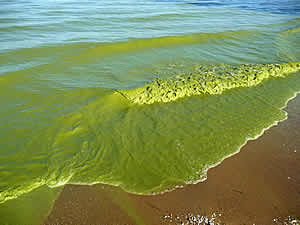
This summer a cyanobacterial bloom in Lake Erie left 400,000 people without drinking water for two days.
America the Beautiful
Oh Beautiful for smoggy skies, insecticided grain,
For strip-mined mountain's majesty above the asphalt plain.
America, America, man sheds his waste on thee,
And hides the pines with billboard signs, from sea to oily sea.
― George Carlin
 |
| Water near Toledo intake Photograph: Haraz N. Ghanbari/AP |
The dominant organisms of the summer season algal blooms occurring in Lake Erie are microcystins.
Microcystis causes skin rashes. If ingested it causes vomiting and liver damage. Microcystis can be fatal if ingested by dogs or other animals.
Freshwater algae blooms create adverse conditions because they:
- deplete the dissolved oxygen content of water;
- contaminate drinking water making it impotable;
- threaten commercial and recreational fisheries; and
- degrade recreational swimming and fishing.
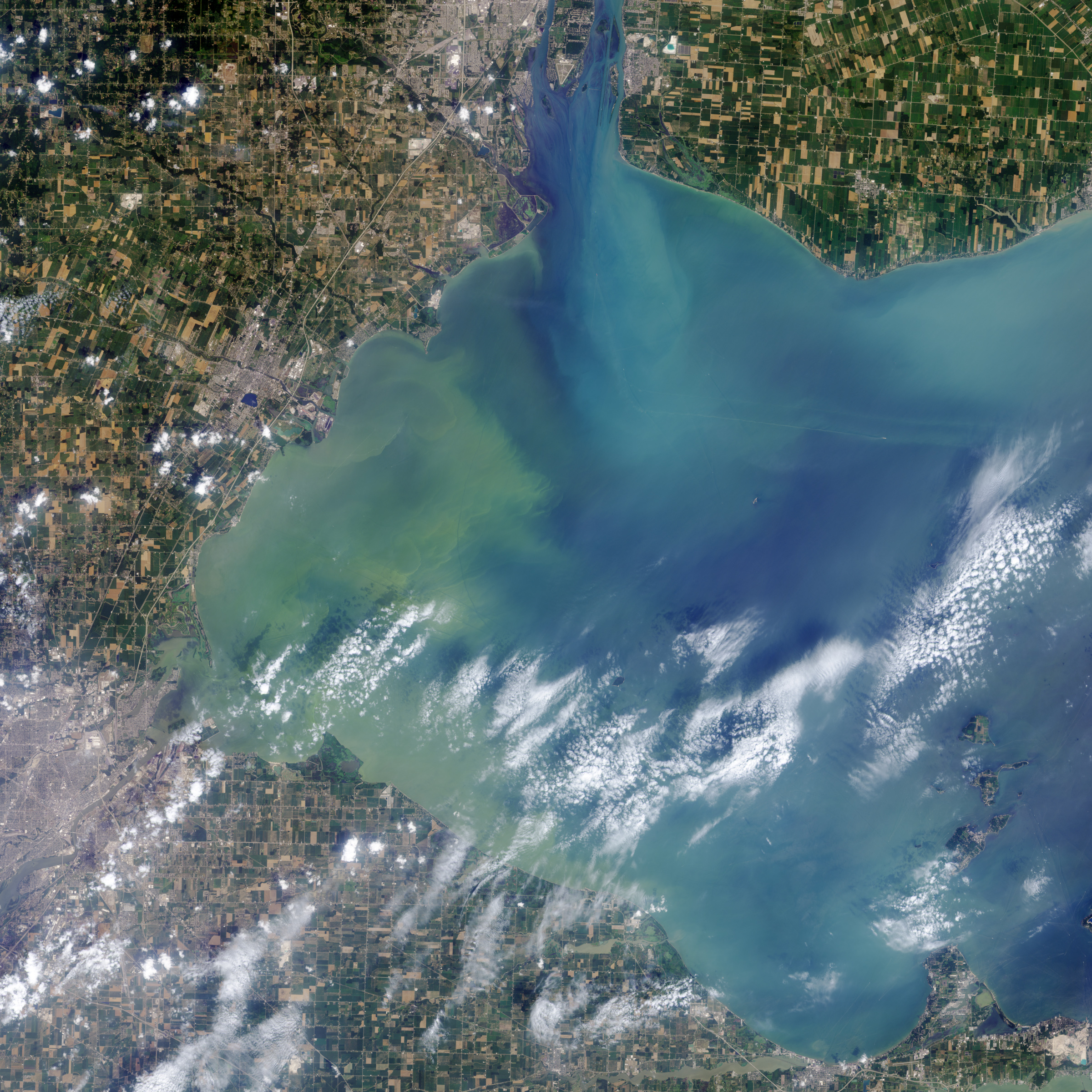 |
| Algae bloom in the west end of Lake Erie NASA’s Aqua satellite, 8/1/14. |
We assume that everything's becoming more efficient, and in an immediate sense that's true; our lives are better in many ways. But that improvement has been gained through a massively inefficient use of natural resources.
― Paul Hawken
REFERENCES
- Aqua Project Science, NASA.
- Farming practices and climate change at root of Toledo water pollution, by Suzanne Goldenberg, The Guardian, 3 August 2014.
- Record-setting algal bloom in Lake Erie caused by agricultural and meteorological trends consistent with expected future conditions, Michalak, A.M., et al., Proceedings of the National Academy of Sciences, Vol. 110 (16), 6448-6452, 2013.


