Showing posts with label Aldo Leopold. Show all posts

Saturday, November 1, 2014

Everything is Hitched

John Muir wrote,
"When we try to pick out anything by itself, we find it hitched to everything else in the Universe." 
Wolf Reintroduction, January 1995.
What-eats-what in the biosphere is a dynamic web where organisms are hitched. Consider the grey wolf.

Grey wolves were extirpated from Yellowstone by the mid-1920s. During the winters of 1995-96 wolves were re-introduced to the park after a 70-year absence.

This ecological tinkering has allowed scientists to study a textbook example of a trophic cascade.

Trophic cascades occur when a predator reduces the population of its prey. This population reduction cascades to release the next trophic level from predation. Grey wolves are apex predators. Grey wolves have gradually surpressed the population of elk in the park since their reintroduction.

Eleven-member wolf pack in winter, Yellowstone National Park, 2001

Elk are ruminant mammals. They consume grasses, plants, leaves, and bark.

The suppression of the elk population has enabled plant species like aspen, cottonwood, and willow to flourish. Scientists have observed the top-down impact of the grey wolf since its reintroduction in Yellowstone 15 years ago. The abundance and diversity of plant species have increased.

Source: Trophic cascades in Yellowstone: The first 15 years after wolf reintroduction

Aldo Leopold first described the concepts of trophic cascades after observing the overgrazing of mountain slopes following the extermination of wolves.
“We reached the old wolf in time to watch a fierce green fire dying in her eyes. I realized then, and have known ever since, that there was something new to me in those eyes – something known only to her and to the mountain. I was young then, and full of trigger-itch; I thought that because fewer wolves meant more deer, that no wolves would mean hunters’ paradise. But after seeing the green fire die, I sensed that neither the wolf nor the mountain agreed with such a view.”
― Aldo Leopold
Bottom-up cascades also occur. Changes in the abundance and diversity of plants will directly impact higher level predation and population.
“Only the mountain has lived long enough to listen objectively to the howl of the wolf.”
― Aldo Leopold
Wolves howling at the moon is a compelling myth. A howling wolf is a plaintive reminder of our existential connection to all living things. Seeing constellations in the night sky while wolves howl harkens us to consider our place in the cosmos. We are bound to a thin band of life that covers the Earth. Everything is hitched.


REFERENCES

Saturday, April 6, 2013

Illusion and Delusion

Our relationship with nature is often marked by illusion, delusion, and a false sense of separateness.
Sand Castle, Cannon Beach

Making a sand castle on the edge of a sandy lake, an estuarine bay, or an ocean, we delight in creating, shaping, and altering the landscape.

The pleasure of sand castle making gives some insight into the desire to shape and exert controls over our ecosystem.
Nature, with equal mind,
Sees all her sons at play,

Sees man control the wind,
The wind sweep man away.

Matthew Arnold, from Empedocles on Etna
Man controls the wind, but the wind sweeps man away.

The Delusion of Control

Poet Matthew Arnold reveals our delusion of control, that is
the false duality of man of- and man apart from- the very flow of the wind.
Like sand castles, the shape and seemingly static quality of nature is, at best, temporal. The false struggle that pits man against nature is part of the human narrative.
“When we see land as a community to which we belong, we may begin to use it with love and respect.”
― Aldo Leopold
Part of the human narrative reveals a sisyphean quest - whether it is the unrealized plan to divert the Mississippi River for flood control, or a scheme to protect Los Angeles from boulders ejected from adjacent mountains by tectonic compression (cf. The Control of Nature by John McPhee).
"Nature is trying very hard to make us succeed, but nature does not depend on us. We are not the only experiment."
― Buckminster Fuller
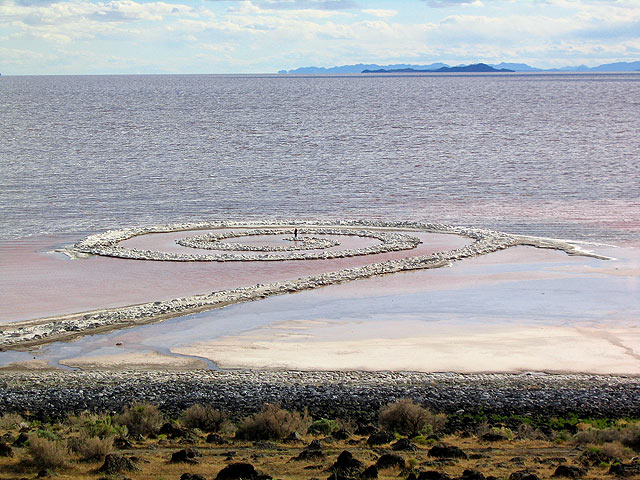
Spiral Jetty by Robert Smithson
Artists have used the natural landscape to create the illusion of control.

The Illusion of Control

Sand castle building almost certainly gives us a window into the psyche of the makers of land art.

Land art, Earthworks is a phrase coined by Robert Smithson. Land art is created using soil, rock, organic media, and water.

The landscape becomes the means of the creation.
"...the artist seeks.... the fiction that reality will sooner or later imitate"
― Robert Smithson
Land art celebrates the illusion of control.

Spring Summer 6, Walter Mason

Humans are like daisy petals coalesced in a pool. We ebb and flow with nature contracting toward orderliness, while simultaneously expanding toward chaos.
"I only went out for a walk and finally concluded to stay out till sundown, for going out, I found, was really going in."
―  John Muir, 1913

REFERENCES

Saturday, February 16, 2013

Nature Writing

Mystic Lake, 1872
by William Henry Jackson
Nature writing reaches a crest when it is poetic and mysterious, yet grounded in the observational discipline of scientific inquiry.

Most often written in the first-person, readers are treated to the author's reflections and existential musing. The earthly mechanics of nature provide a wealth of metaphors.
"The grand show is eternal. It is always sunrise somewhere; the dew is never dried all at once; a shower is forever falling; vapor is ever rising. Eternal sunrise, eternal dawn and gloaming, on sea and continents and islands, each in its turn, as the round earth rolls."
― John Muir
Nature writing engages our senses, coaxing from us heightened sensory awareness. At its best, nature writing reminds us training our senses enables us to see beyond mere highlight, shadow, and color.
"It's all a matter of keeping your eyes open...If I can't see these minutiae, I still try to keep my eyes open. I'm always on the lookout for antlion traps in sandy soil, monarch pupae near milkweed, skipper larvae in locust leaves. These things are utterly common, and I've not seen one."
― Annie Dillard, Pilgrim at Tinker Creek
Words and phrases engage our auditory sense:
"Every hidden cell is throbbing with music and life, every fiber thrilling like harp strings."
― John Muir, The Wilderness World of John Muir
Words and phrases engage our olfactory sense:
"In the spring, at the end of the day, you should smell like dirt."
― Margaret Atwood, Bluebeard's Egg
Words and phrases appeal to our sense of taste:
"One swallow does not make a summer, but one skein of geese, cleaving the murk of a March thaw, is the spring."
― Aldo Leopold
Words and phrases appeal to our primal instinct to connect:
"One touch of nature makes the whole world kin."
― John Muir, Our National Parks
Nature writing is often deliciously multi-sensory:
"Once there were brook trout in the streams in the mountains. You could see them standing in the amber current where the white edges of their fins wimpled softly in the flow. They smelled of moss in your hand. Polished and muscular and torsional. On their backs were vermiculate patterns that were maps of the world in its becoming. Maps and mazes. Of a thing which could not be put back. Not be made right again. In the deep glens where they lived all things were older than man and they hummed of mystery."
― Cormac McCarthy, The Road
From acute sensory experience, the best nature writers deftly transition to existential ruminations and philosophy. Compelling nature writing frames the alluring sensory experience with the limit of our senses, our morality:
"Autumn teaches us that fruition is also death; that ripeness is a form of decay. The willows, having stood for so long near water, begin to rust. Leaves are verbs that conjugate the seasons."
― Gretel Ehrlich, The Solace of Open Spaces
"All through autumn we hear a double voice: one says everything is ripe; the other says everything is dying. The paradox is exquisite. We feel what the Japanese call "aware"--an almost untranslatable word meaning something like "beauty tinged with sadness."
― Gretel Ehrlich, The Solace of Open Spaces
Nature writers invite us to find comfort and solace:

"Those who contemplate the beauty of the earth find reserves of strength that will endure as long as life lasts. There is something infinitely healing in the repeated refrains of nature -- the assurance that dawn comes after night, and spring after winter."
― Rachel Carson, Silent Spring
From comfort and solace, we are gently coerced to the short leap into meditation and philosophy:
Being the Stream

Meditation is not just a rest or retreat from the turmoil of the stream or the impurity of the world. It is a way of being the stream, so that one can be at home in both the white water and the eddies. Meditation may take one out of the world, but it also puts one totally into it."

― Gary Snyder

REFERENCES

Saturday, June 23, 2012

Fire and Life

Uncontrolled wildland fires occur naturally. Wildfire is an integral part of its ecosystem.

Fire Ecology is the study of fire dependence, the adaptation of plants and animals to wildfires, and fire effects on ecosystems.
No matter how intently one studies the hundred little dramas of the woods and meadows, one can never learn all the salient facts about any of them.
― Aldo Leopold

High Park Fire

The High Park fire is burning in the Arapaho and Roosevelt National Forests and the Pawnee National Grassland in north central Colorado. Thick timber and large stands of Mountain Pine Beetle-devoured trees provide the fuel.

NASA satellite image of the High Park Fire.  June 10, 2012
High winds and hot, dry weather caused the High Park fire spread rapidly over tens of thousands of acres.

Fire and Life

Lodgepole Pine Cone
Many plant species require fire to germinate, establish, or reproduce.

The Lodgepole Pine depends on fire to germinate, establish, and reproduce. Lodgepoles produce resin-coated, serotinous pine cones.

The resins seal the scales of the cones protecting the seeds inside. Lodgepole seeds often remain sealed for decades.

Eventually a passing fire provides enough heat to melt the resin. The cone scales open up to release their seeds to the forest floor. Without wildland fires, Lodgepole seeds would likely never be released.

The heat from the fire does not penetrate the soil more than a few centimeters. This affords the seeds the required nutrients to quickly germinate and to give life to a new generation.

References

Popular