Showing posts with label Fire. Show all posts

Saturday, May 7, 2016

Obligate Seeders

Fort McMurray wildfires
Smoke travelled 1130 miles overnight from the Fort McMurray wildfires, drifted into the window before daybreak, bringing the scent of burning pitch.

In Chinese cosmology, Yin and Yang is a metaphorical construct of opposing but complimentary forces. The continuous joining and separation of Yin and Yang regulates the rise and disappearance of all entities and phenomena in the cosmos.

A theme in the poem Fire Flowers by E. Pauline Johnson, first printed in a Canadian newspaper in December 1894, is that from desolation comes renewal.


The poet's personified purple-headed wild flowers emerge from the desolation of fire. Life revives. Life's resilience is its wonder.

If Yin is the tender green shoot, then Yang is the fire's heat that melted its seed coat.

In apparent cyclical perpetuity, death is the catalyst. Plants with fire-activated seed coats germinate and grow soon after the fire recedes. Such plants are called obligate seeders.


Elk Bath
A wildfire in the Bitterroot National Forest
by John McColgan

Obligate means to oblige, compel or commit, which are actions with an implied interdependence like the continuous joining and separation of Yin and Yang. In a analogous way, all living things become obligate seeders.


REFERENCES

Saturday, September 21, 2013

Fall Meditation

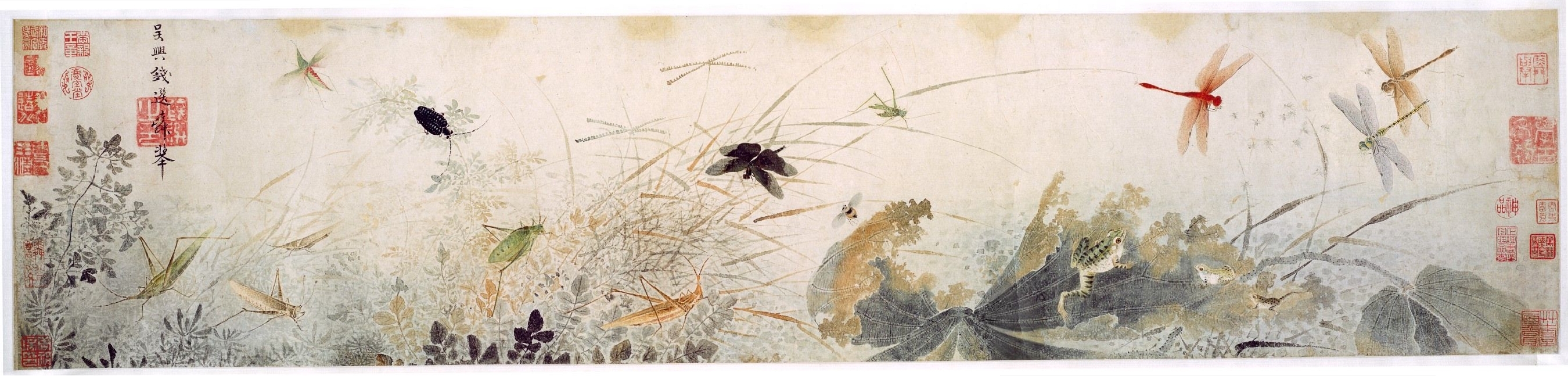
Perception passes mostly unnoticed from the present into a carousel of snapshots in memory. The repetition of seasons, while predictable, predictably come to an end for every life.

Early Autumn
Qián Xuǎn (钱选 /錢選), 13th Century, Ink on Paper

The imagery in Qián Xuǎn's drawing Early Autumn above, and the words in J.R.R. Tolkien's poem below, express a bittersweet recognition of the repetition and finality of living and the melancholic passage of time.

I sit beside the fire and think
Of all that I have seen
Of meadow flowers and butterflies
In summers that have been

Of yellow leaves and gossamer
In autumns that there were
With morning mist and silver sun
And wind upon my hair

I sit beside the fire and think
Of how the world will be
When winter comes without a spring
That I shall ever see

For still there are so many things
That I have never seen
In every wood in every spring
There is a different green

I sit beside the fire and think
Of people long ago
And people that will see a world
That I shall never know

But all the while I sit and think
Of times there were before
I listen for returning feet
And voices at the door


― J.R.R. Tolkien

Tolkien repeats the line, "I sit beside the fire and think" to mirror the repetition of the seasons. Then in the closing lines, deftly coaxes the reader to experience our senses by listening for returning feet.

Saturday, May 25, 2013

Meditation on Fire

Ancient Greeks considered fire, along with earth, air, and water, to be one of the four classic elements.

photo by Tyler MacNeal
We know now that fire is made up of several different substances primarily a mixture of hot gases.
O! for a muse of fire, that would ascend the brightest heaven of invention.
― William Shakespeare
What is fire?

Chemical Reaction

The flames of fire are a chemical reaction that occurs between oxygen and a fuel source like wood or a combustible gas. The chemical reaction produces smoke, steam, light, and heat.

The ecology and anthropology of fire are well studied.

photo by Tyler MacNeal
Ecology

Fire Ecology is the study of Fire and Life. That is,
  • the fire dependence of living organisms,
  • the adaptation of plants and animals to wildfires, and
  • the effects of fire on ecosystems.

Anthropology

The anthropology of fire is focused on how early humans used fire and on how the controlled use of fire changed over time.

Evidence in the massive Wonderwerk Cave, an ancient solution cavity in dolomite rocks, indicates that human ancestors used controlled fire a million years ago.

Scientists speculate the use of fire by homo erectus might have been a turning point in human evolution. For human ancestors and early humans, we know the control of fire:
  • provided warmth;
  • allowed for the cooking of prey;
  • provided protection from predators and insects;
  • provided light for expanded activity into the night; and
  • allowed for waste disposal;

Art & Literature

Fire has captivated of generations of artists and writers perhaps because fire has constructive and destructive potential, and perhaps because it has an abundance of metaphors.

Fire is found throughout cultural mythology ― most notably Prometheus who was credited for the theft of fire for human use that enabled progress and civilization.

It is stern work, it is perilous work, to thrust your hand in the sun
And pull out a spark of immortal flame to warm the hearts of men:
But Prometheus, torn by the claws and beaks whose task is never done,
Would be tortured another eternity to go stealing fire again.

― Joyce Kilmer in "The Proud Poet" in Main Street and Other Poems

REFERENCES

Popular