Showing posts with label Standing Wave. Show all posts

Saturday, April 13, 2013

Breaking Waves

Repeated variations on a theme play out continually in nature. Variations like the micro-scale formation of snow crystals we imagine, the large-scale diurnal and seasonal cycles we experience, or the many variations of fresh and saltwater waves we see.
Breaking wave
North Piha, west of Auckland

Fresh and saltwater waves abound:

The underlying theme of a breaking wave is that the wave steepens until its crest becomes unstable, then breaks.
"The world is full of magical things patiently waiting for our wits to get sharper."
― Bertrand Russell
A shore break is grand, unrelenting, ever-changing, yet somehow the same. Breaking waves are the narrative of the ebb of flow of energy and the story of entropy.

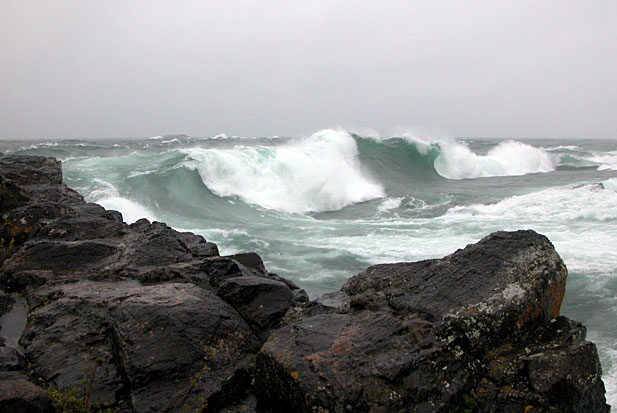
Breaking wave on Lake Superior. Photograph by Tim Case

Each wave builds, crests, and dissipates its energy into a rush of white water.

Breaking waves fit into the cosmological theme of well-ordered to less well-ordered that plays out continually in nature.

Observing breaking waves is calming and meditative, if not hypnotic.
“Breathing in, I calm body and mind. Breathing out, I smile. Dwelling in the present moment I know this is the only moment.”
― Thich Nhat Hanh, Being Peace
Waves embody the repetition of a pattern. They demonstrate the infinite and subtle variations on how a single pattern can unfold.

The beginning, the middle, and the resolution of a wave is the same on a grand scale, but infinitely different in detail.
“Thanks to impermanence, everything is possible.”
― Thich Nhat Hanh

REFERENCES

Saturday, July 14, 2012

Traveling & Standing Waves in Water

Traveling Waves


I recall jerking a garden hose, then seeing the bend I'd made travel away from me down a finite length of the hose. This retreating bend, or pulse, is a traveling wave.

Waves are caused by a disturbance - an input of energy - that travels through spacetime while the energy of the disturbance is transferred and dissipated.

A traveling wave is seen when the wave is not confined to a given space along the medium such as ocean waves approaching a shoreline.
The sea pronounces something, over and over, in a hoarse whisper; I cannot quite make it out.
~Annie Dillard
Ocean waves can travel thousands of miles before reaching land.


From the Wave

It mounts at sea, a concave wall
   Down-ribbed with shine,
And pushes forward, building tall
   Its steep incline.


...opening stanza from a poem by Thom Gunn

Standing Waves


A standing wave is stationary. It is confined in some way by natural or man-made contraints.

A vibrating guitar string is an example of a standing wave. A guitar string has a number of frequencies at which it will vibrate (i.e., the harmonics of the guitar string). The frequency at which a guitar string vibrates depends on the tension of the string, the linear density of the string and its length.

Standing Waves in Rivers

Standing waves in rivers are caused by a high volume of water constricted by flowing into and over a structure like a submerged boulder and creating a wave behind it known as a hydraulic jump. Thought another way, when flowing water encounters a zone of slower moving water a abrupt rise occurs in the surface of the water.

Standing waves can been ridden like the river surfers on the Eisbach in Munich (below). The Eisbach river surfers catch the wave by launching into it from the sides, then facing upstream while traversing its stationary wave front.


The Eisbach wave is about 3' high. Enthusiasts have modified the wave to boost its height and to break more cleanly by submerging planks attached to an upstream bridge.

Surfing a standing wave gives the sensation of traveling over water while not actually moving. A standing wave can be surfed for as long as one maintains the right position and balance.
How could drops of water know themselves to be a river? Yet the river flows on.
~Antoine de Saint-Exupery


Further Reading

Popular