Showing posts with label Voltaire. Show all posts

Saturday, April 18, 2015

Shifting Pattern

A massive swath of unusually warm water has settled off the coast of North America since early 2014. Ocean surface water temperatures are about 1° to 4° Celsius (2° to 7° Fahrenheit) above the mean.
"In the fall of 2013 and early 2014 we started to notice a big, almost circular mass of water that just didn’t cool off as much as it usually did, so by spring of 2014 it was warmer than we had ever seen it for that time of year."
— Nick Bond, Joint Institute for the Study of the Atmosphere and Ocean
Sea Surface Temperature Anomaly, March 2015, NASA Earth Observatory

Significantly warmer ocean temperatures, dubbed "The Blob" by climate scientist Nick Bond, seem linked to weather anomalies across North America.

Scientists hypothesize that the persistently warmer ocean temperatures over the past 15 months could be causing a range of phenomena from stressing Northwest salmon and steelhead trout populations to supplying a pipeline of moisture that fed record-breaking East Coast snowstorms.
"Men argue. Nature acts."
― Voltaire (1694 – 1778)
Natural phenomena are often characterized as a continuous process, by a state of continuous change, or by evolutionary adaptations. As humans observing and collecting data from the world around us, we establish and recognize patterns that enable us to distinguish anomalous changes from expected changes.

Shifting patterns are a leading indicator of larger systemic changes that demand our attention.
"Are humans any smarter than frogs in a pot? If you put a frog in a pot and slowly turn up the heat, it won't jump out. Instead, it will enjoy the nice warm bath until it is cooked to death. We humans seem to be doing pretty much the same thing."
— Jeff Goodell

REFERENCES

Saturday, January 11, 2014

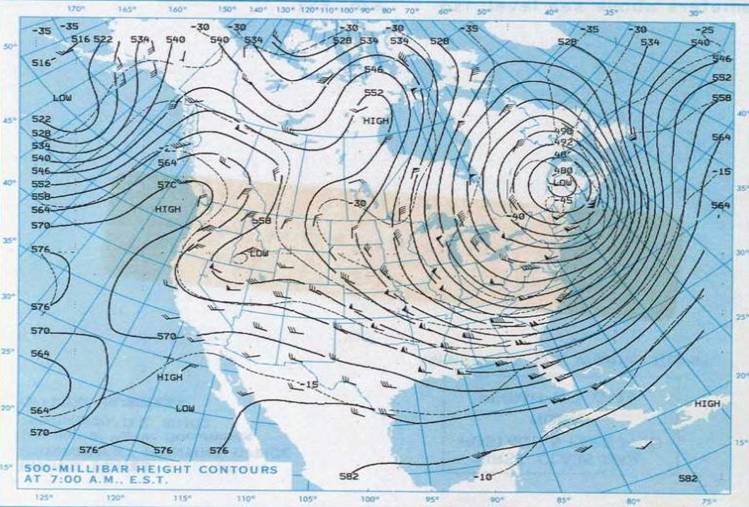
The Polar Vortex

Polar Vortex over Maine, 1985
The polar vortex is circulation of upper-level, stratospheric winds that normally surround the North Pole. The circulating winds flow around a low-pressure system in a counterclockwise direction.

Occasionally this vortex becomes distorted so that it dips much farther south allowing lobes of arctic air to blanket parts of North America, northern Europe and Asia.

When the polar vortex is perturbed, temperatures tend to be colder in the mid-latitudes across the US, Europe, and Eurasia.
Perturbed Polar Vortex

The vortex typically lies directly over the North Pole and confines the cold air to the Arctic. Warm air masses pushing north will occasionally shift the polar vortex off the North Pole.

Normally circular, the vortex can become distorted and elongated, as shown in the animation, allowing arctic air to spill into the mid-latitudes.
"Men argue. Nature acts."
― Voltaire
Scientists have discovered a statistically significant link between Siberian snow cover and the behavior of the winter polar vortex.

AER scientists (Atmospheric and Environmental Research) use Siberian snow cover measured from the previous October to project the strength of the winter polar vortex. Using those projections, AER forecasts winter temperatures for much of North America and Northern Europe and Northern Eurasia.
“Three feet of ice does not result from one day of cold weather.”
― Chinese Proverb
The polar vortex of January 2014 could be a side effect of climate change. Climate scientists recognize that distortions of the jet stream cause extreme cold snaps in winter and anomalous heat waves in summer.

REFERENCES

Saturday, July 20, 2013

A Changing Climate

Glacier Bay
Voltaire said, "Men argue, Nature acts."

Indeed the Earth is a planet of relentless action.

Science draws from an abundance of data to interpret Earth's changes.

The Paleoclimate Record

Paleoclimatologists consider data preserved within rocks, sediments, ice sheets, tree rings, corals, shells and micro-fossils when determining the past states of the Earth's climate and atmospheric system.
“The paleoclimate record shouts to us that, far from being self-stabilizing, the Earth's climate system is an ornery beast which overreacts even to small nudges.”
― Wallace Broecker
The Modern Record

The modern record of science (since the late 19th century) gives us a plenitude of atmospheric temperature data from weather stations distributed around the globe.

A NASA animation (below) uses near surface atmospheric temperatures between 1880 and 2011 to illustrate above average temperatures (shades of red) and below-average temperatures (shades of blue) over 131 years.


Clearly global temperatures have warmed significantly since 1880 and most notably since the 1980s. Many of us see and feel the effect. What is the cause?

Cause and Effect

Cause and effect is a fundamental principle of classical physics. The effect of temperature change is a matter of record. There are a wealth of globally distributed temperature measurements that render the effect indisputable. Temperatures are rising.

The cause of this temperature change has been controversial. However an overwhelming majority of the controversy has been stoked by science-averse, and fact-challenged, climate change deniers with a political ax to grind.
“Those who cannot change their minds cannot change anything.”
― George Bernard Shaw
The overwhelming majority of scientists attribute the steady temperature rise to the corresponding rise in greenhouse gas emissions from energy production, industry and motor vehicles.

The science and engineering challenge of this millennium is to address the symptoms of climate change, but more importantly, to understand, buffer, and counter-act the destabilizing impact of humanity.
“Go to heaven for the climate and hell for the company.”
― Mark Twain

REFERENCES

Popular