Showing posts with label Continental Plate. Show all posts

Saturday, January 17, 2015

Island Creation in Tonga

Tonga
Tonga is an island nation of some 176 islands distributed over 270,000 square miles in the southern Pacific Ocean.

A volcano that started spewing rocks and ash last December is creating a new island.

Tonga's official island tally might soon be incremented by one.
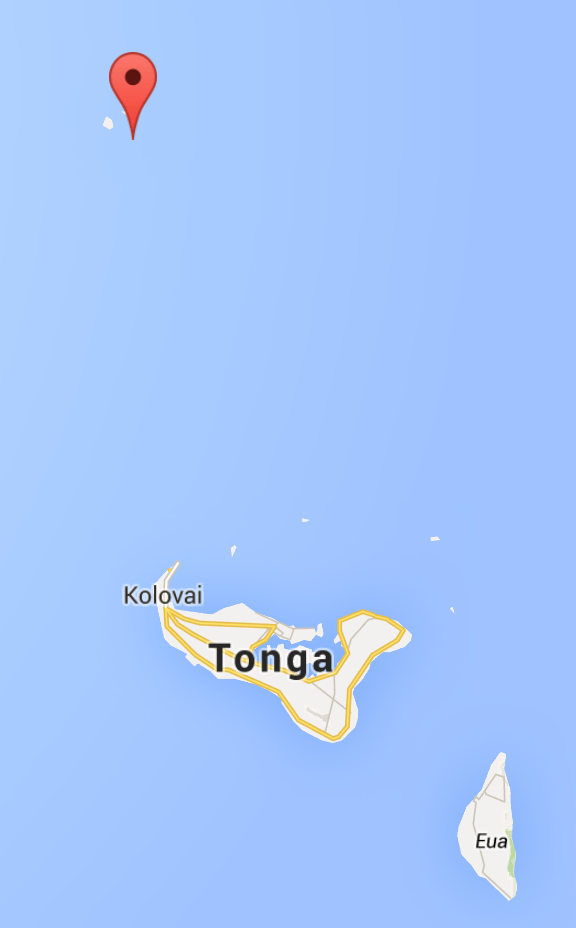
HungaHa'apai
Geologists from the Tongan Ministry of Lands traveled by boat to study the volcano. They confirmed that a huge amount of volcanic material continues to transform the landscape.

Tongan geologists indicated the volcano is erupting from two vents. One vent is located on the uninhabited Hunga Ha'apai (red marker, right). The other is about 100 yards offshore from Hunga Ha'apai.
"The new island is more than one kilometer wide, two kilometers long and about 100 meters high"
— Ministry of Lands
Prior to the month-long eruption, the surface area of the Tongan islands was about 290 square miles. The surface area continues to expand.
"During our observations the volcano was erupting about every five minutes to a height of about 400 meters, accompanied by some large rocks... as the ash is very wet, most is being deposited close to the vent, building up the new island."
— Ministry of Lands
Rock and ash exploding from the Hunga Ha'apai volcano.
photo: AFP/MFAT

The Tongan islands lie on a global hotspot called the Ring of Fire. 75% of the world's active and dormant volcanoes lie on the Ring of Fire where continental plates collide causing seismic rumbles and volcanic eruptions. It's here that the Pacific Plate slides under the Indo-Australian Plate.
"The real difficulty about vulcanism is not to see how it can start, but how it can stop."
— Sir Harold Jeffreys, 1891–1989

REFERENCES

Saturday, February 1, 2014

Tectonic Fire

Observing Mount Vesuvius, Mount Etna, and other Volcanoes, Sir William Hamilton posited
May not subterraneous fire be considered as the great plough (if I may be allowed the expression) which Nature makes use of to turn up the bowels of the earth? — Sir William Hamilton, 1774
Steam plume rising from Shishaldin.
28 January 2014.
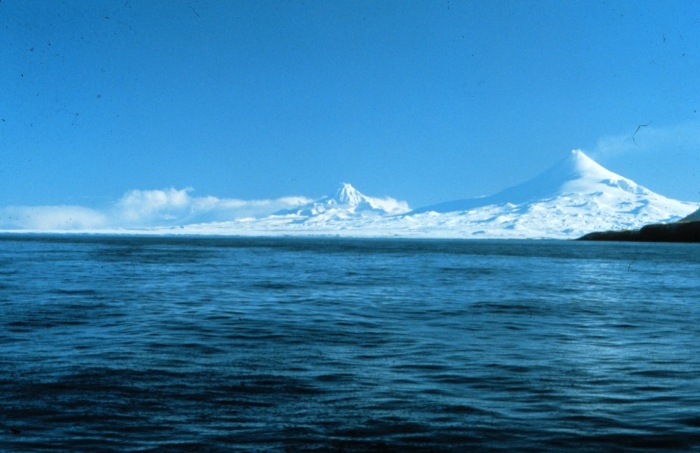
A steam plume and elevated surface temperature were recently observed at Mount Shishaldin. The Shishaldin volcano is located on Unimak Island in the Aleutian Islands.

Mount Shishaldin is the highest peak in the Aleutian Islands. Shishaldin is distinguished as the most symmetrical cone-shaped glacier-clad mountain on earth.

Native Aleuts called the volcano Sisquk meaning:
Mountain which points the way when I am lost.
Unimak Island, and its highest peak, rise above one of the most active plate boundary zones on earth. The collision of the Pacific oceanic plate and the North American continental plate cause frequent earthquakes and volcanic activity.

Subduction of Pacific oceanic plate along the Aleutian Trench.

The oceanic plate is heavier than the continental plate, so it is forced below the edge of the continental plate. The ongoing process, called subduction, generates extreme stresses and heat.
And many a fire there burns beneath the ground.
— Empedocles, 490 BC.

The Aleutian Trench

The subducting oceanic plate is marked by the Aleutian Trench which runs along the Aleutian Islands and the Alaska Peninsula. The Aleutian Trench is 22,638 feet deep south of Unimak Island.

Shishaldin and Isanotski Volcanoes, Unimak Island, Aleutian Islands

REFERENCES

Popular