Showing posts with label Ring of Fire. Show all posts

Saturday, January 17, 2015

Island Creation in Tonga

Tonga
Tonga is an island nation of some 176 islands distributed over 270,000 square miles in the southern Pacific Ocean.

A volcano that started spewing rocks and ash last December is creating a new island.

Tonga's official island tally might soon be incremented by one.
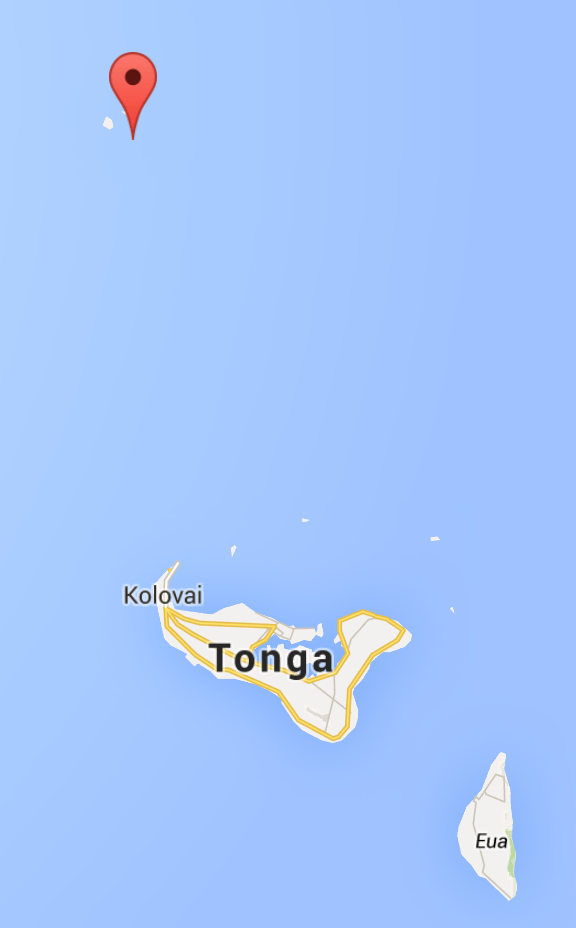
HungaHa'apai
Geologists from the Tongan Ministry of Lands traveled by boat to study the volcano. They confirmed that a huge amount of volcanic material continues to transform the landscape.

Tongan geologists indicated the volcano is erupting from two vents. One vent is located on the uninhabited Hunga Ha'apai (red marker, right). The other is about 100 yards offshore from Hunga Ha'apai.
"The new island is more than one kilometer wide, two kilometers long and about 100 meters high"
— Ministry of Lands
Prior to the month-long eruption, the surface area of the Tongan islands was about 290 square miles. The surface area continues to expand.
"During our observations the volcano was erupting about every five minutes to a height of about 400 meters, accompanied by some large rocks... as the ash is very wet, most is being deposited close to the vent, building up the new island."
— Ministry of Lands
Rock and ash exploding from the Hunga Ha'apai volcano.
photo: AFP/MFAT

The Tongan islands lie on a global hotspot called the Ring of Fire. 75% of the world's active and dormant volcanoes lie on the Ring of Fire where continental plates collide causing seismic rumbles and volcanic eruptions. It's here that the Pacific Plate slides under the Indo-Australian Plate.
"The real difficulty about vulcanism is not to see how it can start, but how it can stop."
— Sir Harold Jeffreys, 1891–1989

REFERENCES

Saturday, August 3, 2013

Large Earthquakes

The magnitude of the 1906 San Francisco earthquake has been estimated at 7.9 (Moment Magnitude Scale). The 1906 San Francisco earthquake was the first natural disaster of its magnitude documented by photography and motion pictures.

San Francisco Earthquake aftermath on Market St.April 18, 1906

Seismologists describe earthquake size in the Moment Magnitude Scale. The largest earthquakes recorded between 1900 and 2013 are:
Location Date UTC Magnitude
1. Chile 1960 05 22 9.5
2. Prince William Sound, Alaska 1964 03/28 9.2
3. Off the West Coast of Northern Sumatra 2004 12/26 9.1
4. Near the East Coast of Honshu, Japan 2011 03/11 9.0
5. Kamchatka 1952 11/04 9.0
6. Offshore Maule, Chile 2010 02/27 8.8
7. Off the Coast of Ecuador 1906 01/31 8.8
8. Rat Islands, Alaska 1965 02/04 8.7
9. Northern Sumatra, Indonesia 2005 03/28 8.6
10. Assam - Tibet 1950 08/15 8.6
11. Off the west coast of northern Sumatra 2012 04/11 8.6
12. Andreanof Islands, Alaska 1957 03 09 8.6
13. Southern Sumatra, Indonesia 2007 09/12 8.5
14. Banda Sea, Indonesia 1938 02/01 8.5
15. Kamchatka 1923 02/03 8.5
16. Chile-Argentina Border 1922 11/11 8.5
17. Kuril Islands 1963 10/13 8.5
Last Updated: 2012 April 11

Many large earthquakes occur along the Ring of Fire:

Ring of Fire, from USGS

For tracking earthquakes around the world in near real-time, follow GrokEarth's @SeismicPing feed on Twitter. To track earthquakes within a 300 mile radius of San Francisco, follow GrokEarth' @SeismicPingSF feed on Twitter.
“The poetry of the earth is never dead.”
― John Keats

REFERENCES

Saturday, August 11, 2012

The Ring of Fire

The Ring of Fire is a series of volcanic arcs and ocean trenches that encircle the the pacific basin. Earthquakes and volcanic eruptions frequently occur along the Ring of Fire.

The Ring of Fire includes 75% of the world's active and dormant volcanoes.

Ring of Fire, from USGS

The Ring of Fire, shown above in dark pink, extends clockwise from New Zealand, along the eastern edge of Asia, north across the Aleutian Islands of Alaska, and south along the coast of North and South America.
Ocean trenches are shown in blue-green. Arcs of volcanic islands run parallel to- and on the landward side of- the ocean trenches.

Prominent volcanic islands are the Aleutian Islands and the Mariana Islands. The Aleutian Islands, extending westward from the Alaskan peninsula, are a chain of volcanoes on the landward side of the Aleutian Trench. In the Pacific Ocean, south of Japan and north of New Guinea, the Mariana Islands form an archipelago that includes the summits of 15 volcanic mountains


3D Visualization of Daikoku Volcano in Mariana Arc region, NOAA Photo
There are many active submarine and above sea-level volcanoes on the Ring of Fire. The Daikoku Volcano (shown above) is a submarine volcano located in the southern part of the Izu-Bonin-Mariana Arc. It lies 323 meters below the ocean surface. During a 2006 NOAA expedition, Daikoku was observed emitting a cloudy hydro-thermal fluid.

Pacific Plate Collision and Subduction

The Ring of Fire is located at the interface between the Pacific Plate and other tectonic plates. These plates are giant rafts of the earth's surface. Plates collide with and slide underneath other plates (called subduction). Tremendous heat energy is created when these plates collide -- enough heat to melt rock into magma which can rise to the surface as lava to form volcanoes.

Volcanic areas in the Ring of Fire include:
  • South America - The Nazca plate is colliding with the South American plate creating the Andes mountains and volcanoes such as Cotopaxi and Azul.
  • Central America - The Cocos plate is colliding with the North American plate giving rise to the Mexican volcanoes Popocatepetl and Paricutun.
  • North America - The Pacific, Juan de Fuca, and Gorda plates between Northern California and British Columbia, have created the Cascade Mountains and caused the 1980 eruption of Mount Saint Helens.
  • Aleutian Islands - The Pacific plate is colliding with the North American plate causing this arc of islands to grow.
  • Asia - The subduction of the Pacific plate under the Eurasian plate from Russia's Kamchatka Peninsula to Japan, has caused the Japanese islands and volcanoes (such as Mt. Fuji).
  • South Pacific - The Indo-Australian plate subducts under the Pacific plate creating volcanoes in the New Guinea and Micronesian areas. Near New Zealand, the Pacific Plate slides under the Indo-Australian plate.
References

Popular