Showing posts with label Calving. Show all posts

Saturday, November 29, 2014

Persistent Ice

Glacial ice is the largest freshwater reservoir on Earth. Glaciers are persistent bodies of ice that form where the accumulation of snow exceeds its ablation.

Glaciers account for a significant portion of the world's cryosphere.

ablationThe opposite of accumulation, ablation refers to processes that remove snow, ice, or water from a glacier (melting, evaporation, sublimation, calving, or wind erosion).
calvingCalving is the severing of chunks of ice at the terminus of a glacier.
cryospherePortions of Earth where water is in solid form (e.g., sea ice, lake ice, river ice, snow cover, glaciers, ice caps, ice sheets, and frozen ground).
sublimationSublimation is the conversion from the solid to the gaseous phase of water, without an intermediate liquid stage.

Calving at the terminus of the Perito Moreno Glacier in western Patagonia

Glaciers slowly deform and flow from the force of gravity.
The wintry clouds drop spangles on the mountains. If the thing occurred once in a century historians would chronicle and poets would sing of the event; but Nature, prodigal of beauty, rains down her hexagonal ice-stars year by year, forming layers yards in thickness. The summer sun thaws and partially consolidates the mass. Each winter's fall is covered by that of the ensuing one, and thus the snow layer of each year has to sustain an annually augmented weight. It is more and more compacted by the pressure, and ends by being converted into the ice of a true glacier, which stretches its frozen tongue far down beyond the limits of perpetual snow. The glaciers move, and through valleys they move like rivers.
— John Tyndall, 1861

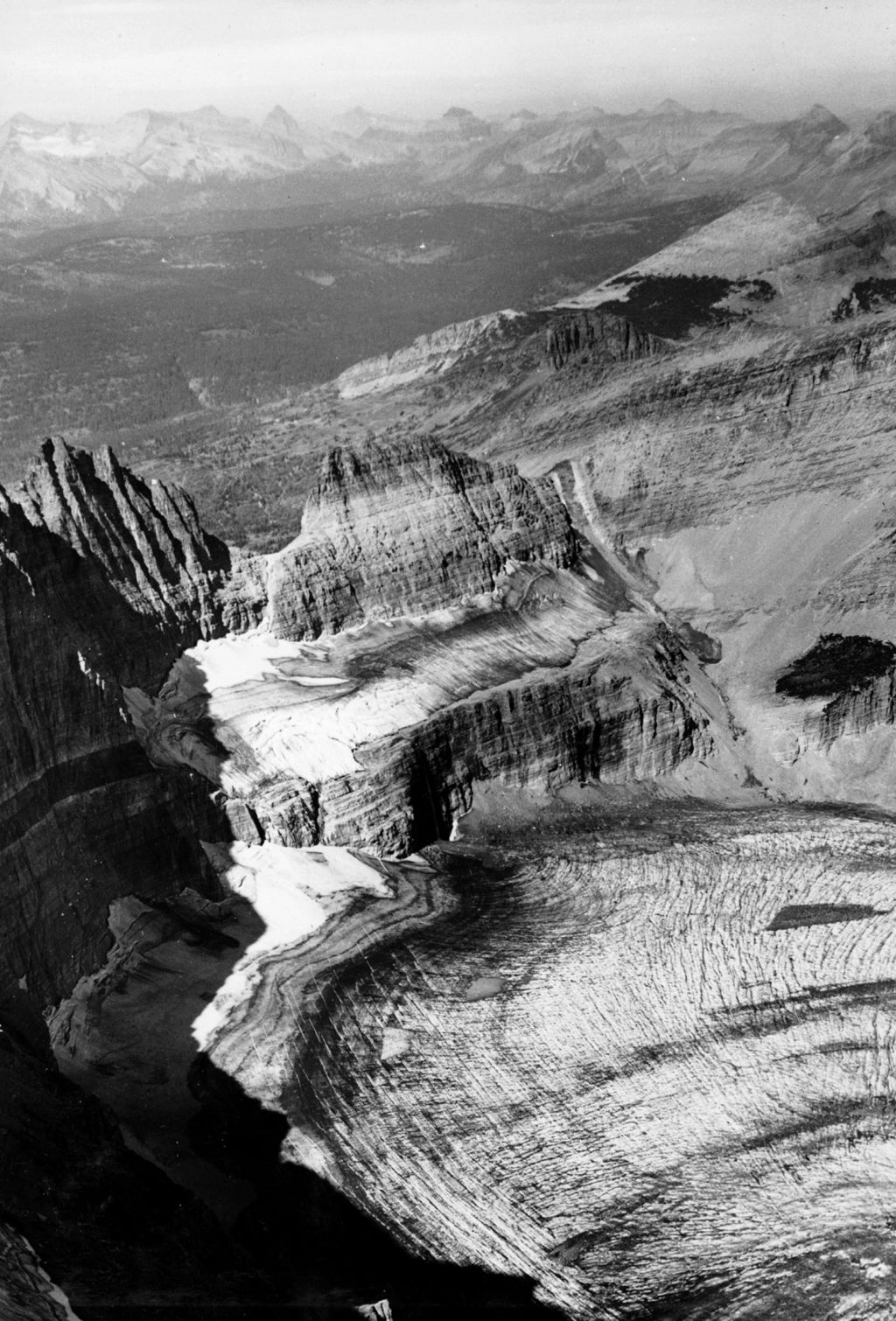
Grinnell Glacier 1938
Grinnell Glacier 2009

Unlike seasonal snow cover, freshwater ice, or transient sea ice that lasts perhaps a few years, a water particle in a glacier can remain frozen 10-100,000 years longer.
A man who keeps company with glaciers comes to feel tolerably insignificant by and by.
— Mark Twain, 1880
99% of glacial ice resides within vast ice sheets cover the poles. Deep ice in East Antarctica might be approaching a million years in age.
The truth is, that those who have never entered upon scientific pursuits know not a tithe of the poetry by which they are surrounded.
— Herbert Spencer, 1889

REFERENCES

Saturday, February 9, 2013

Eon to Instance

We expect geologic phenomena to occur on a geologic time scale. We expect these phenomena to be revealed on a time scale so vast that scientists must describe them in terms of their relationships to other major geologic milestones or paleontologic occurrences like mass extinctions, which have unfolded over the 4.54 billion year history of the Earth.

Unless one has the good fortune, like Adam LeWinter and Jeff Orlowski, to witness and record a massive, lower-Manhattan-sized glacier calving in real-time (video below).


Ice calving is the sudden cleaving of a mass of ice.

The video shows the calving of the Jakobshavn Glacier in western Greenland during 2008. For 75 minutes, the glacier retreated a full mile along a calving face estimated at 3 miles in length.


The footage is featured in the film Chasing Ice. For a sense of the size of the calved ice, the film producers likened it to the entire lower tip of Manhattan Island breaking off.

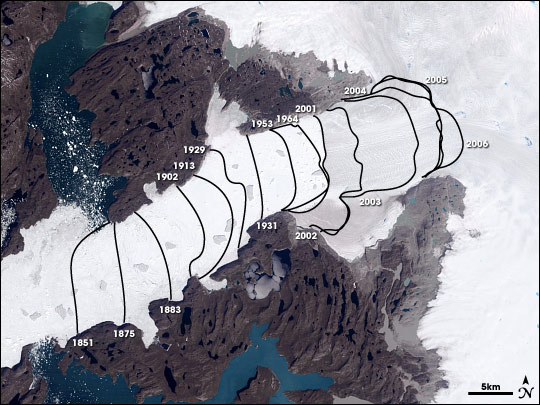
Scientists have recorded the steady retreat of the Jakobshavn Glacier since 1851 (NASA satellite image below).

Retreating calving front of the Jacobshavn Glacier (1851 - 2006)
"A man who keeps company with glaciers comes to feel tolerably insignificant by and by. The Alps and the glaciers together are able to take every bit of conceit out of a man and reduce his self-importance to zero if he will only remain within the influence of their sublime presence long enough to give it a fair and reasonable chance to do its work."
— Mark Twain, from A Tramp Abroad, p. 466.

Geologists have divided the 4.54 billion year history of the Earth into a hierarchy of supereon, eon, era, period, epoch, and age. Calving of the Jakobshavn Glacier has been recorded in modern history since 1851 The 2008 calving occurred in a matter of minutes.


REFERENCES

Popular