Showing posts with label Origin of Life. Show all posts

Saturday, November 7, 2015

Increasingly Earlier Life

Every creature inhabiting Earth, including newcomers like humans, represents an unbroken line to primitive carbon-based life present on Earth nearer and nearer to the planet's probable inception some 4.54 billion years ago.
Gnat encased in amber
"What we normally think of as 'life' is based on chains of carbon atoms, with a few other atoms, such as nitrogen or phosphorus."
— Stephen Hawking, from a 2008 lecture
Chains of carbon atoms are common to all living things.

Biogenic Substances

Biogenic substances contain carbon which is a recognized marker for living organisms. Such substances, in the form of constituents, or as secretions from plants or animals, embody biomolecules which are the building blocks of life.

coal & oilgeologic-age constituents that have undergone changes
chalk & limestonegeologic-age secretions (e.g., marine animal shells)
grass & woodcontemporary constituents
pearls, silk & ambergriscontemporary secretions

Improbable Life

That life-forming elements came from dying stars in the far reaches of the universe make life on Earth nearly incomprehensible, if not improbable.
I tell my students, with a feeling of pride that I hope they will share, that the carbon, nitrogen, and oxygen that make up ninety-nine per cent of our living substance were cooked in the deep interiors of earlier generations of dying stars. Gathered up from the ends of the universe, over billions of years, eventually they came to form, in part, the substance of our sun, its planets, and ourselves. Three billion years ago, life arose upon the earth. It is the only life in the solar system.
— George Wald, Harvard Biochemist (1)
olive-green zircon crystal
by Rob Lavinsky
Earliest Biogenic Substances

The earliest recorded biogenic substances on Earth gets incrementally pushed back as scientists find and analyze new artifacts.

Until recently, graphite detected in rock dated 3.8 billion years ago was the earliest known biogenic residue of life.

UCLA geochemists recently identified specks of biogenic carbon encased in undisturbed, crack-free zircon crystals from Western Australia.

This discovery pushes back the earliest biogenic residue some 300 millions years to 4.1 billion years ago. Thus it places the probable earliest life closer to the time when Earth was formed 4.54 billion years ago.
"Life on Earth may have started almost instantaneously. With the right ingredients, life seems to form very quickly."
— Mark Harrison, UCLA geochemist

REFERENCES
(1) From speech given at an anti-war teach-in at the Massachusetts Institute of Technology, (4 Mar 1969) 'A Generation in Search of a Future', as edited by Ron Dorfman for Chicago Journalism Review, (May 1969)

Saturday, May 9, 2015

Life Producing Vents

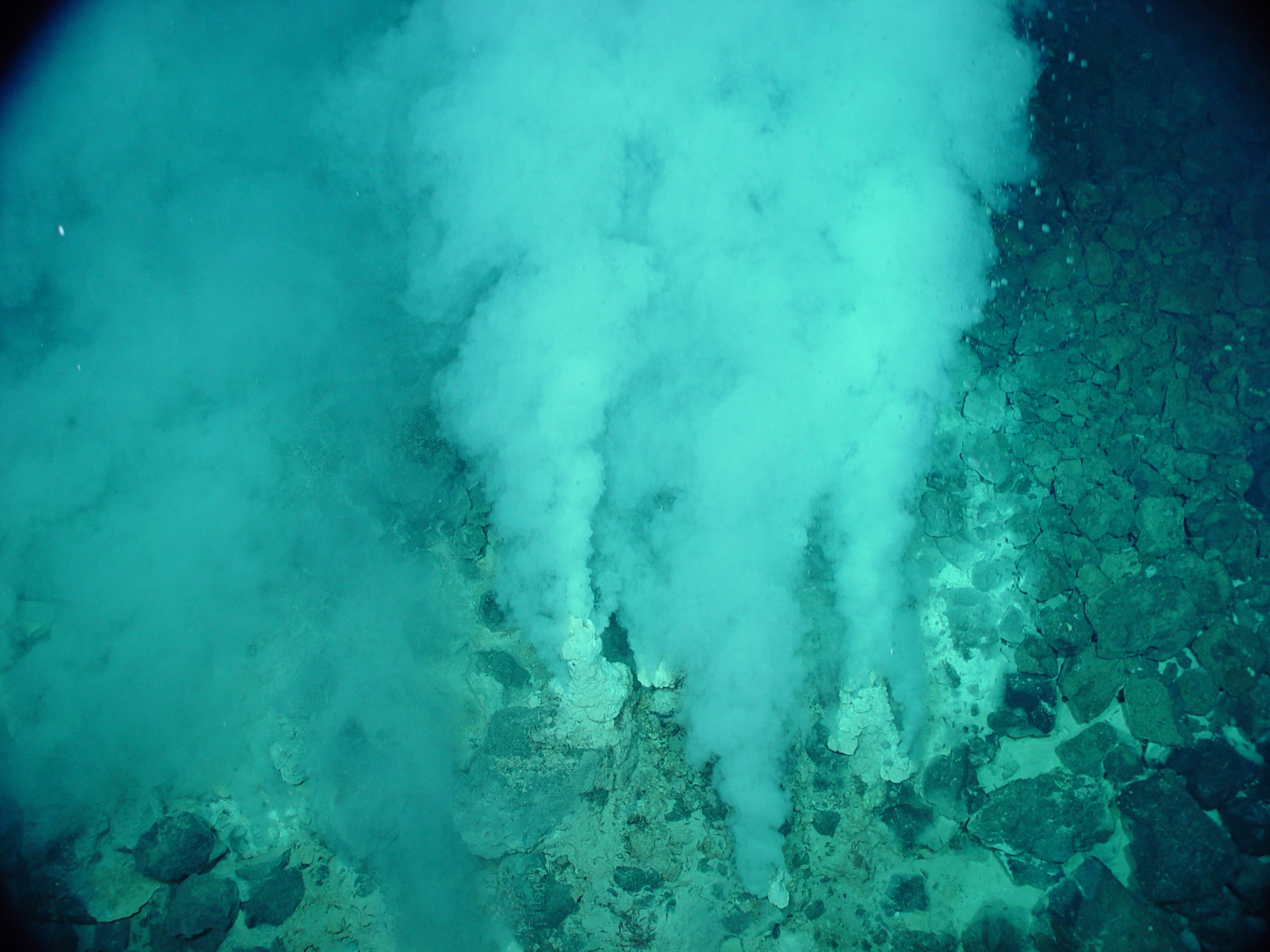
Champagne vent
Northwest Eifuku volcano
Mariana Trench
When seawater enters into the ocean crust, heats and reacts with crustal rock, then rises to the seabed, the columns of emerging fluid and gas is called a hydrothermal vent.

Hydrothermal vents dot the Earth's seabeds in volcanically active areas and in zones where tectonic plates are moving apart.

Marine biologists study the unique chemosynthetic biological communities living around vents. Some hypothesize that hydrothermal vents produced the organic molecules needed for life.

A recent study by chemists at University College London reports that the chemical properties found on the surfaces inside hydrothermal vents are similar to enzymes.
Enzymes /ˈɛnzaɪmz/ are macromolecular biological catalysts. Enzymes accelerate, or catalyze, chemical reactions.
Enzymes are biological catalysts that govern chemical reactions in living organisms. Hydrothermal vents would therefore be capable of spontaneously producing carbon-based molecules like methanol and formic acid from the carbon dioxide dissolved in the emerging water.
"There is a lot of speculation that hydrothermal vents could be the location where life on Earth began. There is a lot of CO2 dissolved in the water, which could provide the carbon that the chemistry of living organisms is based on, and there is plenty of energy, because the water is hot and turbulent. What our research proves is that these vents also have the chemical properties that encourage these molecules to recombine into molecules usually associated with living organisms."
― Nora de Leeuw, Principle Investigator, University College London

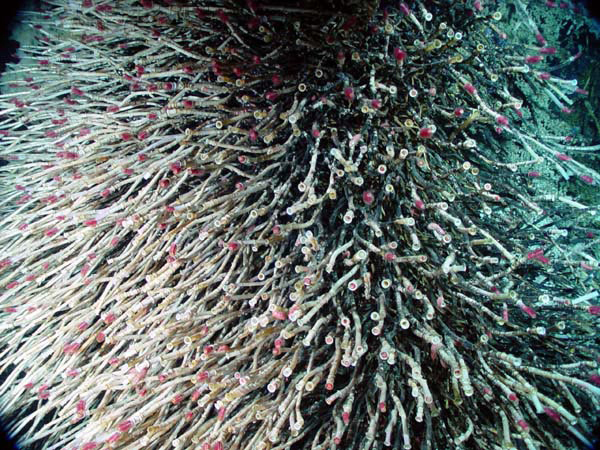
Invertebrate tubeworms covering a sulfide chimney called Zooarium.
Image: NOAA

REFERENCES

Saturday, November 22, 2014

Life from Comet Collisions

The biosphere covering Earth remains a deep mystery. Where did life originate?

Bioluminescent dinoflagellates lighting a breaking wave at midnight

Earth might well have coalesced from cosmic dust and gas. Billions of years later, a thin raft surrounding Earth teems with co-dependent organisms.
The question of the origin of life is essentially speculative. We have to construct, by straightforward thinking on the basis of very few factual observations, a plausible and self-consistent picture of a process which must have occurred before any of the forms which are known to us in the fossil record could have existed.
— John Desmond Bernal
Where did the ingredients for the simplest unicellular life forms come from? Life's ingredients might have come from comets.
Early Earth was not very hospitable when it came to jump-starting life. In fact, new research shows that life on Earth may have come from out of this world.
― Astrobiology Magazine
Comet Hale Bopp
Comets are vestiges from the formation of our solar system some 4.5 billion years ago. Comets that move into range of space travel, arrive well-preserved from the freeze locker of the outer solar system.

As it travels near the Sun and Earth, a disintegrating comet represents a treasure-trove of hard data about conditions present during the early stages of the solar system.

The composition of comets interests us because scientists posit that life-building organic compounds might have come from icy comets that collided with Earth millions of years ago.

Organic compounds form the basis of proteins and nucleobases (the building blocks of DNA and RNA). Oceans might have been formed from icy comets and asteroids crashing into Earth.

The first comet landing of a robotic spacecraft touched down on Comet 67P on November 12, 2014. Until then, our knowledge of comets came from a handful of flyby space missions

Comet 67P

Comet 67P
The robotic lander Philae bounced to rest on Comet 67P more than 10 years after being launched from Earth by the European Space Agency.

The Philae landing was a historical touchdown on a comet nucleus.

Philae transmitted in-situ data that will enable scientists to determine the composition of the comet's surface material.

Our Quest

Comets were once believed to be harbingers of human destruction by anthropomorphic gods. Our understanding of our habitat and origin accrues through scientific discovery.


Scientific discovery yields physical explanations to mysterious and once feared phenomena. Our appreciation of the far-fetched phenomena of life grows with every scientific revelation.
Our quest to solve the existential puzzle continues.
The origin of life is a complex narrative of improbable events. The lineage of events stretch back perhaps 13.8 billion years to the Big Bang or beyond.


REFERENCES

Saturday, April 19, 2014

Life and Beauty

Three questions motivate astrobiologists:
  • What is life?
  • How did life begin and evolve on Earth? and
  • Does life exist elsewhere in the universe?
Science understands surprisingly little about the first question, and the answer seems likely to remain elusive. Astrobiologists continue to pursue the discovery of extraterrestrial life by sending probes to Mars and other planets. So far we only know only of life on Earth.

Science knows a lot about life on Earth, but questions remain unanswered. There are enticing clues that suggest when and how life began on Earth. To the best of our knowledge life began about 4 billion years ago with humans, the latecomers, appearing as recently as a couple of hundred thousand years ago (cf. Cosmic Newcomers).

There is plenty of evidence of life adapting at the molecular level. The shared DNA of all living things, and the coexistence of identical segments of DNA code across species, makes a compelling narrative for a life force that has been replicating and adapting for billions of years.
Shall I not have intelligence with the earth? Am I not partly leaves and vegetable mould myself.
— Henry David Thoreau
What is the role of sensory attraction in the adaptation and evolution of living things?
"How did these organs of plant sex manage to get themselves cross-wired with human ideas of value and status and Eros? And what might our ancient attraction for flowers have to teach us about the deeper mysteries of beauty - what one poet has called "this grace wholly gratuitous"? Is that what it is? Or does beauty have a purpose?"
— Michael Pollan from The Botany of Desire: A Plant's-Eye View of the World
In Botany of Desire Michael Pollan examines the properties of sweetness, beauty, intoxication, and control and the role they each property played in the codependent evolution of apples (sweetness), tulips (beauty), cannabis (intoxication), and potatoes (cultivatable control).

Pollan asks, "Does beauty have a purpose?" When viewed as the result of accidents of nature, beauty seems to be attained, or converged upon, through incremental change. What constitutes or defines beauty seems free to evolve along with changing desires of the species.
"Design in nature is but a concatenation of accidents, culled by natural selection until the result is so beautiful or effective as to seem a miracle of purpose."
— Michael Pollan from The Botany of Desire: A Plant's-Eye View of the World
Cypripedium reginae
Pink Lady's Slipper
Cypripedium calceolus
Yellow Lady's Slipper
REFERENCES

Popular