Showing posts with label Aleutian Islands. Show all posts

Saturday, February 1, 2014

Tectonic Fire

Observing Mount Vesuvius, Mount Etna, and other Volcanoes, Sir William Hamilton posited
May not subterraneous fire be considered as the great plough (if I may be allowed the expression) which Nature makes use of to turn up the bowels of the earth? — Sir William Hamilton, 1774
Steam plume rising from Shishaldin.
28 January 2014.
A steam plume and elevated surface temperature were recently observed at Mount Shishaldin. The Shishaldin volcano is located on Unimak Island in the Aleutian Islands.

Mount Shishaldin is the highest peak in the Aleutian Islands. Shishaldin is distinguished as the most symmetrical cone-shaped glacier-clad mountain on earth.

Native Aleuts called the volcano Sisquk meaning:
Mountain which points the way when I am lost.
Unimak Island, and its highest peak, rise above one of the most active plate boundary zones on earth. The collision of the Pacific oceanic plate and the North American continental plate cause frequent earthquakes and volcanic activity.

Subduction of Pacific oceanic plate along the Aleutian Trench.

The oceanic plate is heavier than the continental plate, so it is forced below the edge of the continental plate. The ongoing process, called subduction, generates extreme stresses and heat.
And many a fire there burns beneath the ground.
— Empedocles, 490 BC.

The Aleutian Trench

The subducting oceanic plate is marked by the Aleutian Trench which runs along the Aleutian Islands and the Alaska Peninsula. The Aleutian Trench is 22,638 feet deep south of Unimak Island.
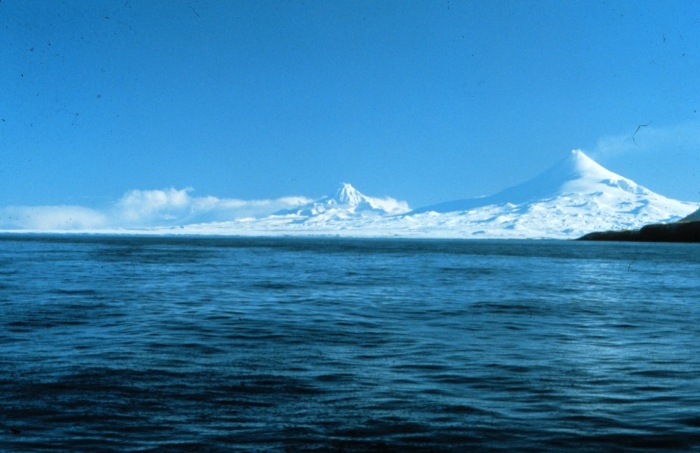
Shishaldin and Isanotski Volcanoes, Unimak Island, Aleutian Islands

REFERENCES

Saturday, August 11, 2012

The Ring of Fire

The Ring of Fire is a series of volcanic arcs and ocean trenches that encircle the the pacific basin. Earthquakes and volcanic eruptions frequently occur along the Ring of Fire.

The Ring of Fire includes 75% of the world's active and dormant volcanoes.

Ring of Fire, from USGS

The Ring of Fire, shown above in dark pink, extends clockwise from New Zealand, along the eastern edge of Asia, north across the Aleutian Islands of Alaska, and south along the coast of North and South America.
Ocean trenches are shown in blue-green. Arcs of volcanic islands run parallel to- and on the landward side of- the ocean trenches.

Prominent volcanic islands are the Aleutian Islands and the Mariana Islands. The Aleutian Islands, extending westward from the Alaskan peninsula, are a chain of volcanoes on the landward side of the Aleutian Trench. In the Pacific Ocean, south of Japan and north of New Guinea, the Mariana Islands form an archipelago that includes the summits of 15 volcanic mountains


3D Visualization of Daikoku Volcano in Mariana Arc region, NOAA Photo
There are many active submarine and above sea-level volcanoes on the Ring of Fire. The Daikoku Volcano (shown above) is a submarine volcano located in the southern part of the Izu-Bonin-Mariana Arc. It lies 323 meters below the ocean surface. During a 2006 NOAA expedition, Daikoku was observed emitting a cloudy hydro-thermal fluid.

Pacific Plate Collision and Subduction

The Ring of Fire is located at the interface between the Pacific Plate and other tectonic plates. These plates are giant rafts of the earth's surface. Plates collide with and slide underneath other plates (called subduction). Tremendous heat energy is created when these plates collide -- enough heat to melt rock into magma which can rise to the surface as lava to form volcanoes.

Volcanic areas in the Ring of Fire include:
  • South America - The Nazca plate is colliding with the South American plate creating the Andes mountains and volcanoes such as Cotopaxi and Azul.
  • Central America - The Cocos plate is colliding with the North American plate giving rise to the Mexican volcanoes Popocatepetl and Paricutun.
  • North America - The Pacific, Juan de Fuca, and Gorda plates between Northern California and British Columbia, have created the Cascade Mountains and caused the 1980 eruption of Mount Saint Helens.
  • Aleutian Islands - The Pacific plate is colliding with the North American plate causing this arc of islands to grow.
  • Asia - The subduction of the Pacific plate under the Eurasian plate from Russia's Kamchatka Peninsula to Japan, has caused the Japanese islands and volcanoes (such as Mt. Fuji).
  • South Pacific - The Indo-Australian plate subducts under the Pacific plate creating volcanoes in the New Guinea and Micronesian areas. Near New Zealand, the Pacific Plate slides under the Indo-Australian plate.
References

Popular