Showing posts with label Humanity. Show all posts

Saturday, July 23, 2016

Vagaries of Habitat

Egyptian peasant farmers
The transition from human subsistence on foraging and hunting to crop farming communities began around 10,000 B.C.

Humans have been moving, tilling, diverting, mining, burning, fabricating, fouling and laying waste unabated ever since.

The agricultural revolution was born from an aspiration to exercise sufficient control over our habitat to ensure a predictable supply of food.

Human impact on the biosphere is often ignored, downplayed, or denied, but that doesn't comport with the evidence. Humans have a knack for engineering and adapting the natural environment to changing needs and desires.

In Plans for Altering the River, poet Richard Hugo writes of the human propensity to engineer habitat. Hugo explores the vagaries and absurdities of altering a river.
Plans for Altering the River
by Richard Hugo

Those who favor our plans to alter the river
raise your hand. Thank you for your vote.
Last week, you'll recall, I spoke about how water
never complains. How it runs where you tell it,
seemingly at home, flooding grain or pinched
by geometric banks like those in this graphic
depiction of our plan. We ask for power:
a river boils or falls to turn our turbines.
The river approves our plans to alter the river.

Due to a shipwreck downstream, I'm sad to report
our project is not on schedule. The boat
was carrying cement for our concrete rip rap
balustrade that will force the river to run
east of the factory site through the state-owned
grove of cedar. Then, the uncooperative
carpenters union went on strike. When we get
that settled, and the concrete, given good weather
we can go ahead with our plan to alter the river.

We have the injunction. We silenced the opposition.
The workers are back. The materials arrived
and everything's humming. I thank you
for this award, this handsome plaque I'll keep
forever above my mantle, and I'll read
the inscription often aloud to remind me
how with your courageous backing I fought
our battle and won. I'll always remember
this banquet this day we started to alter the river.

Flowers on the bank? A park on Forgotten Island?
Return of cedar and salmon? Who are these men?
These Johnnys-come-lately with plans to alter the river?
What's this wild festival in May
celebrating the runoff, display floats on fire
at night and a forest dance under the stars?
Children sing through my locked door, 'Old stranger,
we're going to alter, to alter, alter the river.'
Just when the water was settled and at home.

Hugo personifies water, writing water never complains and it runs where you tell it. The natural world seems to comply to the whims of the plan.

Los Angeles Aqueduct
by Jet Lowe

Despite our inclination to control, our most careful plans are subject to the unforeseen like a shipwreck downstream or uncooperative carpenters. Eventually it seems we must alter what's already been altered, "Just when the water was settled and at home".


REFERENCES

Saturday, July 11, 2015

Fleeting Flora

Earth laughs in flowers is an oft quoted phrase plucked from a line of the poem Hamatreya by Ralph Waldo Emerson.

Removed from the context of the poem, the phrase evokes a magnificently poetic personification of Earth's flora.

Within the context of the poem, earth laughs in flowers assumes a different meaning.

Emerson chides the long-deceased settlers of Concord for their braggadocio and for having a sense of ownership over the flora and fauna.
Where are these men? Asleep beneath their grounds:
And strangers, fond as they, their furrows plough.
Earth laughs in flowers, to see her boastful boys
Earth-proud, proud of the earth which is not theirs;
Who steer the plough, but cannot steer their feet
Clear of the grave.
He mocks the boastful boys with the image of flowers laughing at their hubris.

Keenly aware life is fleeting as compared to the longevity of Earth, Emerson asks,
Where are these men?
Emerson foreshadows the Earth-Song poem within this poem. In the Earth-Song part of the poem, Emerson places humankind in the fitting perspective of an Earth that endures and Stars that abide.
Earth-Song

   "Mine and yours;
    Mine, not yours.
    Earth endures;
    Stars abide—

The personification of Earth's flora is curious particularly upon close inspection of a flower. A flower is, foremost, an intricately specialized reproductive system.
The flower is the poetry of reproduction. It is an example of the eternal seductiveness of life. — Jean Giraudoux
A flowering plant is aptly called an angiosperm. We assign the constituent parts of a flower with female ♀ and male ♂ gendered functions. Perhaps one purpose of labeling the constituent parts as such is to understand plant reproduction in a similar context to human reproduction.

Lillium Stamens by JJ Harrison

The gendered constituents of a flower, labeled 1-5 (image above), are:
  1. ♀Stigma is the tip of a style adapted to trap and receive pollen. The stigma germinates the pollen grain containing male reproductive cells.
  2. ♀Style is a tube on top of the ovary where ovules are produced. Ovules eventually develop into the fruit and seeds.
  3. ♂Stamens are the pollen-producing reproductive organs. A stamen has an anther that produces pollen and a filament that supports it. The pollen consists of the male reproductive cells that fertilize ovules.
  4. ♂Filament is the slender stalk of a stamen that supports the anther (where the pollen develops).
  5. Tepal is the outer part (petals).

Emerson's Concord settlers seemed enchanted by material possessions. Perhaps the settlers failed to appreciate the irony that death would turn them into "a lump of mould". Emerson's Concord settlers became part of the land they possessed.


REFERENCES

Saturday, June 14, 2014

Earth Song

Earth sings a broader song than the stanza of human existence.

Some mistakenly suppose we possess Earth.

Ralph Waldo Emerson's poem Hamatreya considers an ego-centric world view.

In the poem Hamatreya, Emerson's narrator Hamatreya is believed to come from a young man found in Hindu scripture who:
upon hearing Earth chant a song to him, loses all earthly ambitions.
Emerson's Hamatreya examines a series of thematic contrasts:
  • Material versus Spiritual - Emerson begins the poem by listing the surnames of Concord settlers. The settlers define themselves by material possessions. Emerson then enumerates the settler's crops, "Hay, corn, roots, hemp, flax, apples, wool, and wood" to emphasize the zeitgeist of ownership, consumption, and alteration of the land through agriculture.
  • Reality versus Illusion - Emerson's Concord settlers believe their notion that nature can be controlled constitutes a special relationship with the land. Because the settlers work the land in an agricultural sense, they view the harvest as the fruits of their labor rather than the result of natural processes. The settlers develop a deluded sense of ownership and the illusion of dominance of their domain.
  • Transience versus Permanence - Emerson submits that the influence of a generation does not extend much beyond the human life-cycle. Further he implies that those thinking to the contrary are misguided by hubris. Ironically, time proves the land is indifferent to the settlers. The existence and impact of the settlers is transient and impermanent.
  • Separateness versus Unity - Emerson describes a world perceived in particulars rather than in totality. The Earth transcends the blink of a human lifetime with indifference. A parcel of Earth is a comparatively insignificant human contrivance. Emerson implies that by recognizing the inevitability of death, and by facing our own physical decomposition, we might better appreciate our physical unity with Earth.
  • Human History versus Universal History - Emerson's poem affirms a more spiritual and universal outlook on history that extends beyond the limits of human history. Human history is typically limited to human events and the achievements of individuals. Emerson addresses the conundrum of reconciling human experience with universal truths and the spiritual realm.
Emerson's Hamatreya includes a poem within a poem. Hamatreya has a section entitled EARTH-SONG, where narrator Hamatreya listens to Earth's chant. The closing stanza of the Earth Song section is the voice of a personified Earth considering control and permanence:
They called me theirs,
Who so controlled me;
Yet every one
Wished to stay, and is gone,
How am I theirs,
If they cannot hold me,
But I hold them?
Emerson deftly addresses our proclivity to hubristic dominance. He reminds us that humans are little more than recycled carbon "in the chill of the grave".
Him to his land, a lump of mould the more.


REFERENCES

Saturday, October 12, 2013

Being the Stream

Emerson observed the unboundedness of living organisms.
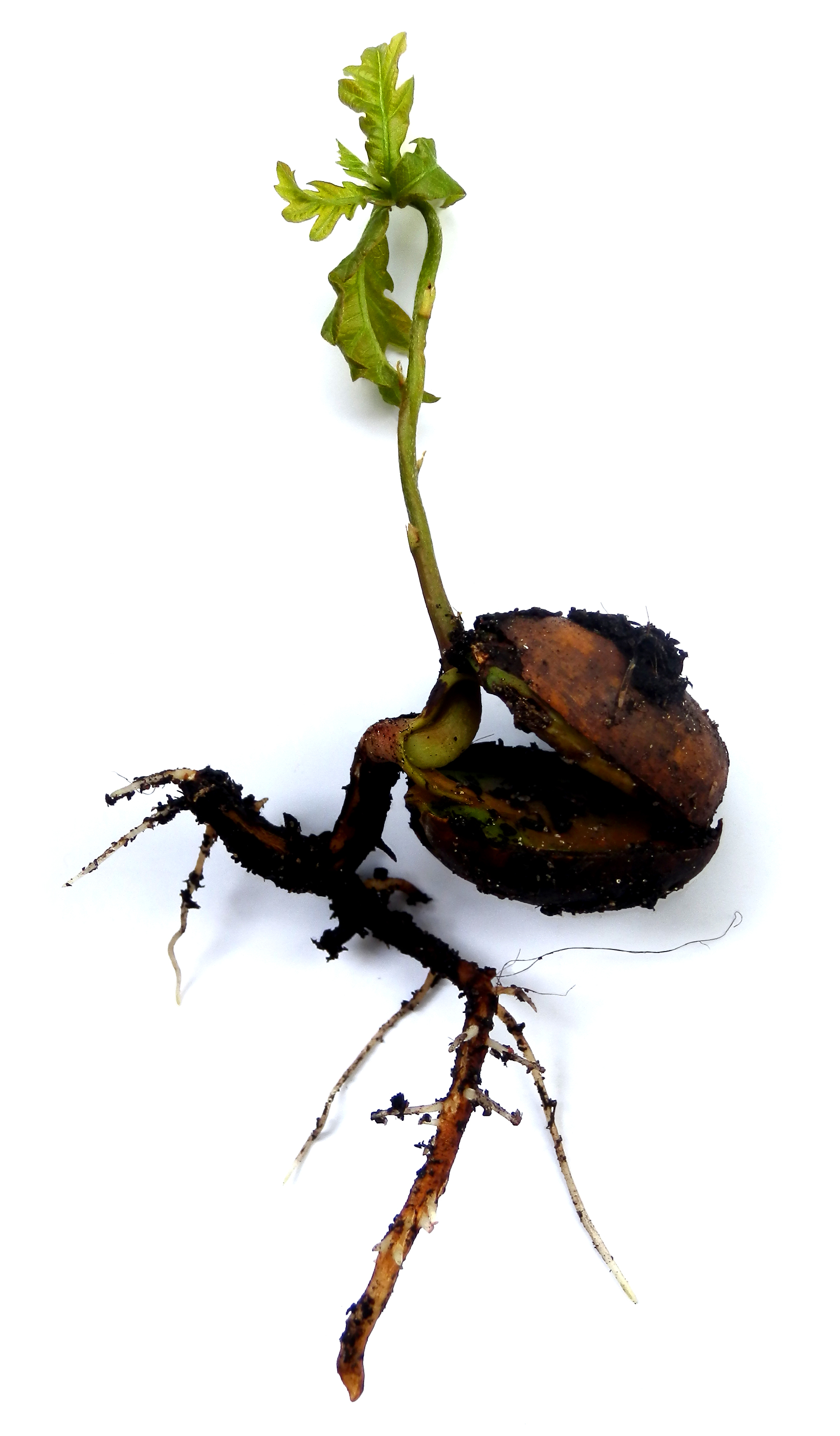
"The creation of a thousand forests is in one acorn" ― Ralph Waldo Emerson
Yet unboundedness is a apparent paradox in a closed ecosystem like Earth's biosphere ― or is it?
"Such a contradictory state of affairs is feasible only because the resources accessible to life can be used over and over again." ― J.I. Gitelson
A path toward deep ecology, and the realization of interconnectedness, is to cast aside what we have learned so that we might reconnect with a deep-seated, primordial awareness ― an awareness devoid of subject or object.
"The fundamental delusion of humanity is to suppose that I am here and you are out there."
― Hakuun Yasutani
Light and shadow are aspects of the whole, just as usefulness and uselessness are aspects of the whole. Taoist philosophy asserts that the moment we choose one side over the other we upset nature's balance.

Allowing ourselves to be immersed in interconnectedness involves the challenging discipline of embracing opposites. Gary Snyder writes about the meditative discipline of being at home in the whitewater and the eddies:
“Being the Stream

Meditation is not just a rest or retreat from the turmoil of the stream or the impurity of the world. It is a way of being the stream, so that one can be at home in both the white water and the eddies. Meditation may take one out of the world, but it also puts one totally into it.”


REFERENCES

Popular