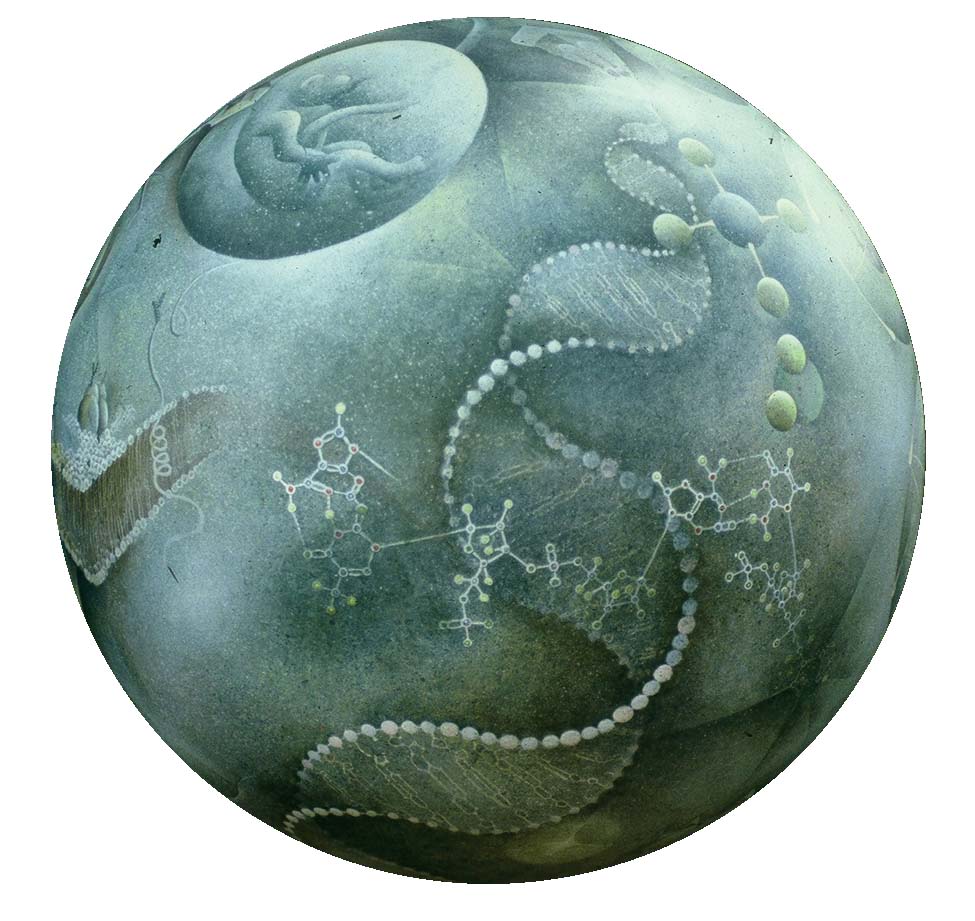
The origin of life eludes us. The leap from organics to organisms isn't definitively understood.
I believe a leaf of grass is not less than the journey-work of the stars.The desire for us to understand existential unknowns produces limits on the range of possibilities. The range of possibilities provide the guideposts to inquiry. Within possibilities emerge the paths of plausibility, some more fruitful than others.
— Walt Whitman, Song of Myself
The origin of life, and the nature of the living, remains elusive. Still there are established characteristics, like heredity — the self-replicating passing on of information — that links all organisms to the simplest cells and the most basic elements on the periodic chart.
What do they call it…the primordial soup? The glop? That heartbreaking second when it all got together, the sugars and the acids and the ultraviolets, and the next thing you knew there were tangerines and string quartets.The microcosmic gods of life seem to be nucleic acids and proteins. The earliest detectable life arrived 3.6 to 3.8 billion years ago in the form of simple cells.
— Edward Albee, Seascape
Over billions of years, simple replicating cells evolved into complex organisms. This came about against the deterministic cleave of natural selection.
The one thing we have in common with all other living things is that for nearly four billions years our ancestors have managed to slip through a series of closing doors every time we needed them to.Humans are comparative newcomers arriving 200,000 years ago, yet our organic and earlier inorganic ancestry, is traceable to cosmic stardust.
— Bill Bryson, A Short History of Nearly Everything
| Years Ago |
Event
|
| 4.6 billion | Earth began circling the sun |
| 3.6 billion | Arrival of simple cells - Prokaryotes |
| 3.4 billion | Arrival of cyanobacteria performing photosynthesis |
| 2 billion | Arrival of complex cells - Eukaryotes |
| 1 billion | Arrival of multicellular life |
| 600 million | Arrival of simple animals |
| 550 million | Arrival of bilaterians, animals with a front and a back |
| 500 million | Arrival of fish and proto-amphibians |
| 475 million | Arrival of land plants |
| 400 million | Arrival of insects and seeds |
| 360 million | Arrival of amphibians |
| 300 million | Arrival of reptiles |
| 200 million | Arrival of mammals |
| 150 million | Arrival of birds |
| 130 million | Arrival of flowers |
| 66 million years ago | Departure of the pterosaurs and non-avian dinosaurs, in the Cretaceous–Paleogene extinction event. |
| 60 million | Arrival of primates |
| 20 million | Arrival of Hominidae or great apes |
| 2.5 million | Arrival of the genus Homo - human predecessors |
| 200,000 | Arrival of anatomically modern humans |
An insatiable curiosity and judicious hypothesis testing will eventually lead us to many of the answers we seek. But the satisfaction of each answer will be momentary. The side effect of each aha! moment is a set of new questions. This is the quest of science.
The Existential Ledger
On the known side of the ledger, is the precedence, preponderance and rigor of established science. On the unknown side, it must suffice that the nature of life will reveal itself in fits and starts.
We're continually pinged with incoming data. Revelations necessitate reconciling of our existential accounts. We only know what we know at a given time. What remains is pontification or poetry.
REFERENCES
- Lonely Planets: The Natural Philosophy of Alien Life, David Grinspoon, Harper Collins, November 2003.
- Timeline of evolutionary history of life, Wikipedia.