Showing posts with label Erosion. Show all posts

Saturday, November 8, 2014

Falls

Urami Waterfall
by Kobayashi Kiyochika
Waterfalls are formed when a river is young, but formation gradually occurs over several thousand years.

Rivers flow over strata of rock that vary in resistance to erosion. As rapid river flow scours a channel into a less erosion-resistant stratum below, it transports loose material downstream thus increasing the slope of the watercourse.

As the flowing water carries the softer rock downstream, the riverbed becomes steeper. Gradually the slope increases to the point where rapids become a waterfall.

As a plunge pool develops, turbulence and whirlpools in the water undercuts the soft rock.

Illustration by Jerry Crimson Mann
After a long period as a fully-formed waterfall, the hard rock overhang can slowly retreat upstream to form a river canyon as the hard rock is eventually eroded and carried downstream.
“When I was walking in the mountains with the Japanese man and began to hear the water, he said, 'What is the sound of the waterfall?' 'Silence,' he finally told me.”
― Jack Gilbert, Collected Poems

Selandjafoss, Iceland
by Martin Meeks

Man is not himself only...He is all that he sees; all that flows to him from a thousand sources...He is the land, the lift of its mountain lines, the reach of its valleys.
― Mary Hunter Austin

REFERENCES

Saturday, December 14, 2013

Settling and Coelescence

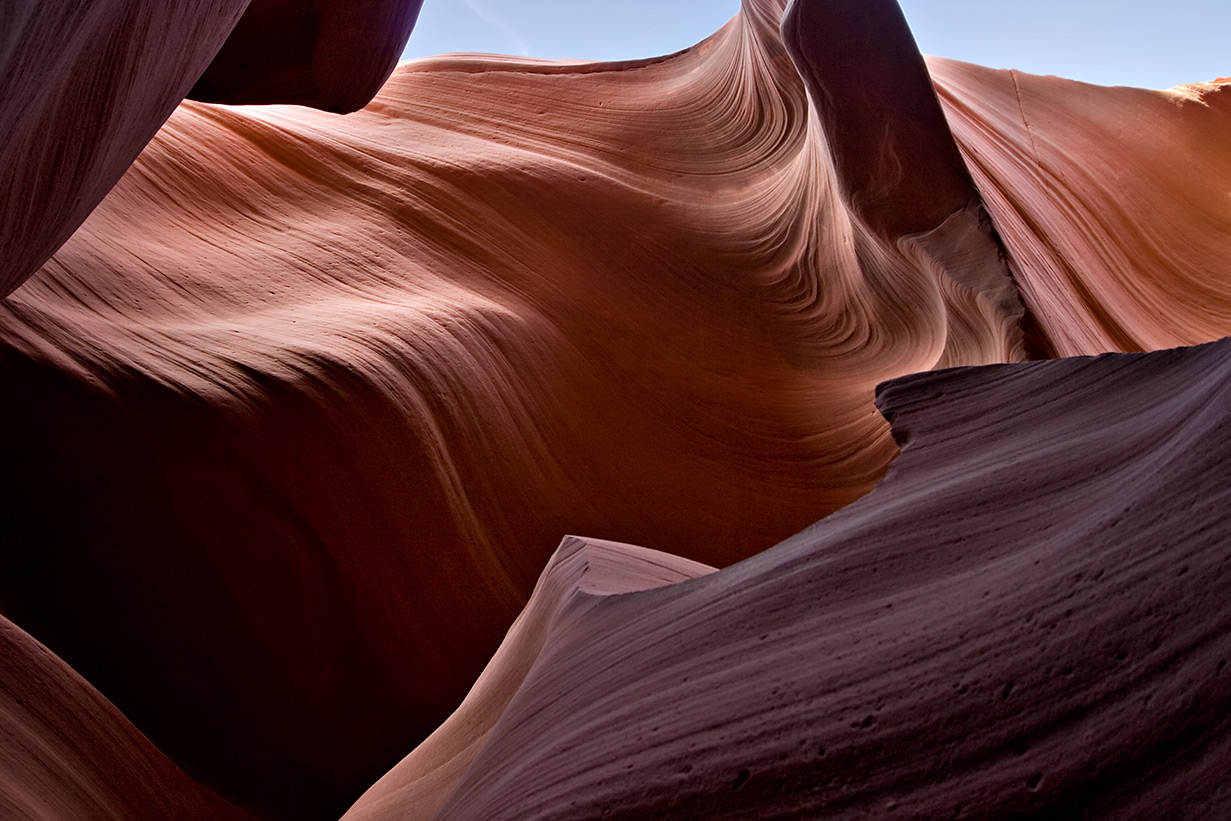
Sandstone layering
Particles suspended in water tend to settle from the pull of gravity before coming to rest against some barrier. The settling and coalescence of Earth's fine-grained material is called sedimentation.

Sedimentation and erosion are poetically reciprocal phenomena.

If erosion is the breaking loose, suspension, and movement of particles via water, then sedimentation is the terminal end of that movement where suspended and transported particles settle out to come to rest.
"The question is, of course, is it going to be possible to amalgamate everything, and merely discover that this world represents different aspects of one thing?"
― Richard Feynman, The Feynman Lectures on Physics

Sedimentary Rocks

Sedimentary rocks form by the settling of Earth's fine-grained material. Earth's fine-grained material occurs from weathering and erosion. Sedimentary rocks cover much of Earth's continents, yet the volumetric contribution of sedimentary rocks to the total volume of Earth's crust is only about 8 percent.

Lateral Continuity

The result of the settling of particles or deposition of particles is the formation of new depositional landforms. These landforms are often observed in a lateral or horizontal plane. The lateral plane is orthogonal to the direction of gravitational pull.

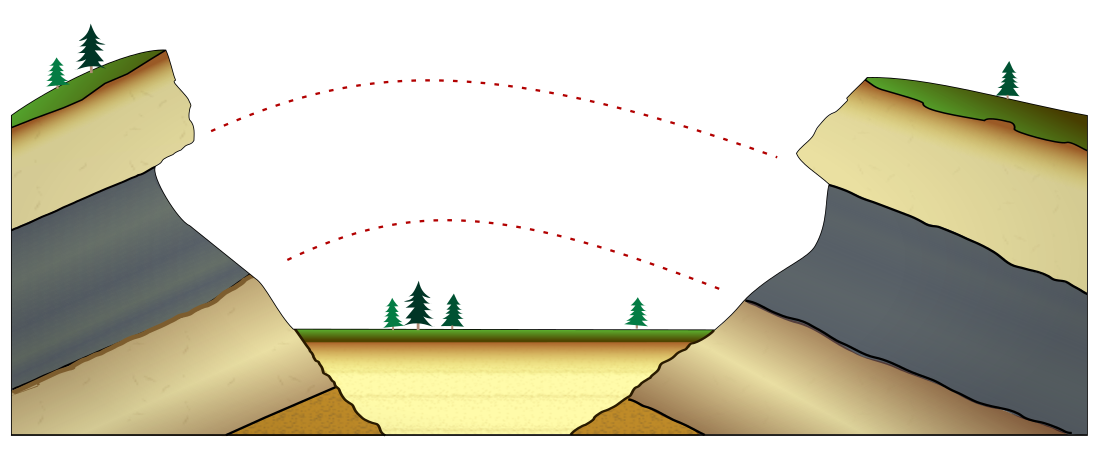
Sedimentary rocks separated by a valley

Layers of sediment extending laterally in all directions are said to have lateral continuity (cf. The Principle of Lateral Continuity). Sometimes the lateral plane appears to be tilted or has been interrupted by other forces.

"Curiosity demands that we ask questions, that we try to put things together and try to understand this multitude of aspects as perhaps resulting from the action of a relatively small number of elemental things and forces acting in an infinite variety of combinations."
― Richard Feynman, The Feynman Lectures on Physics

REFERENCES

Saturday, September 8, 2012

The Mountain River Sūtra

The earth presents its inhabitants with seemingly endless enrichment and, when we are most lucky, fleeting opportunity for enlightenment. In River Run Dance, I wondered about the metaphysics of water molecules flowing in a river.
Would we need to trace a water molecule to know that water flowing through a river is never the same water?
I have the same wonder about mountains. What is the beginning of a mountain? Do mountains have a beginning and an end? Yes and no.

Orogeny and Erosion

Orogeny and erosion are a mountain's yin and yang. Orogeny encompasses the events leading to the deformation of the Earth's crust because of the engagement of tectonic plates.

From plate collision, a mountain begins.

Erosion refers to soil and rock that is transported by wind or water flow to other locations.

From transporting winds and water flow, a mountain ends.

Does it matter if a mountain has a beginning and an end?

Perhaps we only need revel in the endlessness and the continuity we experience.
Revel in the endlessness, the endless repetition - the mountains forming, the rivers flowing, and the planet rotating and orbiting to change our light and to change our seasons.
An Earth Verse by poet Gary Snyder:
Earth Verse

Wide enough to keep you looking
Open enough to keep you moving
Dry enough to keep you honest
Prickly enough to make you tough
Green enough to go on living
Old enough to give you dreams

from Mountains and Rivers Without End

A Sūtra

Gary Snyder refers to his the poems in Mountains and Rivers Without End as a sūtra - a collection of words woven to embody a general truth. The literal meaning of the sūtra is a thread or a line that holds things together. The word sūtra is similar in derivation to the medical term suture.

Mr. Snyder's Mountains and Rivers Without End was inspired by a 17th century ink on paper handscroll of the same name.

Mountains and Rivers Without End
Handscroll; ink on paper
Lu Yuan, mid- to late 17th century, China

Popular