Showing posts with label Vincent van Gogh. Show all posts

Saturday, August 8, 2015

True Yellow

Humans distinguish blue, green, yellow, and red as unique hues. Unique hues are psychologically primary — we perceive them as pure rather then a blend of colors.

In higher and lower latitudes, seasons are associated with a dominant color palette: greens during the growing season; reds, yellows, and oranges during harvest; and shades of gray when the snow flies.

Olive Trees with yellow sky and sun
by Vincent van Gogh
Saint-Rémy, November 1889

Seasons also seem to affect our perception of color. Psychologists at the University of York have published research indicating humans see yellow differently in the January (winter in the UK), than in June (summer in the UK).
"In York you typically have grey, dull winters and then in summer you have greenery everywhere. Our vision compensates for those changes and that, surprisingly, changes what we think ‘yellow’ looks like."
— Lauren Welbourne, University of York, Department of Psychology
Yellow is unusual among the unique hues because most people, despite differences in retinal physiology, age, and culture, tend to agree on true or unique yellow. Subjects in the UK exposed to chromatically adjusted artificial light were asked when the light reached true yellow. Significant differences in the recognition of true yellow occurred depending on whether it was winter or summer.
"What we are finding is that between seasons our vision adapts to changes in environment."
— Lauren Welbourne
Painters have long appreciated the changes in the quality of light over the course of a day or across seasons. It seems our minds adjust our perception of color to re-balance or compensate for some of those variations.
Some painters transform the sun into a yellow spot, others transform a yellow spot into the sun.
— Pablo Picasso

REFERENCES

Saturday, May 30, 2015

Irises

Iris, a poem by William Carlos Williams, is a celebration of our senses.
Iris

Bearded Iris
a burst of iris so that
come down for
breakfast

we searched through the
rooms for
that

sweetest odor and at
first could not
find its

source then a blue as
of the sea
struck

startling us from among
those trumpeting

petals

Williams' opening line a burst of iris stimulates a search for the sweetest odor that, in turn, reveals a blue as of the sea. Williams closes his poem with trumpeting petals, a word implying shape and sound.


Vincent van Gogh created Irises during the last year of his life while living in an asylum. He called Irises,
"the lightning conductor for my illness"
Van Gogh felt by continuing to paint that he could avert succumbing to insanity.
It strikes the eye from afar. The Irises are a beautiful study full of air and life.
― Theo van Gogh in a letter to Vincent upon seeing Irises exhibited
Irises are perennials that shoot upward from creeping rhizomes. A rhizome is a subterranean stem that sends out roots perpendicular to the force of gravity while also sending up vertical shoots to greet the sunlight of Spring.

With carefully chosen words William Carlos Williams devoted attention to the obvious and the overlooked. Williams, like impressionist Vincent van Gogh, devoted time to experiencing the subtleties of the senses.

The natural world is indifferent to our inattentiveness, but also rewards the slightest attention with the sublimest of experiences.
Nobody sees a flower - really - it is so small it takes time - we haven't time - and to see takes time, like to have a friend takes time.
― Georgia O'Keeffe

REFERENCES

Saturday, December 28, 2013

Perceiving Sky

Ram's Head
Georgia O'Keeffe, 1935
Painting landscapes involves learning how to paint the sky. Whether our intent leans toward realistic or representational, we learn the details of perception like the sky tends to lighten toward the horizon.

We are encouraged to consider atypical skies ― the non-blue moods of the sky we frequently see.

Painting sky, we sensitize ourselves to shadows and highlights. We are reminded that clouds reflect the light in the sky.

Look at your feet. You are standing in the sky. When we think of the sky, we tend to look up, but the sky actually begins at the earth.
― Diane Ackerman
Cloud Study
John Constable, 1822
White light has the visible colors of the spectrum. White light emanating from the Sun is scattered by the gases and particles in the Earth's atmosphere.

Atmospheric gases act as a prism to separate white light into its component colors. The atmospheric prism is mostly nitrogen (78%) and oxygen (21%) with trace gases like argon and water vapor. Particulates can be dust, soot, ash, pollen or salt from the ocean.

Blue light travels as shorter, smaller waves. A cloudless sky appears blue because blue light is scattered more than other colors.
Even
After
All this time
The Sun never says to the Earth,

"You owe me."

Look
What happens
With a love like that,
It lights the whole sky.


― Hafiz
Viewing the sky away from the sun we see light that is bent the most ― a complex spectrum dominated by light of between violet (wavelength of 400 nanometers) and blue (wavelength of 450 nanometers).

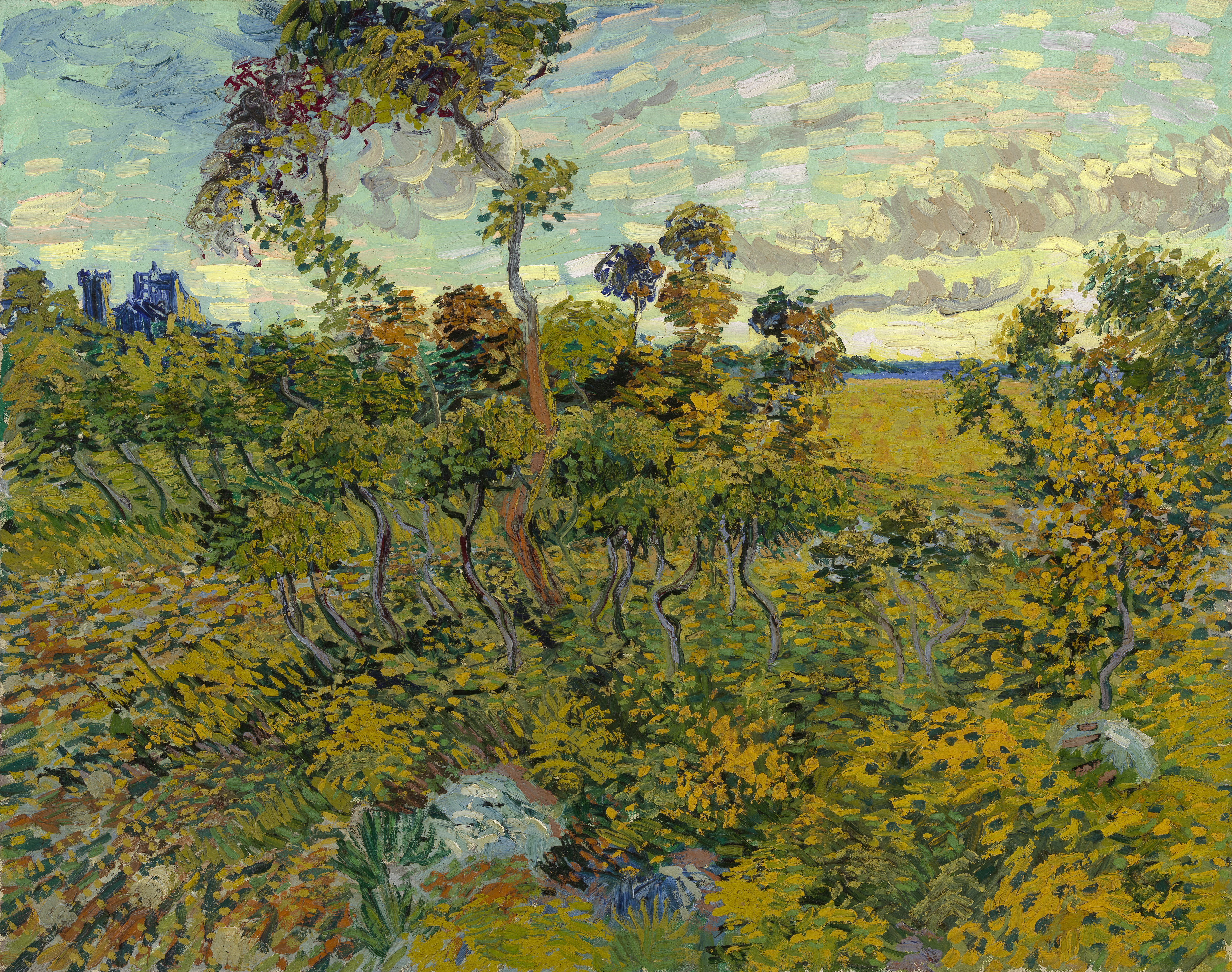
Sunset at Montmajour
Vincent van Gogh, 1888
Sunset light travels farther through the atmosphere before it reaches us. More of that light is scattered.

The color of the sun itself changes from orange to red. The cooler, shorter wavelength blue light is completely scattered leaving the warmer, longer wavelengths like oranges and reds on the horizon.

The sky grew darker, painted blue on blue, one stroke at a time, into deeper and deeper shades of night.
― Haruki Murakami, Dance Dance Dance

REFERENCES

Popular