Showing posts with label John McPhee. Show all posts

Saturday, October 18, 2014

Deep Time

Einstein mused about the illusive nature of distinguishing past, present, and future.
"People like us, who believe in physics, know that the distinction between past, present, and future is only a stubbornly persistent illusion."
― Albert Einstein
An eon in common parlance, is a very long period of time:
e·on/ˈēən,ˈēˌän/noun.an indefinite and very long period of time, often a period exaggerated for humorous or rhetorical effect.
usage: She reached the hilltop cairn eons before my arrival.
An eon acquires the specificity a billion years for geologists and astronomers. Radiometric dating indicates Earth is 4,540,000,000 years old. This translates to about four and one half eons.
“Four days will quickly steep themselves in nights;
Four nights will quickly dream away the time.”

― William Shakespeare, A Midsummer Night's Dream

Deep Time

Þingvellir
by Hansueli Krapf
Earth is roughly 57 million times older than the longest average human life expectancy. Perhaps the 56,750,000-fold difference explains why geologic time is baffling.

Geologic time is also referred to as deep time.

Comparing deep time to human time in Basin and Range, John McPhee borrows a metaphor cited from Stephen Jay Gould's Time's Arrow, Time's Cycle:

Consider the Earth's history as the old measure of the English yard, the distance from the King's nose to the tip of his outstretched hand. One stroke of a nail file on his middle finger erases human history.

Some geologic phenomena occur in real-time like the calving of a glacier, the flow of lava from a volcano, or the formation of a tropical cyclone.

Most geologic phenomena occur on a geologic time scale like continental drift — for example the pulling apart of the North American and Eurasian Plates at Þingvellir in southwestern Iceland.

Geologists have trained themselves to imagine events unfolding in units of time no smaller than a million years. The intersection of human time and geologic time excites our curiosity.
“If you free yourself from the conventional reaction to a quantity like a million years, you free yourself a bit from the boundaries of human time. And then in a way you do not live at all, but in another way you live forever.”
— John McPhee, Annals of the Former World

Image: Tobias Alt

"The mind seemed to grow giddy by looking so far into the abyss of time."
― John Playfair, remarking on the strata of the unconformity at Siccar Point

If one lives to be 100 years old, Earth will still be some 45 million years older.

REFERENCES

Saturday, November 23, 2013

Blink of an Eye

The Earth continues to move, erupt, collide and change shape. Some of these changes are gradual and imperceptible, while others are sudden and catastrophic.

A new island appeared in the Pacific Ocean this week from an exploding underwater volcano. Will this island of ash and rock last long enough to be charted on a map? Will it be subdued and eroded by pounding waves? We don't know. But the story unfolds with or without us.

What once were warm clear oceans are now the world's tallest mountains:
"When the climbers in 1953 planted their flags on the highest mountain, they set them in snow over the skeletons of creatures that had lived in a warm clear ocean that India, moving north, blanked out. Possibly as much as 20,000 feet below the sea floor, the skeletal remains had turned into rock. This one fact is a treatise in itself on the movements of the surface of the earth."
― John McPhee, Annals of the Former World
1977 Soviet Military Map of Mount Everest Region [Scale 1:200,000]

Much of Earth's ongoing phenomena occur beyond the time scale of a human lifespan, but evidence of gradual and sudden changes abound.

The Earth is orders of magnitude older than any of the living creature that clings to it like a life raft. The Earth is much more resilient than living organisms.
"The planet has been through a lot worse than us. Been through earthquakes, volcanoes, plate tectonics, continental drift, solar flares, sun spots, magnetic storms, the magnetic reversal of the poles…hundreds of thousands of years of bombardment by comets and asteroids and meteors, worldwide floods, tidal waves, worldwide fires, erosion, cosmic rays, recurring ice ages…And we think some plastic bags and some aluminum cans are going to make a difference? The planet isn’t going anywhere. WE are!

We’re going away. Pack your shit, folks. We’re going away. And we won’t leave much of a trace, either. Maybe a little Styrofoam…The planet’ll be here and we’ll be long gone. Just another failed mutation. Just another closed-end biological mistake. An evolutionary cul-de-sac. The planet’ll shake us off like a bad case of fleas."


― George Carlin, comedian and social critic.

Human activity adversely impacts Earth's biosphere. The human species is a recent addition to the 3.5 billion year old biosphere, yet human activity, chiefly power generation and waste products, degrades the quality of water and air at an alarmingly accelerated rate. Whether human impacts can be stemmed or reversed remains a grave concern.

Life in the biosphere is fragile and short-lived. On a geologic time scale, species come into existence and vanish in the blink of an eye.
"If by some fiat, I had to restrict all this writing to one sentence; this is the one I would choose: The summit of Mt. Everest is marine limestone."
― John McPhee, Annals of the Former World

REFERENCES

Saturday, April 6, 2013

Illusion and Delusion

Our relationship with nature is often marked by illusion, delusion, and a false sense of separateness.
Sand Castle, Cannon Beach

Making a sand castle on the edge of a sandy lake, an estuarine bay, or an ocean, we delight in creating, shaping, and altering the landscape.

The pleasure of sand castle making gives some insight into the desire to shape and exert controls over our ecosystem.
Nature, with equal mind,
Sees all her sons at play,

Sees man control the wind,
The wind sweep man away.

Matthew Arnold, from Empedocles on Etna
Man controls the wind, but the wind sweeps man away.

The Delusion of Control

Poet Matthew Arnold reveals our delusion of control, that is
the false duality of man of- and man apart from- the very flow of the wind.
Like sand castles, the shape and seemingly static quality of nature is, at best, temporal. The false struggle that pits man against nature is part of the human narrative.
“When we see land as a community to which we belong, we may begin to use it with love and respect.”
― Aldo Leopold
Part of the human narrative reveals a sisyphean quest - whether it is the unrealized plan to divert the Mississippi River for flood control, or a scheme to protect Los Angeles from boulders ejected from adjacent mountains by tectonic compression (cf. The Control of Nature by John McPhee).
"Nature is trying very hard to make us succeed, but nature does not depend on us. We are not the only experiment."
― Buckminster Fuller
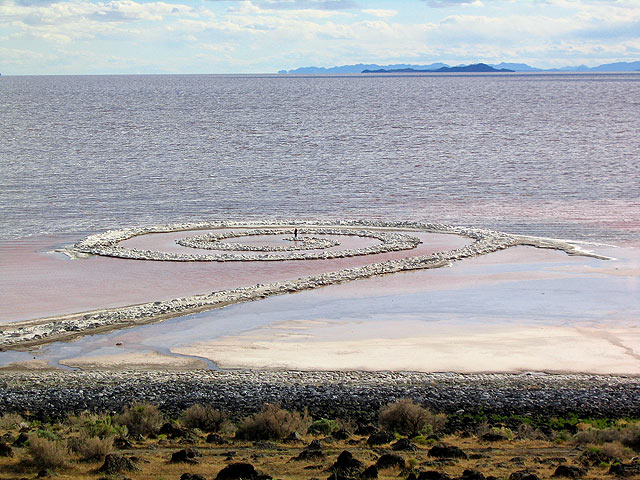
Spiral Jetty by Robert Smithson
Artists have used the natural landscape to create the illusion of control.

The Illusion of Control

Sand castle building almost certainly gives us a window into the psyche of the makers of land art.

Land art, Earthworks is a phrase coined by Robert Smithson. Land art is created using soil, rock, organic media, and water.

The landscape becomes the means of the creation.
"...the artist seeks.... the fiction that reality will sooner or later imitate"
― Robert Smithson
Land art celebrates the illusion of control.

Spring Summer 6, Walter Mason

Humans are like daisy petals coalesced in a pool. We ebb and flow with nature contracting toward orderliness, while simultaneously expanding toward chaos.
"I only went out for a walk and finally concluded to stay out till sundown, for going out, I found, was really going in."
―  John Muir, 1913

REFERENCES

Popular