 |
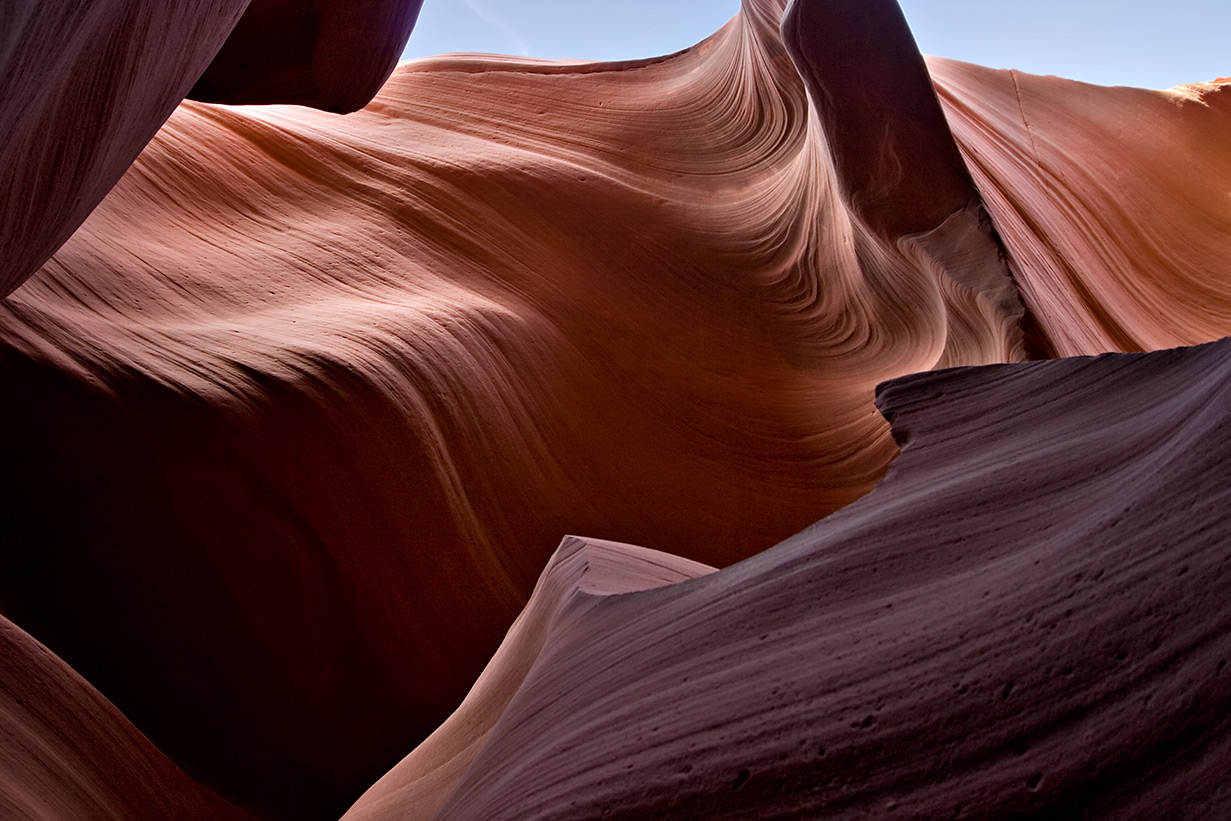
| Sandstone layering |
Sedimentation and erosion are poetically reciprocal phenomena.
If erosion is the breaking loose, suspension, and movement of particles via water, then sedimentation is the terminal end of that movement where suspended and transported particles settle out to come to rest.
"The question is, of course, is it going to be possible to amalgamate everything, and merely discover that this world represents different aspects of one thing?"
― Richard Feynman, The Feynman Lectures on Physics
Sedimentary Rocks
Sedimentary rocks form by the settling of Earth's fine-grained material. Earth's fine-grained material occurs from weathering and erosion. Sedimentary rocks cover much of Earth's continents, yet the volumetric contribution of sedimentary rocks to the total volume of Earth's crust is only about 8 percent.
Lateral Continuity
The result of the settling of particles or deposition of particles is the formation of new depositional landforms. These landforms are often observed in a lateral or horizontal plane. The lateral plane is orthogonal to the direction of gravitational pull.
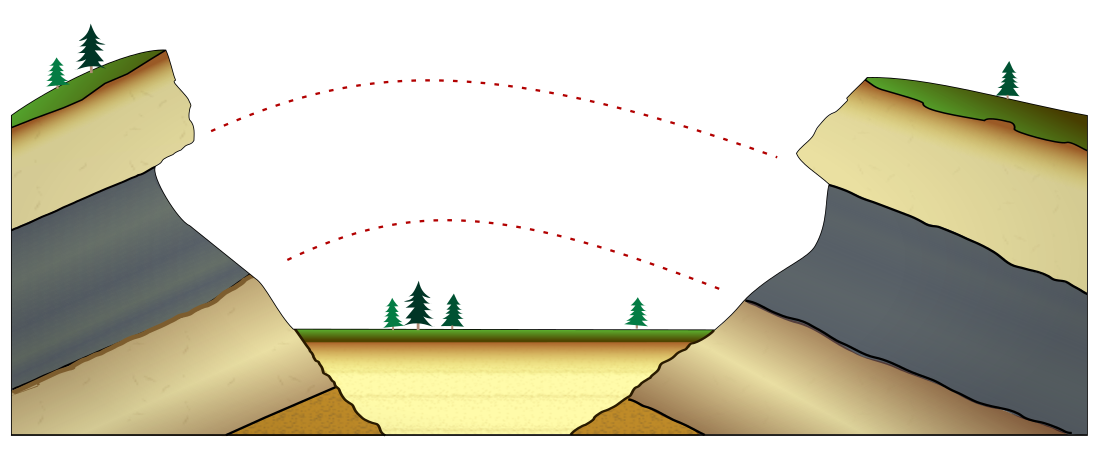 |
| Sedimentary rocks separated by a valley |
Layers of sediment extending laterally in all directions are said to have lateral continuity (cf. The Principle of Lateral Continuity). Sometimes the lateral plane appears to be tilted or has been interrupted by other forces.
"Curiosity demands that we ask questions, that we try to put things together and try to understand this multitude of aspects as perhaps resulting from the action of a relatively small number of elemental things and forces acting in an infinite variety of combinations."
― Richard Feynman, The Feynman Lectures on Physics
REFERENCES
- A Simple Formula to Estimate Settling Velocity of NaturalSediments, Jose´ A. Jime´nez1 and Ole S. Madsen, Journal of Waterway, Port, Coastal and Ocean Engineering © ASCE, March/April 2003.
- Erosion, Wikipedia.
- Principle of Lateral Continuity, Wikipedia.
- Sedimentary Rock, Wikipedia.
- Sedimentation, Wikipedia.
- The Feynman Lectures on Physics, Richard P. Feynman


